
Solar power is defined as a fixed-cost energy system where fuel expenses drop to near zero after installation, while generator fuel costs are a recurring, volatile expense that compounds every year you run the machine. Understanding why generator fuel costs vs solar matters so much comes down to one simple fact: you pay for generator fuel every time you use it, and you never stop. Solar's upfront investment is real, but the operating cost comparison shifts dramatically within a few years. This guide breaks down both sides with real numbers so you can make a confident, informed decision for your home or outdoor setup.
Why generator fuel costs more than solar over time
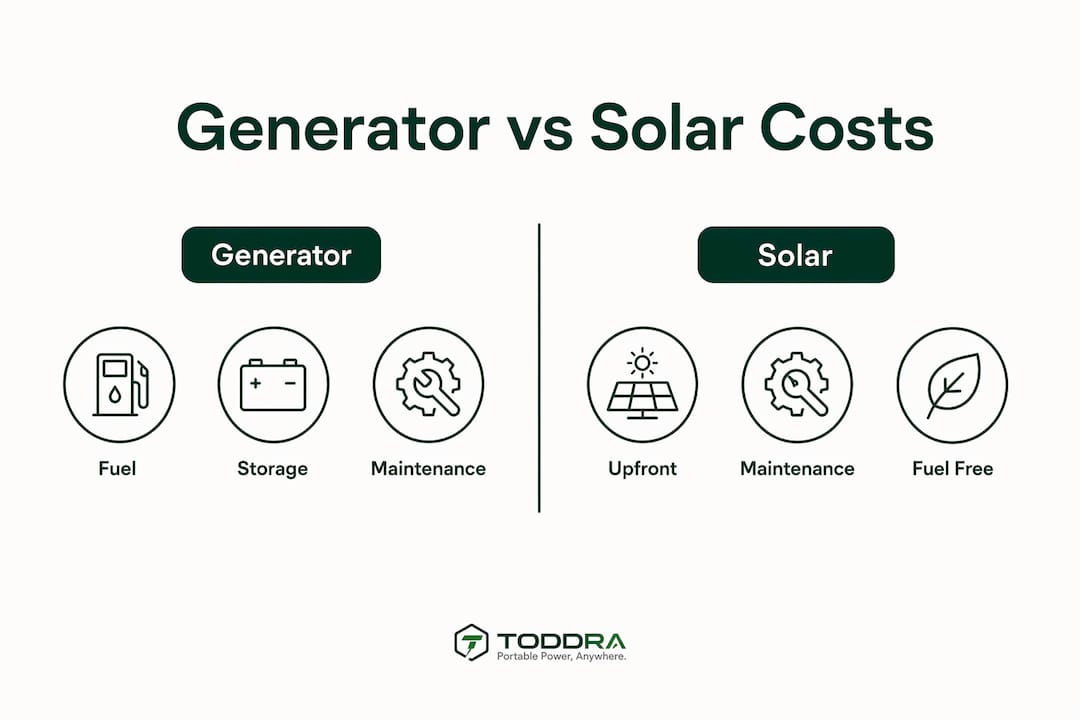
Generator fuel expenses are not a single line item. They include the fuel itself, storage, degradation, and the maintenance that follows. Gasoline costs $2.00–$5.00 per hour to run a typical generator, propane runs $3.00–$6.00 per hour, and natural gas falls in the $2.50–$5.00 range. Solar, by contrast, carries effectively zero fuel cost after installation. That gap is the core of the generator fuel expenses comparison.
The cost per kilowatt-hour tells an even sharper story. Gasoline generators can reach $0.85 per kWh, while diesel runs $0.22–$0.28 per kWh at optimal load. Natural gas is the most affordable fossil fuel option at $0.10–$0.18 per kWh. Solar systems, over their lifetime, deliver energy at roughly $0.06–$0.08 per kWh. That is less than half the national average grid rate of $0.18 per kWh.

Fuel price volatility adds another layer of risk. Gasoline and diesel prices swing with global oil markets, seasonal demand, and supply disruptions. A generator that costs $3.00 per hour to run today could cost $5.00 per hour next year. Solar locks in your energy cost from day one and holds it there for decades.
How load levels drive up generator fuel bills
One of the least-discussed factors in generator fuel price analysis is load efficiency. Running a generator below 40% of its rated load causes fuel consumption per kWh to more than double compared to running it at 75% load. Most homeowners and campers do not run generators at full load. That means real-world fuel costs are consistently higher than the spec sheet suggests.
This is not a minor rounding error. If your generator is rated for 5,000 watts and you are only drawing 1,500 watts to power a refrigerator and some lights, you are burning fuel at a deeply inefficient rate. The combustion engine cannot adjust proportionally to low demand the way a battery system can.
Pro Tip: Size your generator as close to your actual load as possible. Oversized generators running at low loads waste fuel and wear out faster.
The hidden costs of fuel storage and degradation
Gasoline degrades in as little as 30 days without a fuel stabilizer. That means stored fuel for emergency use requires chemical treatment, rotation, and disposal of old stock. These are real costs that rarely appear in a basic generator fuel expenses comparison. Propane stores indefinitely and is more stable during supply disruptions, but it requires pressurized tanks and proper handling. Natural gas is continuous and convenient, but it depends entirely on pipeline infrastructure that may fail during the same disaster that knocked out your power.
Solar has zero fuel degradation risk. There is nothing to store, rotate, or stabilize. The panels sit on your roof or in your yard and convert sunlight silently, day after day.
What does solar energy actually cost to own?
Solar's upfront investment is the number most people focus on, and it is real. A residential solar system typically runs $15,000–$25,000 before incentives. The federal Investment Tax Credit (ITC) currently covers 30% of installation costs, which meaningfully reduces that figure. Payback periods range from 5–12 years depending on your location, electricity rates, and available incentives.
The long-term picture is where solar energy cost benefits become undeniable. The average U.S. homeowner saves $25,000–$65,000 over 25 years with a solar system. That range reflects differences in state electricity rates, roof orientation, and system size. Even at the conservative end, $25,000 in savings over 25 years represents a reliable, compounding financial return.
Here is what makes solar especially valuable for daily energy users:
- Zero fuel cost after installation. The sun does not send a monthly invoice.
- Daily bill reduction. Solar systems reduce your grid draw during daylight hours, cutting your electricity bill every single month, not just during outages.
- Time-of-use arbitrage. Paired with battery storage, solar lets you store cheap midday energy and use it during expensive peak hours.
- Annual savings of $900–$2,400 on electricity bills are typical for solar-plus-battery systems. Generators produce zero financial return between emergencies.
- Maintenance costs are minimal. Solar panels have no moving parts. Annual cleaning and an occasional inverter check are the main tasks.
Solar power locks in fixed energy costs for 25–40 years, protecting you from the fuel price inflation that makes generator ownership increasingly expensive over time. That price stability is a genuine financial advantage, not just a marketing claim.
Solar vs generator: which wins in your situation?
Cost efficiency in solar vs generator decisions depends heavily on how and where you use power. Neither option is universally superior. The right answer depends on your usage pattern, location, and budget.
| Scenario | Generator Advantage | Solar Advantage |
|---|---|---|
| Short-term emergency backup | Fast, high-power output on demand | Less ideal without battery storage |
| Daily home energy use | None. Ongoing fuel cost adds up | Strong. Reduces bills every day |
| Extended outages (3+ days) | Requires fuel resupply | Battery storage sustains power silently |
| Remote outdoor or camping use | Portable, high wattage available | Lightweight solar generators work well |
| High electricity cost states (CA, HI, NY) | No benefit from high rates | Faster payback, greater savings |
| Low electricity cost states (LA, WY) | Lower urgency to switch | Longer payback period, still viable |
Generators remain practical for short-term emergency use and heavy power loads that exceed what a portable solar system can store. A 5,000-watt generator can run a well pump, HVAC, and refrigerator simultaneously. A solar generator in the 1,000–2,000 Wh range handles essential loads but not whole-home power.
The financial crossover point matters most for long-term planning. In states with electricity rates above $0.20 per kWh, solar payback periods shrink to 5–7 years. In lower-rate states, payback stretches to 10–12 years. Either way, solar hedges against future fuel price inflation in a way no generator can match.
Pro Tip: If you experience fewer than three outages per year, a solar-plus-battery system almost always wins on total cost over a 10-year period. Generators only make financial sense when outages are frequent and prolonged.
Hybrid or dual-fuel generators offer a middle ground for those who need high-wattage backup but want some fuel flexibility. They run on both gasoline and propane, giving you options during supply disruptions. They do not, however, eliminate the core problem: every hour of runtime costs money.
Beyond fuel: the full cost of owning a generator
Maintenance is where generator ownership quietly gets expensive. Gas generators cost $300–$600 annually in maintenance, covering oil changes, spark plugs, air filters, and carburetor cleaning. Diesel generators run $400–$800 per year but tend to last longer and require fewer major overhauls. Solar systems, by comparison, require almost no scheduled maintenance beyond panel cleaning.
The operational differences go beyond the wallet:
- Noise. Generators produce 65–80 decibels during operation, roughly equivalent to a vacuum cleaner running continuously. Solar systems are completely silent.
- Emissions. Gasoline and diesel generators emit carbon monoxide, a colorless, odorless gas that is lethal in enclosed spaces. Solar produces zero emissions during operation.
- Fuel handling. Storing gasoline or propane at home introduces fire and explosion risk. Solar panels and battery systems carry no such hazard.
- Incentives. Federal and state solar incentives, including the 30% ITC and various state rebates, reduce the net cost of solar ownership. No equivalent incentives exist for generator fuel purchases.
- Environmental cost. Solar versus generator costs include the carbon footprint of fossil fuel combustion, which is a growing financial consideration as carbon pricing policies expand.
The true cost efficiency of backup power depends on usage patterns, load efficiency, and how much of your daily energy consumption you can offset. A generator sitting in your garage for emergencies costs less annually than one running daily. But a solar system earns its keep every single day, whether the grid goes down or not.
Key takeaways
Solar power is the lower-cost energy solution over any period longer than 5–12 years, while generator fuel costs compound annually with no financial return between uses.
| Point | Details |
|---|---|
| Generator fuel costs are recurring | Gasoline, propane, and diesel costs add up every hour of runtime with no offset. |
| Solar delivers daily savings | Solar-plus-battery systems save $900–$2,400 annually on electricity bills. |
| Load efficiency matters | Generators running below 40% load can double their fuel cost per kWh. |
| Solar locks in long-term pricing | Fixed energy costs for 25–40 years protect against fuel price inflation. |
| Maintenance costs differ significantly | Gas generators cost $300–$600 per year to maintain; solar systems cost far less. |
The real math most people skip
I have talked with a lot of homeowners who frame this as a simple upfront cost comparison. They see a $20,000 solar installation and a $500 generator and call it obvious. That framing misses the entire point of the cost efficiency solar vs generator question.
The generator is not a $500 purchase. It is a $500 purchase plus fuel costs every time you run it, plus annual maintenance, plus fuel stabilizer, plus the risk that gasoline costs $6.00 per gallon the next time a hurricane is bearing down on your neighborhood. I have seen people pay $800 in fuel during a single week-long outage. That is not a hypothetical.
What I find genuinely underappreciated is the daily value of solar. Most people think of it as emergency backup. It is actually a daily money-saving machine that also happens to cover emergencies. A solar-plus-battery system from a brand like Jackery, available through Toddra, reduces your grid draw every single day. The generator in your garage does nothing for your electricity bill on a calm Tuesday in October.
The one honest caveat: if you live somewhere with frequent, prolonged outages and limited sunlight, a generator still has a role. Alaska in winter is not the same calculation as Arizona in summer. Regional factors matter. But for the vast majority of U.S. homeowners and outdoor enthusiasts, the math on solar is clear and getting clearer every year as fuel prices climb.
Do not let the upfront number scare you away from the better long-term decision.
— Jackson
Power your home or adventures without the fuel bill
If you are ready to move past recurring fuel costs and toward reliable, quiet, and cost-effective power, Toddra carries a carefully selected range of solar generators and portable power stations built for exactly that purpose.

Whether you need a compact unit for camping or a high-capacity system for home backup, Toddra's solar generator collection includes models like the Jackery Solar Generator 1000 v2 and the Jackery Explorer 2000 Plus, both featuring LiFePO4 battery technology, fast charging, and zero fuel requirements. Browse the full lineup at Toddra and find the right fit for your energy needs, backed by US-based customer support and secure checkout.
FAQ
How much does it cost to run a generator per hour?
Generator fuel costs range from $2.00–$6.00 per hour depending on fuel type, with gasoline being the most expensive and natural gas the most affordable. Actual costs rise when generators run below 40% of their rated load.
What is the payback period for a solar system vs a generator?
Solar systems typically pay back their installation cost in 5–12 years, after which energy is effectively free. Generators never pay back their operating costs because every hour of use requires more fuel.
Does solar power work during a power outage?
Solar panels alone do not provide power during a grid outage unless paired with battery storage. A solar generator or solar-plus-battery system stores energy and delivers it independently of the grid.
Why is gasoline the most expensive generator fuel?
Gasoline can cost up to $0.85 per kWh to generate, far above diesel or natural gas, because of lower energy density and higher market price volatility. It also degrades within 30 days without a stabilizer, adding hidden storage costs.
Can a solar generator replace a traditional fuel generator?
A solar generator handles essential loads like refrigerators, lights, phones, and medical devices reliably. For whole-home power or high-draw appliances like central HVAC, a larger solar-plus-battery system or a hybrid approach is the better fit.