TL;DR:
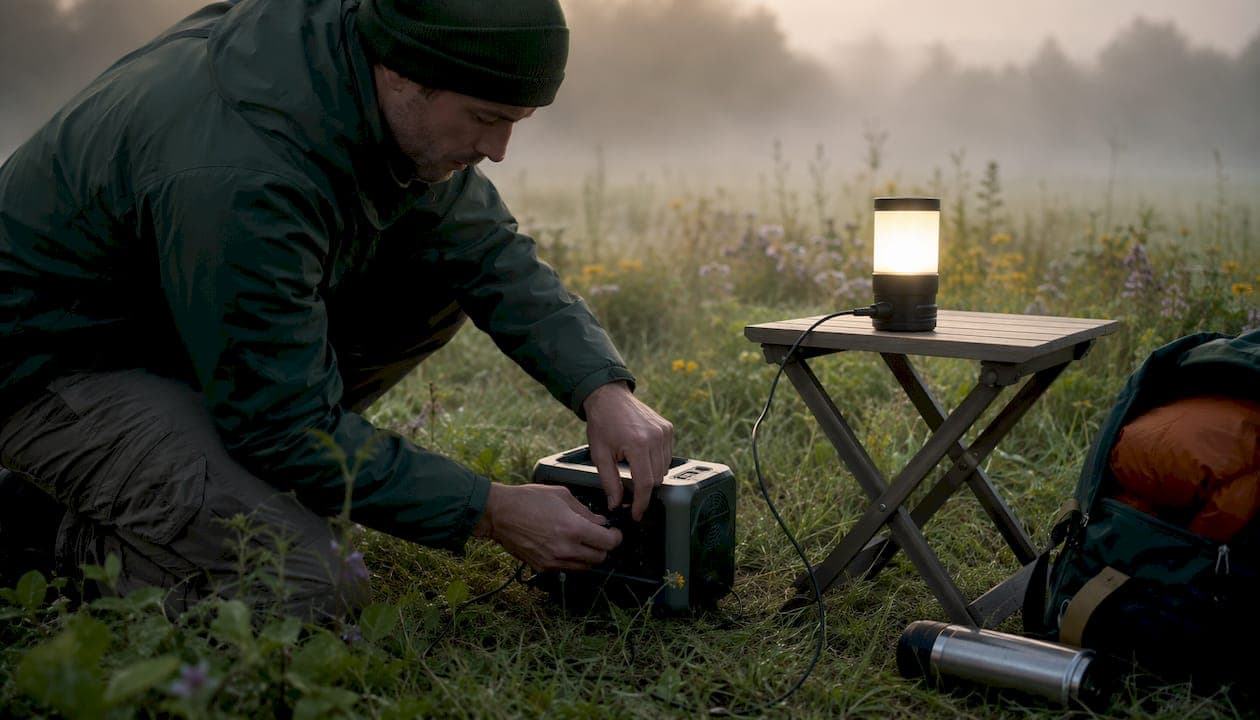
- A LiFePO4 power station of 250 to 500 watt-hours covers most car camping lighting needs. Efficient LED lights and proper zoning ensure minimal energy use, extending battery life during multi-night trips.
For most car-camping trips, a LiFePO4 power station in the 200–600 Wh range paired with efficient LED lanterns and a short string light covers everything you need from sundown to sunrise. Solo campers typically get through a full night on a moderate amount of lighting energy. A couple running a mid-output lantern and some string lights needs a moderate amount of lighting energy. A social campsite with an area lantern, string lights, and a work light near the cooking zone can push a significant amount of lighting energy per night. Add a 20–30% buffer for inverter losses and device charging, and those numbers translate cleanly to station sizes of 250 Wh, 300 Wh, and 400–500 Wh respectively.
LiFePO4 chemistry is the right call for a camping power station. It retains roughly 80% capacity after thousands of charge cycles and self-discharges at only about 2–3% per month, so a station stored in your garage between trips is still ready to go when you pull it out in July. It also handles the bumps and temperature swings of outdoor use more safely than standard lithium-ion.
Table of Contents
- How much power do camping lights actually use?
- How do you calculate your nightly lighting load?
- Which power source is right for your camping style?
- How do you size a power station for your lighting setup?
- Which features on stations and lights are actually worth having?
- How do you set up and run lights efficiently at night?
- Real campsite lighting plans with Wh math
- Key Takeaways
- What the math misses in the field
- Toddra has the right station for your campsite plan
- Useful sources and further reading
How much power do camping lights actually use?
Understanding real watt draws is the foundation of any good night camping lighting power plan. The good news: modern LED lights are remarkably efficient, and the gap between a well-chosen LED setup and an old incandescent or propane lantern is dramatic.
Common camping light types and their typical draws:
- Headlamps: 0.5–3W on low, 3–8W on high. Most campers run them on low for camp tasks.
- Compact USB LED lanterns (100–300 lumens): 1–3W on low, 3–6W on medium. These are the workhorses of tent and table lighting.
- High-output area lanterns (500–1,000+ lumens): 5–10W on medium, 10–20W on high. Use these for cooking areas and group spaces.
- LED string lights (20–140 lumens, 15–44 ft): 1–5W total depending on length and brightness. The BioLite Luci 44' solar string lights run on a 4,000 mAh battery and deliver 40 hours on low or 8 hours on high.
- Work/task lights (300–1,000 lumens, directional): 5–15W. Useful near the camp kitchen but rarely needed all night.
Incandescent bulbs and propane lanterns draw far more energy for the same lumen output. A 100-lumen incandescent pulls 10–15W; a comparable LED light for camping pulls 1–2W. That 5–10x efficiency advantage is why LED dominates every serious camping setup.
| Light Type | Low Setting (W) | Medium Setting (W) | High Setting (W) | Runtime on 10 Wh |
|---|---|---|---|---|
| Headlamp | 0.5 | — | 5 | 20 hrs / — / 2 hrs |
| Compact LED lantern | 1 | 3 | 6 | 10 hrs / — / — |
| High-output area lantern | 3 | — | 15 | 3.3 hrs / 1.4 hrs / 0— hrs |
| LED string lights | 1 | — | 5 | 10 hrs / 4 hrs / 2 hrs |
| Work/task light | 3 | 8 | 15 | 3.3 hrs / 1.25 hrs / 0— hrs |
How do you calculate your nightly lighting load?
The formula is simple: Watts × Hours = Watt-hours (Wh). That single equation tells you exactly how much capacity your power station needs to carry.
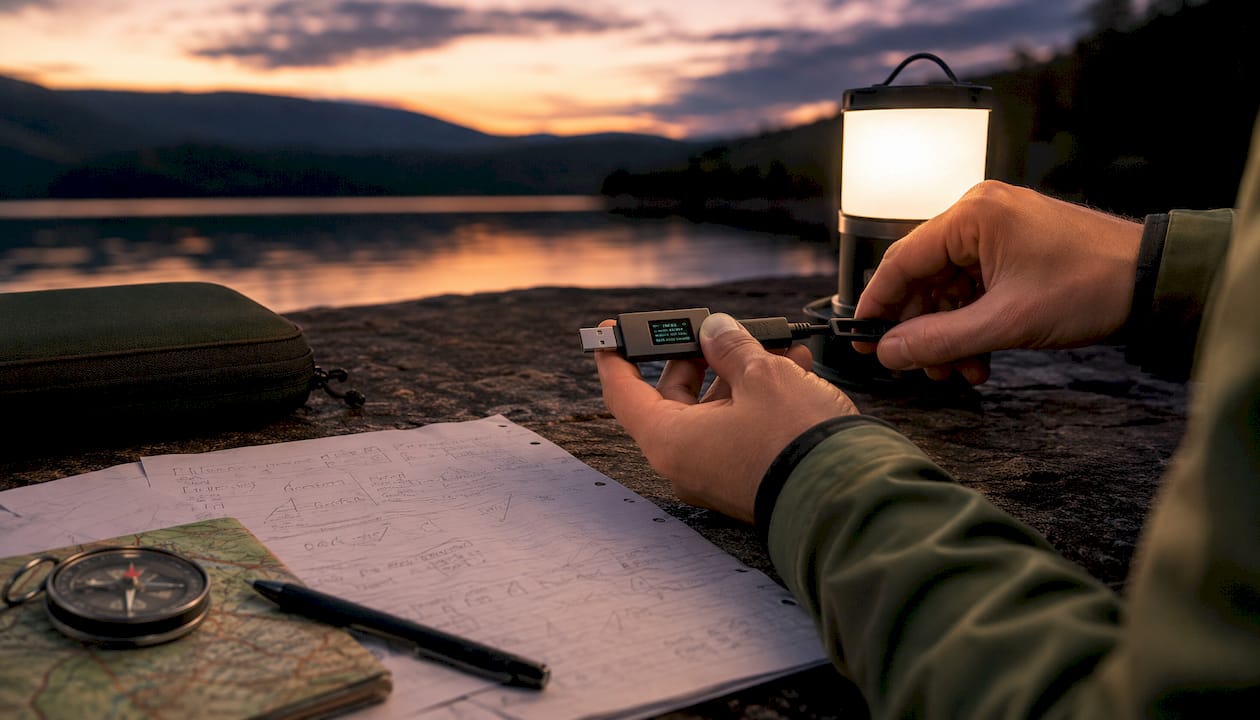
When a device lists its battery in milliamp-hours (mAh) rather than Wh, convert it with: mAh × Volts ÷ 1,000 = Wh. A 4,000 mAh battery at 3.7V holds about 14.8 Wh.
Worked example 1 — solo tent camper: A headlamp on low (1W) runs 4 hours = 4 Wh. A compact USB lantern on medium (3W) runs 3 hours = 9 Wh. Phone charging adds roughly 10–15 Wh. Total: about 25–30 Wh per night. A 250 Wh station handles this for more than a week without recharging.
Worked example 2 — couple, car camping: A mid-output lantern at 5W for 5 hours = 25 Wh. String lights at 2W for 6 hours = 12 Wh. Two phones = 25 Wh. Total: roughly 60–65 Wh. Add the 25% buffer and you're sizing for about 80 Wh of usable capacity per night, well within a 300 Wh station.
Worked example 3 — social campsite: An area lantern at 10W for 4 hours = 40 Wh. String lights at 4W for 6 hours = 24 Wh. A work light near the grill at 8W for 2 hours = 16 Wh. Four phones = 50 Wh. Total: roughly 130 Wh. With a 25% buffer, plan for 160–165 Wh of usable capacity, pointing to a 400–500 Wh station.
Pro Tip: Use an inline USB power meter (like the UM25C or any USB-A/C inline tester) plugged between your station and your light to read the actual watt draw. Spec plates often list peak watts; real-world draw at your preferred brightness is usually 20–40% lower.
Which power source is right for your camping style?
Choosing the right category of power source matters as much as choosing the right light. Each option has a different weight, recharge path, and reliability profile.
| Power Source | Best For | Runtime | Recharge Option | Weather/Cold Notes |
|---|---|---|---|---|
| LiFePO4 power station (200–600 Wh) | Car camping, multi-night, social sites | Multi-night | Solar, wall, car | Handles cold better than Li-ion; keep above freezing |
| Rechargeable lantern with power bank | Solo/couple weekend trips | 5–200 hrs by mode | USB-C/micro-USB | Li-ion; keep out of freezing temps overnight |
| Small power bank (10,000–6,400 mAh) | Headlamps, USB lights only | 1–3 nights for small lights | USB-C wall/car | Same Li-ion cold caution |
| Disposable alkaline batteries | Emergency backup, ultralight | Long shelf life | Not rechargeable | Lose up to 50% capacity below 20°F |
| Small inverter generator | Extended base camps, high-watt needs | Continuous (fuel-dependent) | N/A | Fuel handling; noise; CO risk — outdoor use only |
| Solar panel + power station | Multi-day off-grid trips | Continuous with sun | Daytime solar | Panel output drops in clouds and cold |
Portable power stations are the most versatile night camping lighting power solution for car campers. They run USB-C, USB-A, 12V, and AC outputs simultaneously, so one unit handles your lantern, string lights, phone, and any other device. Pairing a station with a solar panel lets you recover daily usage during peak sun hours, making multi-day trips genuinely off-grid.
Rechargeable lanterns with integrated power banks are the right call for solo backpackers or weekend car campers who want to travel light. Many tested models deliver several hours on high and dozens of hours on low, and the USB output doubles as a phone charger. The tradeoff is total capacity: most hold 3,000–6,400 mAh, enough for one or two nights of combined lighting and phone charging.
Disposable alkaline batteries still have a place as emergency backup. They're reliable on the shelf for years, but cold weather is their weakness. Storing spares inside your sleeping bag overnight is a simple fix that preserves most of their capacity.
Generators are a last resort for lighting. Fuel handling, carbon monoxide risk, and noise make them a poor fit for most campsites. If you need that much power, a larger LiFePO4 station is a safer, quieter choice.
How do you size a power station for your lighting setup?
Capacity and outputs both matter. A station with the right Wh but the wrong ports leaves you with adapters and frustration.
Capacity checklist:
- Calculate your nightly Wh load (lights + devices) using the W × hours formula above.
- Add 20–30% for inverter/conversion losses and unexpected use.
- For multi-night trips without solar, multiply by the number of nights.
Pro Tip: Advertised Wh is not fully usable Wh. Expect roughly 80–90% of the rated capacity to reach your devices after inverter and conversion losses. A 300 Wh station delivers about 240–270 Wh of real output.
| Output Port | Best Used For | Notes |
|---|---|---|
| USB-C PD (up to 100W) | USB lanterns, phones, tablets, laptops | Fastest charge; check lantern's max input |
| USB-A (5–10W) | Older USB lanterns, headlamp chargers | Slower but universal |
| 12V DC (car-style) | 12V string light hubs, fans, some lanterns | Efficient; no inverter loss |
| AC outlet (continuous rating) | Work lights, small appliances | Check continuous vs peak watts; most lights need well under 20W continuous |
Cycle life is where LiFePO4 stations earn their price premium. Standard lithium-ion stations often rate 500–800 cycles before meaningful capacity loss. A quality LiFePO4 camping power station typically rates 2,000–3,500 cycles, which translates to a decade or more of regular camping use. For gear that sits in storage between seasons, the low self-discharge rate of LiFePO4 (about 2–3% per month) means it's still charged when you need it.
Weight matters for car camping too, though less than for backpacking. Most 200–300 Wh stations weigh 5–8 lbs. A 500–600 Wh station typically runs 12–16 lbs. That's a reasonable trade for the reliability and multi-night capacity.
Which features on stations and lights are actually worth having?
Not every spec on a lantern box earns its place in the field. A few features genuinely improve your nights; others are marketing noise.
Features worth prioritizing:
- Dual-battery architecture: Some designs use a separate lamp battery independent from the main power bank. This prevents the lantern from draining the same reserve you're counting on for your phone or CPAP. A dual-battery design keeps emergency device power available even after the light has run all night.
- Dimmable output with red/night-vision mode: Dimming to the lowest useful setting is the single most effective way to extend runtime. Red mode preserves your night vision and is noticeably easier on the eyes during late-night camp tasks. The NEBO Galileo 1000, for example, offers a red low mode at 2 lumens that runs 60 hours on a single charge.
- High-CRI LEDs (CRI 80+): High color-rendering index LEDs produce light that looks natural and warm rather than harsh and blue-white. For social and ambient lighting, this makes a real difference in comfort.
- IP/weather ratings: IPX4 handles rain splashes and is the minimum worth carrying. IP67 (fully submersible) is worth the extra cost for wet-weather camping or kayak trips.
Convenience features that genuinely help:
- Magnetic bases for hands-free attachment to tent poles or vehicle frames
- Hanging hooks and loop straps for overhead placement
- Tripod-mount compatibility for directional task lighting
- USB-C PD passthrough charging (charge the station while it powers your lights)
One honest caveat on passthrough charging: most stations reduce output efficiency slightly when charging and discharging simultaneously. It works fine for lighting loads, but avoid running high-draw appliances through passthrough if you can help it.
How do you set up and run lights efficiently at night?
Good placement cuts your power use as much as choosing efficient lights. The goal is to put the right amount of light exactly where you need it, and nowhere else.
Zone your campsite into three lighting layers:
- Central ambient light: A dimmable 200–500 lumen lantern hung at head height covers the social area and table. Run it at medium or low; you rarely need full output once your eyes adjust.
- Task lighting: A directional spot or work light near the cooking area, pointed at the prep surface. Turn it off when you're done cooking.
- Tent night-light: A compact USB lantern or headlamp on its lowest setting inside the tent. A 10-lumen glow is plenty for reading or finding gear.
String lights along a ridgeline or around a tarp perimeter add warmth and define the space without drawing much power. They're one of the most efficient ways to make a campsite feel welcoming.
Pro Tip: Switch to warm white (2700–3000K) or amber LEDs for social lighting after dark. Cool white (5000K+) suppresses melatonin and makes it harder to wind down. Most rechargeable lanterns with color modes let you set this once and leave it.

For cold-weather camping, battery performance is the variable most campers underestimate. Lithium-ion cells lose meaningful capacity below 32°F, and alkaline batteries can lose up to 50% of their capacity below 20°F. Keep spare battery packs inside your sleeping bag or jacket pocket overnight. LiFePO4 stations handle cold better than standard Li-ion, but even they benefit from being stored in the vehicle or tent rather than left outside on a freezing night.
Real campsite lighting plans with Wh math
These three plans give you a ready-made starting point. Adjust device hours to match your actual schedule.
| Setup | Devices | Watts | Hours | Wh | +25% Buffer | Recommended Station |
|---|---|---|---|---|---|---|
| Solo overnight | Headlamp (low) + USB lantern (med) + phone | 1 + 3 + 3 | 4 / 4 / 1 | 4 + 12 + 3 = 19 Wh | ~24 Wh | 200–250 Wh |
| Couple, car camp | Area lantern (med) + string lights + 2 phones | 5 + 2 + 6 | 5 / 6 / 1 | 25 + 12 + 6 = 43 Wh | — | 300 Wh |
| Social campsite (4–6 people) | Area lantern (high) + string lights + work light + 4 phones | 10 + 4 + 8 + 12 | 4 / 6 / 2 / 1 | 40 + 24 + 16 + 12 = 92 Wh | — | 400–500 Wh |
Multi-day recharging with solar: For trips of two or more nights without a wall outlet, pair your station with a solar panel sized to recover your daily draw. A solar panel and station pairing works best when panel wattage times peak sun hours (typically 4–6 hours in most of the US) meets or exceeds your daily Wh use. For the social campsite plan above, a 100W panel in 5 peak sun hours recovers 500 Wh — more than enough. For off-grid system design principles, resources like San Diego Solar's off-grid guides explain panel-to-battery matching in practical terms that translate well to camping setups.
Cold weather reduces effective runtime by 10–20% for LiFePO4 stations and more for standard Li-ion. Build that into your margin for winter or high-altitude trips. Carry a small backup: a 10,000 mAh power bank costs almost nothing in weight and keeps headlamps and phones running if the main station runs low.
Key Takeaways
A LiFePO4 power station sized with a 20–30% buffer above your calculated nightly Wh load, paired with dimmable LED lights zoned by task, is the most reliable and efficient night camping lighting power solution for most campers.
| Point | Details |
|---|---|
| Size with a buffer | Add 20–30% to your calculated Wh load to cover inverter losses and device charging. |
| Use the W × hours formula | Multiply each light's watt draw by hours of use, then sum all devices for your nightly Wh total. |
| Choose LiFePO4 chemistry | LiFePO4 retains ~80% capacity after thousands of cycles and self-discharges at only 2–3% per month. |
| Zone your lighting | Separate ambient, task, and tent lighting to run high-output lights only where needed. |
| Toddra for ready-made solutions | Toddra's LiFePO4 power stations and solar-compatible systems match the 200–600 Wh ranges in this guide. |
What the math misses in the field
There's a version of campsite lighting planning that looks perfect on paper and falls apart by 10 PM. The Wh math is right, but the setup isn't.
The most common mistake isn't under-sizing the station. It's running everything at full brightness all night because it's easier than adjusting. A 500-lumen lantern on high for six hours uses three times the energy of the same lantern on medium. Most campers genuinely cannot tell the difference in comfort once their eyes adjust to the dark. Dimming is the single highest-return habit you can build, and it costs nothing.
The second issue shows up at social campsites: everyone assumes someone else is managing the power. Four people plugging phones into the same station without tracking draw is how you wake up to a dead station and no headlamp for the 3 AM bathroom trip. Assign one person to monitor the station's display and set a charging schedule. Lights first, phones after midnight when draw is lower and everyone's asleep.
Cold weather is the variable that surprises people most. A station that delivered three nights of reliable power in August may only deliver two in October at the same campsite. The fix is simple: keep the station in the tent or vehicle overnight, not on the picnic table. That one habit preserves most of the capacity loss.
Toddra has the right station for your campsite plan
The Wh ranges in this guide map directly to what Toddra carries. Whether you're planning a solo overnight or a weekend with a full crew, Toddra's LiFePO4 power stations and solar-compatible systems are sized to match real campsite loads, not theoretical maximums.
For campers who want serious multi-night capacity or the ability to daisy-chain expansion batteries, the Jackery Battery Pack 5000 Plus Expansion Battery available through Toddra delivers 5,040 Wh of expandable storage, enough to run a full social campsite for a week without a wall outlet. Before you buy any station, check three things: LiFePO4 chemistry (not just "lithium"), continuous AC output rating (not peak), and solar input compatibility. Toddra's product pages list all three clearly, and the camping power checklist on the Toddra blog walks through final packing math so you can confirm your setup before you leave the driveway.
Useful sources and further reading
- U.S. Department of Energy — LED Lighting: authoritative baseline for LED efficiency vs incandescent comparisons
- TreelineReview — Best Camping Lanterns 2026: field-tested lantern reviews with real runtime data across modes
- GearJunkie — Best Camping Lanterns 2026: runtime testing and power-bank capacity comparisons across rechargeable models
- Large-Battery.com — Designing Long-Lasting Batteries for Outdoor Lights: cold-temperature performance data for alkaline and lithium batteries
- Unixpow — LiFePO4 Power Bank with Camping Light: dual-battery architecture example and LiFePO4 cycle-life data
- Toddra — Camping Power Checklist 2026: capacity-margin guidance and packing checklist
- Toddra — Solar Panel Campsite Charging Setup: panel sizing and multi-day recharge planning
- Toddra — Solar-Powered Camping Setups: Real Examples: worked campsite configurations with Wh math
- Toddra — Why LiFePO4 Beats Lithium Ion for Camping Power: chemistry comparison and long-term reliability case for LiFePO4