
When you pack portable power for international travel, three things determine whether you stay charged or scramble for an outlet: the right plug adapter compatibility, a battery capacity that clears airline limits, and a compact design that survives security screening without a second glance. Get those three right, and the rest of the trip takes care of itself.
Here is what every prepared traveler carries:
- A portable power station or power bank with universal voltage support and interchangeable AC plug adapters for AU, EU, UK, and US outlets
- A battery capacity that complies with airline boarding rules, which generally allow smaller batteries without approval and require airline approval for larger capacity units
- All power devices packed in carry-on luggage only, never checked bags
- Redundant USB-C cables and a copy of your device's watt-hour specs for security checks
- A travel pouch or cable organizer to keep everything tangle-free and accessible
Table of Contents
- How plug adapter compatibility and universal voltage keep you charging worldwide
- Choosing the right battery capacity for your trip length and devices
- How to maintain portability and manage cables when packing
- Ensuring reliable recharge across international power grids
- Why Toddra's portable power solutions work well for international travelers
- Safety regulations and airline restrictions for portable power devices
- Tips for conserving battery life during travel
- Backup power options for emergencies and device failure
- Toddra has the portable power your next trip deserves
- Key Takeaways
How plug adapter compatibility and universal voltage keep you charging worldwide
Modern portable power devices often include interchangeable AC plug adapters covering AU, EU, UK, and US sockets, along with integrated USB-C cables that simplify charging across varying international electrical grids. That built-in flexibility removes the need to hunt down a separate travel adapter at every destination.
- Universal voltage (100–240V): Devices rated for this full range work on any grid worldwide without a voltage converter.
- Plug shape vs. voltage: Plug shape only determines physical fit. Voltage compatibility determines whether your device survives being plugged in.
- USB-C universality: USB-C Power Delivery is now the global charging standard, reducing adapter needs across phones, laptops, and cameras.
- Wall charging your power station: Always carry a universal travel adapter for wall-charging larger portable power stations where interchangeable plugs are not built in.
Choosing the right battery capacity for your trip length and devices
Matching capacity to your actual needs keeps you compliant and confident.
- Under 100Wh: Allowed on virtually all airlines without prior approval. A 10,000mAh unit at 3.7V equals roughly 37Wh, well within limits and ideal for short city trips.
- 101–160Wh: Requires airline approval before flying. Suitable for charging laptops and multiple devices on longer hauls.
- Above 160Wh: Prohibited in carry-on and checked luggage on commercial flights.
- Multi-device trips: For phones, laptops, and cameras over several days, a 20,000mAh+ unit or multiple smaller banks may be necessary. Verify your airline's quantity limits before packing more than two.
- Visible capacity markings: Security officers frequently flag power banks without clear watt-hour labels. Keep the Wh rating visible and carry a printed spec sheet as backup.
Pro Tip: Compact 10,000mAh power banks suit short city trips, while long-haul or off-grid travel benefits from higher-capacity units that can charge laptops and multiple devices simultaneously.
How to maintain portability and manage cables when packing
Seasoned travelers know that loose cables are the enemy of a smooth security line.
- Prioritize lightweight, compact power stations that fit in a carry-on without dominating your bag. Read more on why lightweight power stations matter for travel comfort.
- Use power banks with built-in USB-C and Lightning cables to cut down on loose accessories.
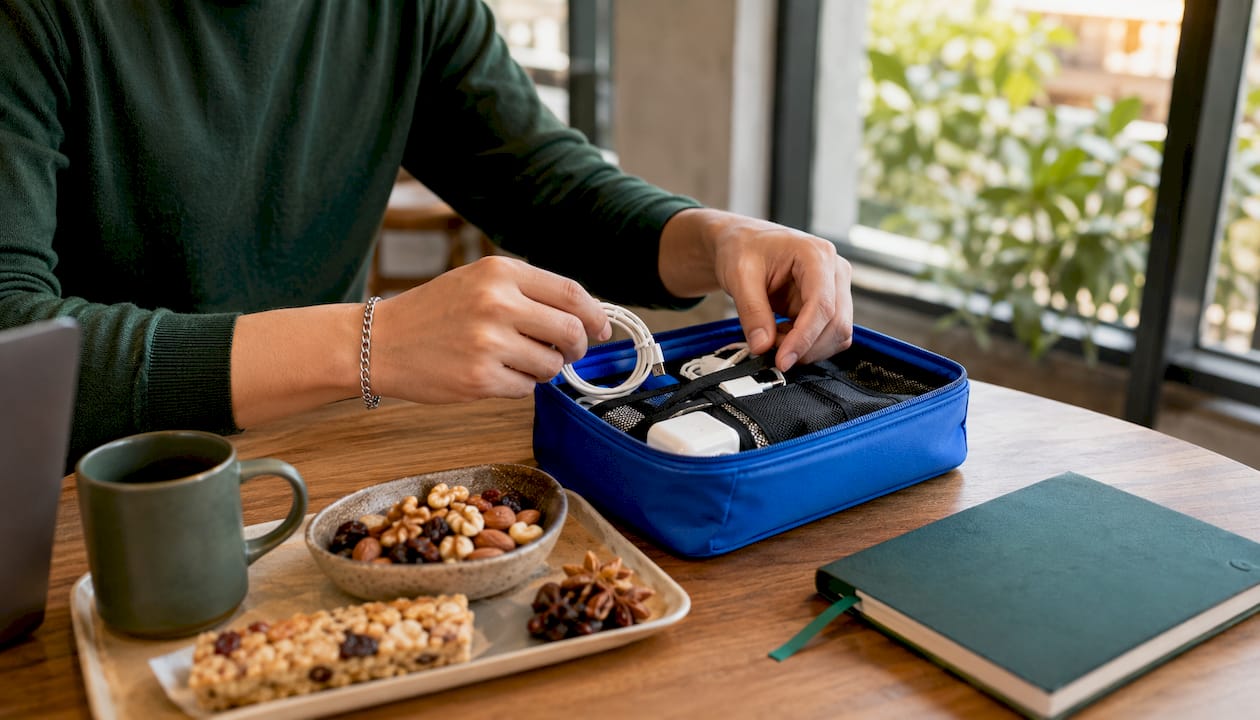
- Store all cables and adapters in a dedicated travel pouch, keeping them organized and easy to remove for screening.
- Carry at least one high-quality redundant USB-C cable. Built-in cables can fail, and power grid fluctuations in some countries stress cables more than you might expect.
Pro Tip: Pack your cables and adapters in a separate, top-accessible compartment of your bag. Security agents can inspect them without unpacking everything else.
Ensuring reliable recharge across international power grids
Power grid stability varies widely from country to country, and that variability directly affects how efficiently your devices recharge.
- Choose portable power devices with quality surge protection and universal voltage input to handle fluctuations without damage.
- Fast-charging USB-C PD adapters compatible with global power standards (100–240V) keep recharge times predictable regardless of local grid conditions.
- For extended off-grid travel, portable solar panels provide a reliable backup charging source independent of any grid.
- A multi-port USB wall charger lets you recharge your power bank and devices simultaneously, maximizing downtime at hotels or airports.
- Pass-through charging, a feature that lets a power bank charge connected devices while it recharges itself, is especially useful during long layovers. For off-grid solar setups, battery storage expertise can help you size your system correctly.
Why Toddra's portable power solutions work well for international travelers
Toddra's portable power stations and solar generators are built around LiFePO4 battery technology, which offers greater thermal stability and a longer cycle life than standard lithium-ion cells. That matters when you are recharging in unpredictable conditions abroad.
- Products include support for multiple international plug configurations, so you are not searching for adapters at the airport.
- Fast charging and solar compatibility make Toddra stations practical for both urban travel and extended off-grid use.
- US-based customer service and secure checkout give buyers confidence before and after purchase.
- Toddra's designs prioritize portability and organized cable management, qualities that translate directly to easier airport security.
Pro Tip: Review your Toddra device's watt-hour rating before every international trip and confirm it against your airline's current battery policy, since carriers occasionally update their limits.
Safety regulations and airline restrictions for portable power devices
TSA regulations are clear: power banks belong in carry-on bags only. Checked luggage is off-limits, and a power bank found there will be removed, potentially delaying your travel. The FAA and ICAO set the 100Wh threshold for unrestricted carry-on use, with 101–160Wh requiring airline pre-approval and anything above 160Wh prohibited entirely. Some airlines impose stricter quantity limits on top of those thresholds, so always verify with your specific carrier before departure.
Tips for conserving battery life during travel
Small habits extend your power bank's range significantly. Lower your phone's screen brightness and disable background app refresh when you are not actively using data. Airplane mode, even on the ground during transit, cuts battery drain by a third or more on most smartphones. Charge devices in order of priority: navigation and communication tools first, entertainment last. Avoid charging in extreme heat, which degrades lithium-ion cells faster than almost any other factor.
Backup power options for emergencies and device failure
Carry at least two power sources of different types. A compact power bank handles daily top-ups, while a higher-capacity portable power station covers multi-day outages or device failures. Solar panels add a third layer of independence for outdoor travelers. Store a spare charging cable in a separate bag compartment so a broken cable does not strand all your devices at once. For critical devices like medical equipment or satellite communicators, identify local charging options at hotels, airports, or co-working spaces before you need them.
Toddra has the portable power your next trip deserves
Travelers who want reliable, travel-ready power without the guesswork will find Toddra's lineup worth a close look. The brand's LiFePO4-powered stations deliver stable performance across varying grid conditions, and the focus on compact, organized design means less friction at every security checkpoint. US-based customer support is available when questions come up, and the checkout process is secure from start to finish.

For high-capacity needs, the Jackery Battery Pack 5000 Plus Expansion Battery 5040Wh available through Toddra is built for travelers and outdoor enthusiasts who need serious, dependable power. Browse Toddra's full range and find the right fit for your next adventure.
Key Takeaways
Packing portable power for international travel requires universal voltage support, carry-on compliance under 100Wh, and organized cable management to stay charged and stress-free worldwide.
| Point | Details |
|---|---|
| Airline capacity limits | Batteries under 100Wh fly without approval; 101–160Wh need prior airline sign-off; above 160Wh is prohibited. |
| Carry-on only rule | TSA and FAA require all power banks in carry-on luggage; checked bags are not permitted. |
| Universal voltage matters | Choose devices rated 100–240V to charge safely on any international power grid without a converter. |
| Cable management | Use a travel pouch and carry a redundant USB-C cable; built-in cables can fail under grid stress. |
| Toddra's advantage | Toddra's LiFePO4 portable power stations offer thermal stability, solar compatibility, and US-based support for international travelers. |