Matching your power station wattage to your camping needs means knowing two numbers: your total daily watt-hour (Wh) consumption and your highest simultaneous watt load. Get those two figures right, and you will never wake up to a dead battery or a tripped inverter. This guide walks you through calculating device wattage, reading power station specs, sizing for your camping style, and adding solar recharge to the mix. Whether you run a CPAP machine, a 12V compressor fridge, or just a few LED lights and phone chargers, the math is straightforward once you know the method.
How to calculate your power station wattage camping needs

The calculation starts with a simple device list. Write down every item you plan to power, its wattage, and how many hours per day you will run it. Multiply watts by hours to get watt-hours for each device, then add everything together.
Here is a practical example for a typical weekend camper:
- LED lantern: 10W × 4 hours = 40Wh
- Smartphone charging (two phones): 20W × 2 hours = 40Wh
- Laptop: 65W × 2 hours = 130Wh
- CPAP machine (no humidifier): 30W × 8 hours = 240Wh
- 12V compressor fridge: 45W average × 24 hours = 1,080Wh
That total comes to roughly 1,530Wh per day. Before you shop, add a 20% safety buffer for startup surges and inefficiencies, which brings the real target to about 1,836Wh.
Two wattage figures matter beyond the total: continuous watts and surge watts. Continuous watts is the steady draw a device pulls while running. Surge watts is the short spike a motor or compressor needs to start. A compressor fridge rated at 45W continuous might surge to 150W or more at startup. Your power station must handle that spike without tripping.
Pro Tip: Use a Kill A Watt meter (available at most hardware stores) to measure the actual draw of your devices at home before your trip. Measured wattage draw is typically 30 to 60 percent lower than the nameplate max, so you may be able to size down without any risk.
- CPAP machines without a humidifier draw 4 to 12W continuously, translating to roughly 32 to 96Wh per night at low settings.
- A CPAP with a heated humidifier can draw up to 100W, pushing nightly consumption to 480 to 720Wh.
- A 12V compressor fridge consumes 900 to 1,600Wh per day depending on size and ambient temperature.
- LED lights and phone chargers are low-impact devices, typically adding fewer than 100Wh per day combined.
What do power station specs actually mean?
Every power station spec sheet lists three key numbers: capacity in Wh, continuous output in watts, and surge output in watts. Understanding all three prevents costly mismatches.
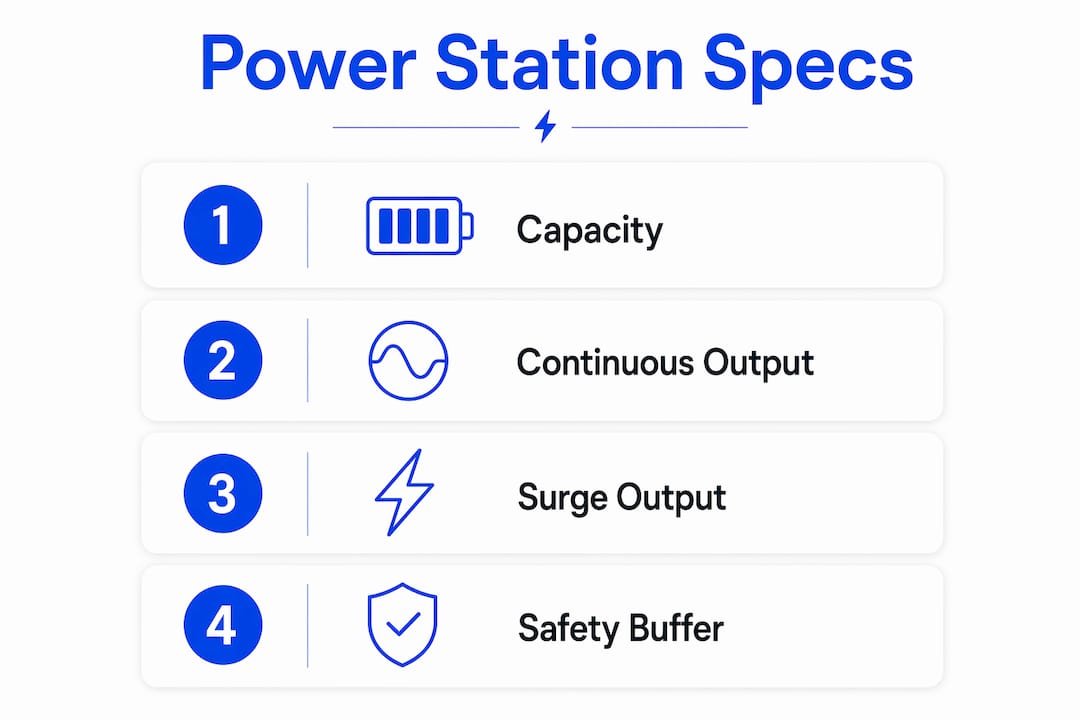
Wh capacity tells you how much total energy the battery holds. A 1,000Wh station does not deliver exactly 1,000Wh to your devices because inverter conversion losses typically reduce usable output by 10 to 15 percent. Plan for that gap.
Continuous output watts is the maximum steady power the station can deliver at any moment. If your fridge, CPAP, and laptop all run at the same time, their combined wattage must stay below this number. Exceeding it triggers an automatic shutoff.
Surge output watts covers the brief startup spikes from motors and compressors. A station with 1,000W continuous output might offer 2,000W surge capacity. That headroom is what keeps the inverter from tripping when your fridge compressor kicks on.
Pro Tip: When comparing stations, balancing continuous watts and Wh capacity is the most reliable sizing method. A high-capacity battery paired with a low continuous watt rating will still shut down under a heavy simultaneous load.
Additional spec details worth checking:
- Inverter type: Pure sine wave inverters are safe for sensitive electronics like CPAPs and laptops. Modified sine wave inverters can damage some devices.
- Output ports: Confirm the station has the AC outlets, USB-A, USB-C, and DC barrel ports your devices need.
- Solar input rating: The maximum solar wattage the station can accept per hour, which determines how fast panels can recharge it.
How much wattage do you need by camping style?
Your camping style determines your realistic daily energy budget more than any single device. Here is how the three most common styles break down.
| Camping style | Typical daily Wh | Common devices | Recommended station size |
|---|---|---|---|
| Car camping | 300 to 800Wh | LED lights, phones, small fan, laptop | 500 to 1,000Wh |
| Overlanding | 1,000 to 2,000Wh | Fridge, CPAP, lights, phones, camera gear | 1,500 to 2,500Wh |
| Glamping | 1,500Wh and above | Fridge, CPAP, TV, coffee maker, fan or heater | 2,000 to 3,000Wh+ |
Car campers who stick to lights, phones, and a laptop can get through a weekend on a 500Wh station with careful use. The moment you add a compressor fridge, the math changes completely. That single appliance can consume more energy than everything else combined.
Overlanding setups typically need a 1,500Wh station as a minimum for a weekend trip with a fridge and CPAP running overnight. Longer trips or hotter conditions push that requirement toward 2,500Wh or more.
Glamping setups that include a small coffee maker (600 to 900W), a portable TV (50 to 100W), and a fridge need both high Wh capacity and a continuous output rating above 1,000W to run multiple appliances without tripping. A station with 2,000Wh capacity and 1,500W continuous output covers most glamping loads comfortably.
- For car camping, prioritize portability and weight over raw capacity.
- For overlanding, prioritize Wh capacity and surge rating to handle fridge startups.
- For glamping, prioritize continuous watt output alongside capacity.
Should you add solar panels to your camping setup?
Solar recharge transforms a power station from a fixed battery into a self-sustaining system. The math is straightforward: a 100W solar panel produces roughly 400 to 500Wh per day under ideal conditions with about five peak sun hours. Two panels at 200W total produce roughly 800 to 1,000Wh per day.
For a weekend car camper using 500Wh daily, a single 100W panel can fully replace what you use each day. For an overlander running a fridge and CPAP at 1,500Wh daily, you need at least three to four 100W panels or two larger 200W panels to keep pace.
Solar output is not guaranteed, though. Flat placement or shading can reduce output by 20 to 30 percent. Dirty panels lose efficiency too. The practical steps to maximize solar yield on a camping trip:
- Position panels facing south (in the Northern Hemisphere) at an angle matching your latitude.
- Reposition panels every two to three hours to track the sun across the sky.
- Keep panel surfaces clean and free of dust, pollen, or bird droppings.
- Use a DC extension cable to place panels in full sun even when your station sits in the shade.
- Check your station's solar input wattage limit before connecting multiple panels in parallel.
Pro Tip: A solar panel connector kit lets you daisy-chain multiple panels without complicated wiring. This is the fastest way to scale up solar input on longer trips without buying a new station.
Using a mix of AC, car, and solar charging gives you the most flexibility on extended trips. Charge via your vehicle's 12V port while driving, top up with solar during the day, and use AC at a campsite hookup when available.
Common power management mistakes and how to avoid them
The most frequent cause of inverter trips is starting multiple high-draw appliances at the same time. Inverter overload occurs when the combined surge or continuous load exceeds the station's rated output, and the unit shuts down to protect itself. The fix is staggered startup: turn on the fridge first, let it stabilize, then start the CPAP or other devices.
Running a CPAP directly on DC power from a 12V output can save 10 to 20 percent of energy compared to using the AC inverter, though this may disable the humidifier function on some models.
A few more habits that protect your runtime and your equipment:
- Monitor consumption actively. Most modern stations display real-time wattage draw and estimated runtime. Check it after starting each device to confirm you are within limits.
- Use DC outputs when possible. Powering 12V devices through the DC port bypasses the inverter entirely, cutting conversion losses and extending battery life.
- Avoid running a fridge and a high-watt appliance simultaneously. A coffee maker at 900W plus a fridge surge at 150W can briefly exceed a 1,000W continuous station's limit.
- Watch the weight. A 2,000Wh LiFePO4 station typically weighs 40 to 50 pounds. That is manageable for car camping but significant for any setup requiring carry distance.
- Recharge before you need to. Lithium batteries last longer when kept between 20 and 80 percent charge rather than run to zero repeatedly.
Key takeaways
Matching your power station to your camping needs requires calculating total daily Wh consumption, identifying peak simultaneous watt loads, and adding a 20 percent buffer before selecting a unit.
| Point | Details |
|---|---|
| Calculate Wh first | Multiply each device's watts by daily hours of use, then sum all devices for your total. |
| Add a 20% buffer | Include a safety margin to cover startup surges and inverter conversion losses. |
| Check continuous and surge watts | Your station's continuous output must cover all simultaneous loads; surge rating handles compressor startups. |
| Match station size to camping style | Car camping needs 500 to 1,000Wh; overlanding needs 1,500 to 2,500Wh; glamping needs 2,000Wh or more. |
| Solar extends your range | A 100W panel produces 400 to 500Wh per day under ideal conditions, enough to offset a car camper's full daily use. |
What I've learned from sizing power stations in the field
The number that surprises most campers is the compressor fridge. On paper, a 45W fridge sounds manageable. In practice, the startup surge can hit three to four times that wattage for a fraction of a second, and if your station's surge rating is too close to its continuous rating, that spike trips the inverter every time the compressor cycles. I have seen this catch people off guard even with stations they thought were generously sized.
The second lesson is about real versus rated wattage. Adapter labels are worst-case numbers set by engineers for liability reasons. A CPAP labeled at 90W might draw 35W at your actual pressure setting. Measuring with a Kill A Watt meter before a trip consistently reveals that people can size down one tier and still have comfortable headroom.
My practical recommendation: size your Wh capacity for two full days of use without any recharge. That buffer covers cloudy days, unexpected guests, or a longer stay. Then confirm the continuous watt rating covers your fridge plus your CPAP plus one other device running at the same time. If it does, you are covered for nearly every scenario. Solar is a bonus, not a guarantee. Treat it as a way to extend a well-sized station, not as a substitute for adequate battery capacity.
— Jackson
Power your next trip with Toddra
Toddra carries a carefully selected range of portable power stations sized for every camping style, from compact 500Wh units for weekend car campers to high-capacity 2,000Wh+ systems built for overlanding and glamping setups. Each station in the catalog is chosen for reliable continuous output, strong surge ratings, and solar compatibility so you can build a complete off-grid power setup with confidence. Toddra's team is US-based and ready to help you match the right station capacity and wattage to your specific device list. Visit Toddra to browse the full range of power stations and solar accessories, with secure checkout and responsive support every step of the way.
FAQ
How much wattage do I need for a camping power station?
Most campers need between 500 and 2,500Wh of capacity depending on their devices. Add a 20 percent buffer to your total daily watt-hour calculation, then confirm the station's continuous watt output covers your highest simultaneous device load.
Can a 1,000Wh power station run a CPAP and a mini fridge?
A CPAP without a humidifier uses roughly 32 to 240Wh per night, while a compressor fridge uses 900 to 1,600Wh per day. A 1,000Wh station can run a CPAP overnight but will not sustain a fridge for a full day without solar recharge.
What is the difference between watts and watt-hours on a power station?
Watts measure the rate of power draw at any instant; watt-hours measure total energy stored or consumed over time. A device drawing 50W for 10 hours consumes 500Wh, which is the capacity unit used to size power stations.
How many solar panels do I need to recharge a camping power station?
A 100W solar panel produces roughly 400 to 500Wh per day under ideal conditions. Divide your daily energy use by 400 to 500 to estimate the number of 100W panels needed to keep pace with consumption on a sunny day.
Does running a CPAP on DC power save battery on a camping trip?
Running a CPAP directly through a 12V DC output saves 10 to 20 percent of energy compared to using the AC inverter, because it bypasses conversion losses. Note that some CPAP humidifier functions may not work in DC mode.