TL;DR:
- Transfer switches safely disconnect homes from utility power to prevent backfeed and protect utility workers. They are essential for legal and reliable backup power systems, whether manual or automatic, and must meet safety standards and code requirements. Homeowners should carefully match switch types to their power sources, load needs, and installation complexity to ensure safe, compliant operation.
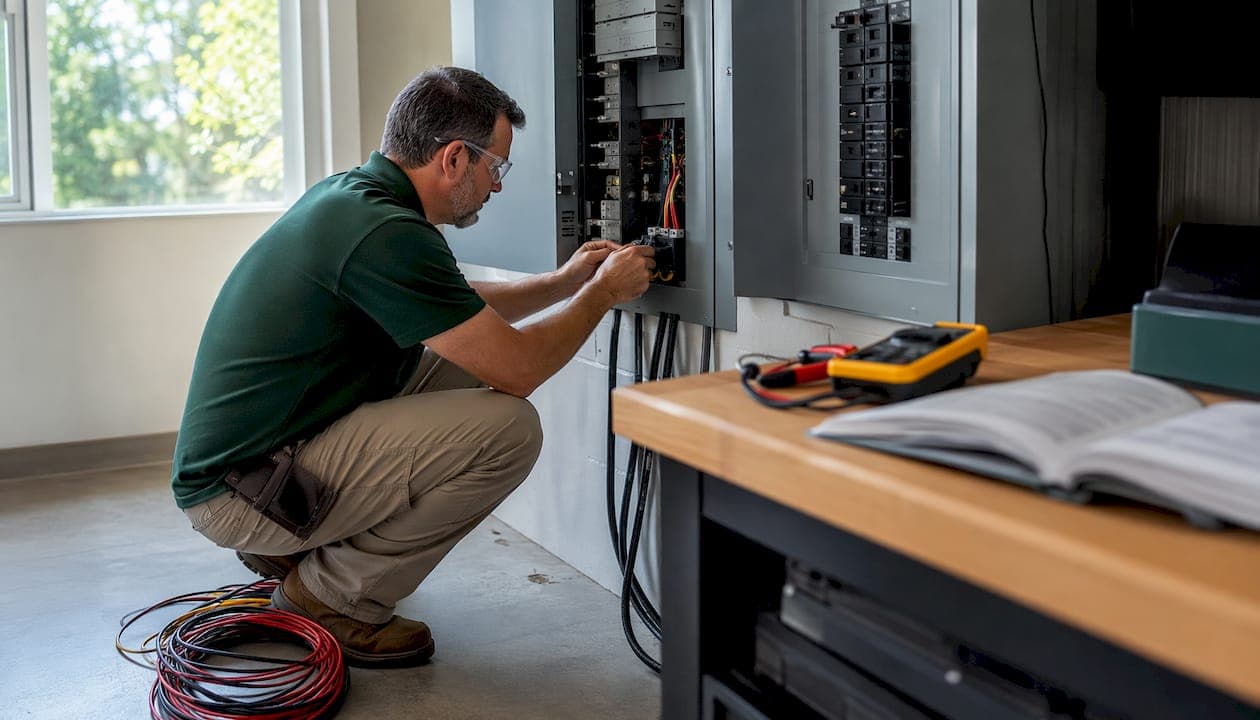
A transfer switch isolates your home from the utility grid and safely routes power from a generator or solar/inverter source to selected circuits, preventing dangerous backfeed that can injure utility workers and damage equipment. Every reliable home backup power solution, whether a portable generator or an inverter-based solar station, depends on this one device to operate safely and legally under NEC Articles 700, 701, and 702. Toddra's guides consistently point to transfer switch compatibility as the first thing to confirm before choosing any backup power setup.
Quick answers:
- Safety first: A transfer switch prevents backfeed by breaking the connection to the grid before connecting your backup source.
- Two modes: Manual switches require you to flip a lever; automatic transfer switches (ATS) detect an outage and switch without any action from you.
- Works with solar too: Inverter-based portable power stations and solar generators can connect through a transfer switch when properly sized and wired.
- Compliance matters: Listed equipment and a licensed electrician are required in most jurisdictions.
Table of Contents
- What is the role of a transfer switch in home backup?
- What types of transfer switches should you know about?
- What safety and code requirements apply to transfer switches?
- How do you choose the right transfer switch for portable or solar backup?
- What does transfer switch installation actually involve?
- How do transfer switches work with portable power stations and solar generators?
- What mistakes do homeowners make with transfer switches?
- Key Takeaways
- A practical take on transfer switches and portable backup
- Toddra portable power stations: a simpler path for some homeowners
- Useful sources
What is the role of a transfer switch in home backup?
The switch moves your circuits from utility power to your backup source and back again. That sounds simple, but the sequence an ATS performs is precise: it senses the outage, sends a start command to the generator, verifies that the generator's output is stable in voltage and frequency, then transfers the load. When utility power returns, it retransfers and shuts the generator down.
"Transfer switches are the unsung and often neglected heroes of emergency, legally required standby, and optional standby systems. These devices sense normal power loss and activate the generator or alternate power source to critical loads." — Electrical Contractor Magazine
Most home systems use an open transition (break-before-make) switch. There is a brief interruption of a second or less during the transfer. Sensitive electronics like computers or medical devices may need a UPS alongside the transfer switch to bridge that gap. Closed-transition switches eliminate the interruption but are more common in commercial settings.
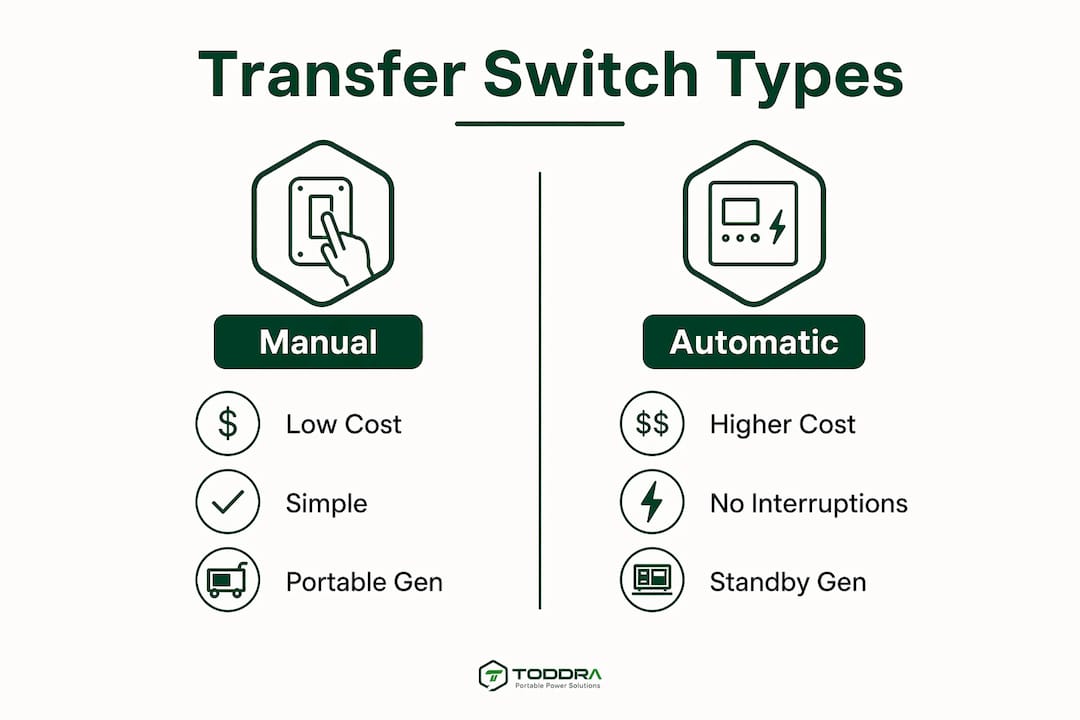
Manual switches follow a simpler user-driven sequence: shut off the main breaker, flip the transfer switch, then start the generator. No automation, but a lower price point. Automatic systems offer continuity without you doing anything, which matters when you are away from home during a storm.
What types of transfer switches should you know about?
Choosing the right type starts with matching the switch to your power source and how many circuits you need covered.
| Switch Type | Power Rating | Coverage | Operation | Solar/Inverter Compatible | Install Complexity | Safety Listing |
|---|---|---|---|---|---|---|
| Manual transfer switch | Up to 25A typical | Essential circuits | Manual | Yes, with sizing check | Moderate | UL listed required |
| Automatic transfer switch (ATS) | 100A–200A+ | Whole-house or essential | Automatic | Yes, with pure-sine inverter | High | UL 1008 / listed |
| Subpanel transfer switch | 30A–60A | 6–12 essential circuits | Manual | Yes | Moderate | UL listed required |
| Generator interlock kit | Matches panel rating | Whole-house (limited by generator) | Manual | Limited | Low–Moderate | Code-dependent |
| Portable inlet / cord-connect | Up to 30A | Essential circuits via cords | Manual | Yes, portable stations | Low | Listed inlet required |
Manual transfer switches are the go-to for portable generator owners who want a clean, code-compliant setup without the cost of automation. A subpanel version lets you pre-wire your six to twelve most critical circuits, so flipping one switch covers the refrigerator, furnace, and a few lights.
An ATS makes sense when you have a standby generator and cannot afford any gap in power, such as for a home office or medical equipment. Whole-house switches must match your service amperage, either 100A or 200A, and your generator must be sized to carry the full load.
Generator interlock kits are the lowest-cost option, but they depend heavily on local code acceptance and proper installation. They prevent the main and generator breakers from being on simultaneously, which achieves the anti-backfeed goal, but they do not offer the circuit-selection flexibility of a dedicated transfer switch.
What safety and code requirements apply to transfer switches?
Compliance is not optional. NEC Articles 700, 701, and 702 govern emergency, legally required standby, and optional standby systems respectively, and all require that transfer equipment be properly listed. For most homes, Article 702 (optional standby) applies, but the listing requirement is the same across all three.
"Listed" means the equipment has been evaluated by a recognized testing laboratory, such as UL under standard UL 1008, and found to meet safety requirements for load switching, inrush capacity, and cycle life. An unlisted device may not carry the load reliably or safely.
Unpermitted installations can result in fines, forced removal, and insurance claim denials after a loss. Your utility may also require notification before you connect any backup power source to your home's wiring. Life-safety circuits, including sump pumps and furnaces, often need to be prioritized and labeled clearly so emergency responders know what is backed up.
A licensed electrician and a local permit are the baseline. The inspection that follows confirms grounding, bonding, labeling, and that the transfer switch is correctly rated for your service.
How do you choose the right transfer switch for portable or solar backup?
Start with your power source's continuous output rating, then list the circuits you need most. The switch must handle both without exceeding the generator's or inverter's capacity.
Work through these checkpoints before calling an electrician:
- Confirm your source rating. What is the continuous wattage and peak surge of your generator or inverter? A 3,000W inverter running at 120V delivers roughly 25A continuous.
- List essential loads. Refrigerator, furnace blower, sump pump, lighting, phone charging. Add up running watts and note startup currents for motors.
- Choose coverage. A subpanel covering 6–10 circuits costs less and works well with smaller sources. Whole-house coverage requires a larger, more expensive switch and a generator to match.
- Manual vs. automatic. If you are home during most outages and have a portable generator, manual is fine. If you travel or have medical needs, an ATS is worth the extra cost.
- Check listings. Confirm UL listing and, if the switch will serve as the main disconnect, verify it is service-entrance rated.
For circuit mapping and load prioritization, Toddra's backup power circuit guide walks through the process in detail. Bring your generator or inverter model number, your service amperage, your priority circuit list, and your panel's available space to your electrician consultation.
| Tradeoff | Option A | Option B |
|---|---|---|
| Cost vs. convenience | Manual switch (lower cost) | ATS (higher cost, no user action) |
| Whole-house vs. essential | Whole-house (matches large generator) | Subpanel (works with smaller source) |
| Permanent vs. flexible | Wired transfer switch | Portable inlet + manual switch |
What does transfer switch installation actually involve?
Expect a licensed electrician, a permit, and an inspection. The physical work typically takes a few hours to a full day, but permit processing and scheduling an inspection can add days or weeks to the calendar.
The electrician's scope includes siting the transfer switch near the main panel, running conduit and wiring to the panel and the generator inlet or standby unit, labeling every circuit, verifying grounding and bonding, and running a full load test before signing off. Service-entrance rated switches that include integral disconnects simplify some installations but must be precisely matched to your service rating.
Cost varies by region, switch type, and panel complexity. A manual subpanel transfer switch with installation generally runs in the range of $500–$1,500. A whole-house ATS with a standby generator connection can reach $2,000–$4,000 or more for the electrical work alone, before the generator itself. Factors that push costs higher include conduit runs, additional breakers, panel upgrades, and utility coordination requirements.
Before installation day, map your loads, submit the permit application, and confirm the generator or inverter is on-site. After installation, test the system under real load, not just at idle.
How do transfer switches work with portable power stations and solar generators?
Transfer switches can work with inverter-based solar generators and portable power stations, but compatibility requires a few specific checks. The inverter must produce a pure sine wave output, since modified sine wave power can damage motors and sensitive electronics. It also needs to deliver enough continuous amperage for the circuits you plan to back up.
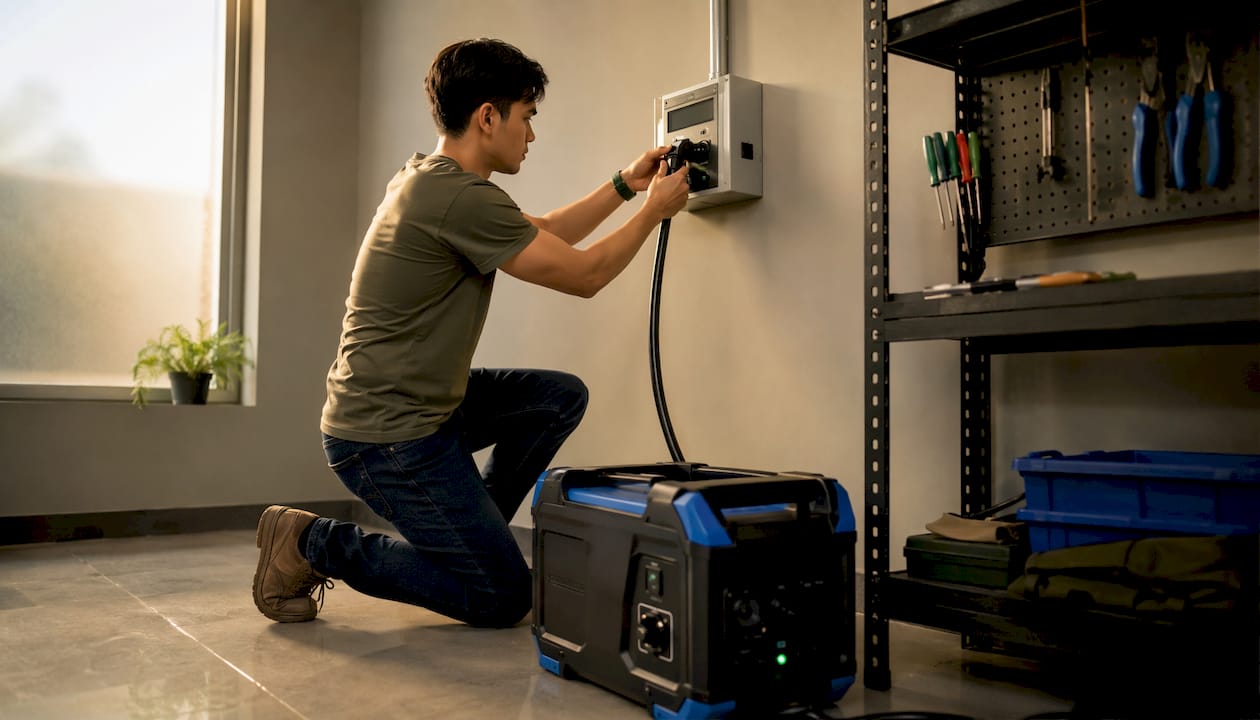
Neutral and ground handling is a common sticking point. Many portable power stations use a floating neutral, which works fine with most manual transfer switches but can cause issues with certain ATS units that expect a bonded neutral. Confirm this with your electrician before purchasing.
Most portable stations output 120V only. If your transfer switch or any backed-up circuit requires 120/240V, the station will not cover it without a split-phase inverter. For solar recharge strategies during outages, Toddra's guide covers how to keep a portable station charged while it is powering your home.
Smart transfer switches can rotate or prioritize circuits so a smaller inverter-based source covers more loads over time without overloading. This load-shedding approach is especially practical with portable stations that have lower continuous output than a standby generator.
Pro Tip: Before committing to a wiring setup, run your portable station at full load for 30 minutes while monitoring its output voltage and temperature. A station that throttles or shuts down under sustained load will not reliably power a furnace or sump pump through a long outage.
Compatibility checklist for inverter-based sources:
- Pure sine wave output confirmed
- Continuous wattage meets or exceeds total essential load
- Neutral/ground configuration matches transfer switch requirements
- Output voltage matches circuits (120V or 120/240V)
- ATS compatibility confirmed if using automatic transfer
What mistakes do homeowners make with transfer switches?
The most common and dangerous mistake is skipping a transfer switch entirely and running a generator through extension cords. Extension cords cannot power hardwired systems like furnaces or well pumps, and they leave the utility connection live, creating a backfeed risk.
Backfeed from an improperly connected generator can energize utility lines that workers assume are de-energized. The consequences can be fatal for line crews and can destroy your generator when utility power returns.
Other frequent errors include underestimating motor startup currents (a sump pump can draw three to five times its running current at startup), improper neutral handling with portable inverters, and assuming a generator will power the whole house when it is only sized for essential loads. Unpermitted work is another trap: it may pass unnoticed until you file an insurance claim.
Practical safety habits that keep your system ready: label every circuit on the transfer switch panel, test the full system under load at least once a year, keep generator fuel fresh or use a fuel stabilizer, and update inverter firmware when the manufacturer releases it. Call a licensed electrician for any wiring change, panel modification, or if the transfer switch trips unexpectedly during testing.
Key Takeaways
A transfer switch is the safety and control core of any home backup system, whether you use a standby generator, a portable unit, or an inverter-based solar station.
| Point | Details |
|---|---|
| Backfeed prevention is primary | A transfer switch isolates your home from the grid, protecting utility workers and your equipment. |
| Match switch to your source | Confirm continuous output, voltage (120V vs. 120/240V), and neutral configuration before buying. |
| NEC and UL compliance required | Listed equipment and a licensed electrician with a permit are required in most US jurisdictions. |
| ATS adds convenience at a cost | Automatic switches transfer without user action; manual switches cost less and suit portable generators well. |
| Toddra portable stations as an alternative | For shorter outages and essential-only loads, a solar-rechargeable portable power station may eliminate the need for a wired transfer switch. |
A practical take on transfer switches and portable backup
The conventional wisdom says every home backup setup needs a permanent, wired transfer switch. That is true when you have a standby generator or need to power hardwired loads like a well pump or central furnace. But a growing number of homeowners are finding that a high-capacity portable power station, solar-rechargeable and ready to go, covers their real needs without the permit timeline or the electrician bill.
The honest tradeoff is this: a wired ATS with a standby generator gives you whole-house continuity with zero effort during an outage. A portable solar station gives you flexibility, no installation, and the ability to take it camping or to a job site, but it tops out at essential circuits and requires you to manage the load manually. Neither is universally better. The right answer depends on how long your outages typically last, which loads you genuinely cannot live without, and whether you own or rent your home.
What I see people get wrong most often is buying the generator or the power station first and figuring out the transfer switch later. The switch is not an accessory. It is the device that makes the whole system safe and legal. Size it first, then choose your source around it.
Toddra portable power stations: a simpler path for some homeowners
If you rent, or if your outages are typically short and your essential loads are limited to a refrigerator, phone charging, lighting, and a few small appliances, a solar-rechargeable portable power station may be the right fit without any wiring work at all.
Toddra carries a carefully selected range of portable power stations and solar generators built on LiFePO4 battery technology, with pure sine wave output, fast charging, and solar compatibility designed for exactly this kind of home backup use. For readers who want serious capacity, the Jackery Battery Pack 5000 Plus offers 5,040Wh of expandable storage, enough to run essential home circuits through a multi-day outage. For guidance on configuring a solar generator for home backup, Toddra's setup guide covers sizing, solar panel pairing, and load management in plain language. Browse Toddra's full portable power lineup at toddra.com and reach out to the US-based support team with any compatibility questions before you buy.
Useful sources
These references form the technical and consumer foundation of this guide. NEC text is the authoritative source for code requirements; the Eaton and Electrical Contractor resources are best for engineering detail; Consumer Reports and Cline Electrical are most accessible for homeowners.
- NEC Articles 700, 701, and 702 via Consumer Reports — Consumer-level summary of why transfer switches are required and what NEC coverage means for homeowners.
- Electrical Contractor Magazine: Transfer Switch Essentials — Code-level reading on listing, labeling, and NEC compliance for transfer equipment.
- Eaton: ATS Fundamentals — Engineering detail on ATS operation modes, transition types, and switching mechanisms.
- Eaton: Transfer Switch 101 White Paper — Practical overview of open vs. closed transition and load-transfer sequences.
- Schneider Electric: What Is a Transfer Switch? — Clear explanation of manual vs. automatic modes and smart load management.
- Cline Electrical: Transfer Switch Selection, Installation & Safety — Homeowner-focused guide covering subpanel vs. whole-house sizing and permit requirements.
- Depco: What Is a Generator Transfer Switch? — Accessible overview of backfeed risks and service-entrance rated switch options.
- Wikipedia: Transfer Switch — Background on open vs. closed transition and UPS pairing for sensitive electronics.