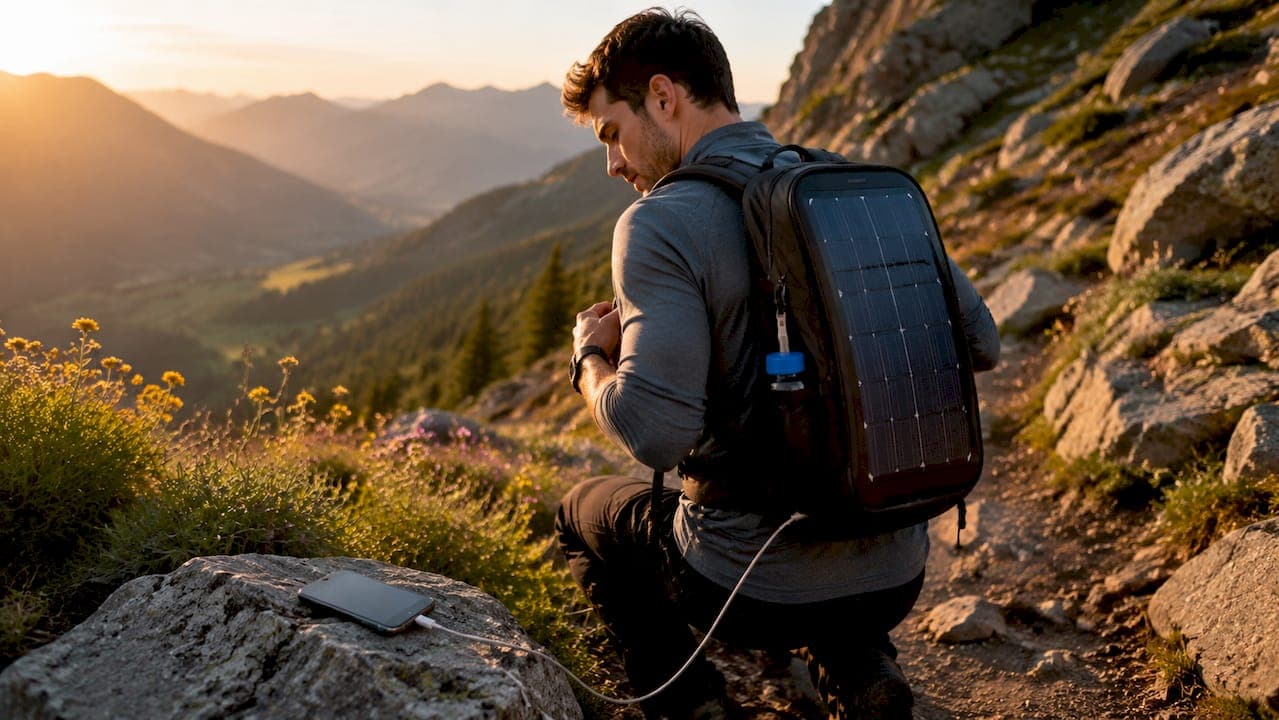
Solar backpack charging is the process by which photovoltaic panels built into a backpack convert sunlight into electrical energy to charge devices like smartphones, GPS units, and cameras while you move. This technology, formally called photovoltaic-integrated portable charging, has matured significantly by 2026. Brands like Solgaard with the Lifepack and Jackery with its solar accessories have pushed the category forward with flexible panels, lithium-polymer batteries, and USB-C ports. If you are researching what is solar backpack charging explained for your next hiking or camping trip, this guide covers the technology, real-world performance, and practical tips you need.
How does solar backpack charging technology work?
Solar backpack charging technology converts sunlight into usable electricity through a straightforward four-step process. Understanding each step helps you set realistic expectations before you buy.
- Photovoltaic conversion. Monocrystalline or polycrystalline silicon cells on the backpack's outer panel absorb photons from sunlight and release electrons, generating direct current (DC) electricity.
- Voltage regulation. A built-in charge controller or voltage regulator smooths out fluctuations in that DC current. Without it, a cloud passing overhead could send an irregular voltage spike directly into your phone.
- Energy storage. Most quality solar backpacks route power into an integrated lithium-ion or lithium-polymer battery first. Solar chargers with integrated batteries are more practical than those without, because they store energy during peak sun hours for use later in the evening.
- Device delivery. Power flows out through USB-A, USB-C, or wireless charging pads to your devices. USB-C ports rated at 18W or higher support fast charging for modern smartphones.
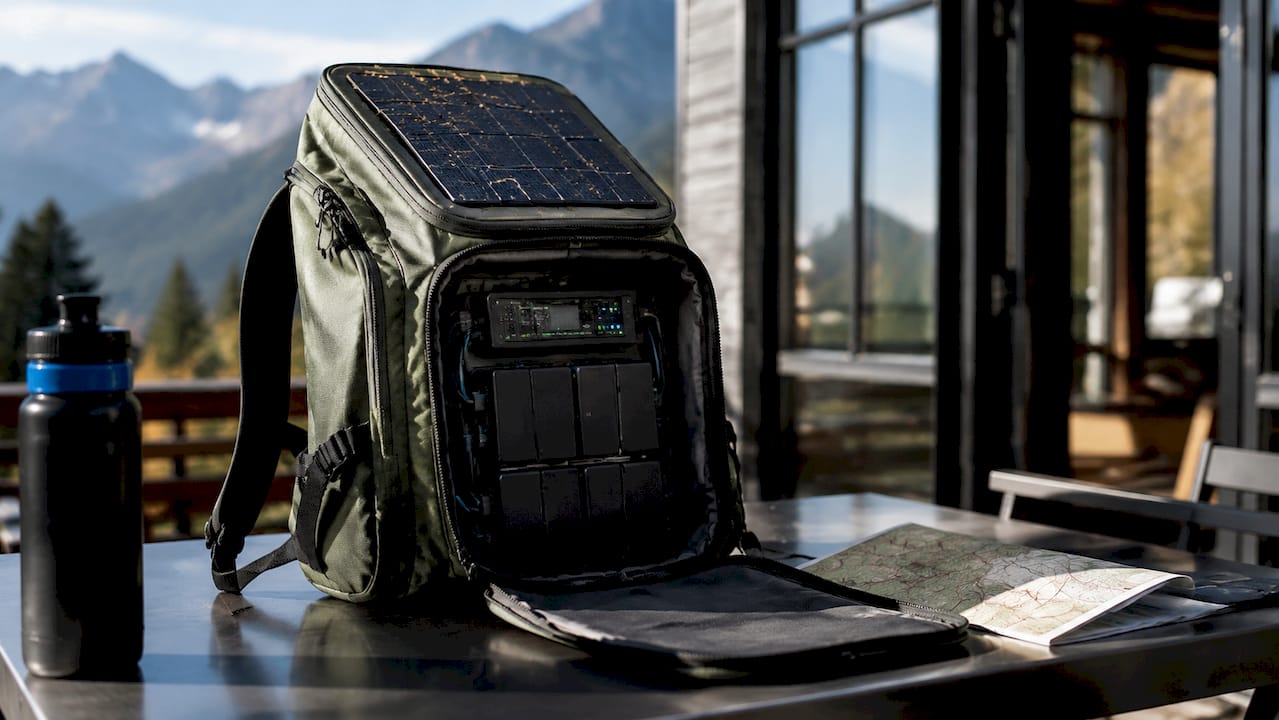
The key hardware distinction is between integrated panels and detachable panels. Integrated panels are sewn or laminated directly onto the backpack fabric. Detachable panels clip onto the exterior and can be removed, repositioned, or replaced. Detachable designs offer more flexibility for angling toward the sun, but integrated panels are more durable on rugged trails.
Pro Tip: Check the output amperage of the USB ports before you buy. A port rated at 1A charges a phone slowly. Look for 2A or higher on USB-A, or 18W+ on USB-C, to get meaningful charge times on the trail.
The latest solar backpacks in 2026 also feature graphene-enhanced batteries and smart app connectivity via IoT sensors, letting you monitor energy input and output in real time from your phone.
What factors affect solar backpack charging speed?
Charging speed is the number one concern for outdoor enthusiasts, and several variables control it. Panel wattage is the most direct factor, but it is not the only one.
| Factor | Impact on Charging Speed | Practical Implication |
|---|---|---|
| Panel wattage | Direct and significant | 7W panels suit phones; 20W+ needed for tablets |
| Sunlight intensity | High impact | Peak sun doubles output vs. overcast conditions |
| Panel orientation | Moderate to high | Misaligned panels lose up to 50% efficiency |
| Device battery size | Determines total time | Larger batteries need more watt-hours to fill |
| Temperature | Moderate | Panels lose efficiency above 77°F (25°C) |
A high-efficiency 7W solar panel charges a standard smartphone in about 2–4 hours of peak sunlight, with one hour providing roughly 25% charge. That is a useful benchmark for planning a day hike. For tablets and laptops, panels rated 20W or higher are required to deliver meaningful charge in a reasonable timeframe.
Weather matters more than most buyers expect. Solar panels function under overcast skies but at reduced efficiency. On a heavily cloudy day, output can drop to 10–25% of peak capacity. This is why an integrated battery is so valuable: it banks whatever energy the panels collect throughout the day, even when that collection is slow.
Panel orientation is the variable most hikers ignore. Charging efficiency requires panels to face outward toward sunlight, and you may need to angle the backpack as the sun moves across the sky. On a fixed trail, this is easy. On a forested switchback route, it becomes a real challenge.
Pro Tip: On partly cloudy days, charge your integrated battery pack during the backpack's use rather than plugging your phone in directly. You will accumulate more total energy by letting the battery buffer the inconsistent input.
Are solar backpacks effective compared to other portable chargers?
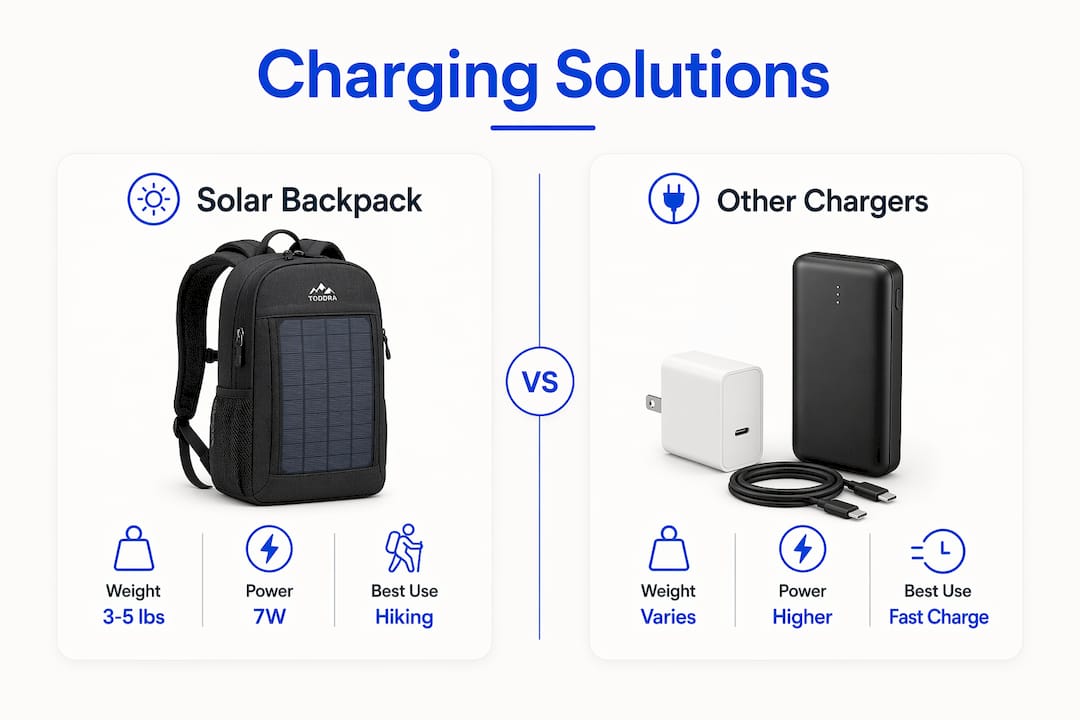
Solar backpacks occupy a specific niche in the portable charging market. They are not the fastest option, and they are not the highest-capacity option. Their advantage is that they generate power while you move, without any additional weight from pre-stored electricity.
| Charging Solution | Weight | Power Source | Best Use Case |
|---|---|---|---|
| Solar backpack (7W) | 3–5 lbs total | Sunlight + battery | Day hikes, light travel |
| Standalone power bank (20,000mAh) | ~1.2 lbs | Pre-charged only | Short trips, urban travel |
| Foldable solar panel (21W) | ~1.5 lbs | Sunlight only | Base camp, stationary use |
| Portable power station (500Wh+) | 12+ lbs | Pre-charged + solar input | Car camping, base camp |
The comparison reveals a clear truth: solar backpacks cannot fully replace wall charging but extend device power availability during off-grid travel. They work best as supplements, not primary energy sources. A hiker who pairs a solar backpack with a Jackery portable power station at base camp covers both scenarios: trickle charging on the trail and full-capacity backup at camp.
The benefits of solar backpacks that no other solution matches are:
- Continuous generation. Every hour of sun exposure adds charge, even while you hike.
- No pre-charging required. You do not need access to a wall outlet before you leave.
- Reduced total pack weight. You carry less pre-stored battery weight because the sun replenishes it.
The limitations are equally real. Standard solar backpacks struggle with laptops. High-wattage devices like laptops are rarely fully compatible with standard solar backpacks. The recommended workaround is to charge a power bank during the day and use that stored energy to power the laptop at night.
Transparent energy monitoring via IoT and mobile apps is becoming standard in 2026 models, which closes one of the biggest gaps: knowing how much power you actually have available.
How to maximize solar backpack efficiency on the trail
Getting the most from your solar backpack requires deliberate habits, not just good gear. These steps apply whether you are on a single-day hike or a five-day backcountry trip.
-
Face panels toward the sun throughout the day. Never let the panels face inward or rest against your back. Adjust your backpack's angle during breaks to track the sun. Even a 30-degree misalignment reduces output noticeably.
-
Use pass-through charging to fill the integrated battery first. Let the backpack battery accumulate charge during hiking hours. Plug your phone in during lunch breaks or at camp when the battery has built up a reserve.
-
Manage your device's power consumption actively. Lower screen brightness, disable Bluetooth and Wi-Fi when not in use, and close background apps. A phone consuming 200mA instead of 400mA effectively doubles the useful output of your panel.
-
Stay within ergonomic weight limits. Backpack total weight should not exceed 10–15% of body weight to protect long-term back health. A 160-pound hiker should carry no more than 24 pounds total. Choose a solar backpack with a panel and battery combination that fits within that budget.
-
Check USB port amperage before plugging in. Match the port to the device. A GPS unit may charge fine on a 1A port, but a modern smartphone needs 2A or higher to charge at a useful rate during a short rest stop.
-
Charge a power bank during the day for nighttime use. This strategy, recommended for solar power in backpacking scenarios, decouples generation from consumption. You collect energy when the sun is out and spend it when you need it.
The ergonomics of solar backpacks deserve as much attention as the wattage specs. A heavier panel setup that generates 20W but strains your back by mile five is a poor trade. The best solar backpack features combine adequate wattage with a frame and harness system designed for all-day wear.
Key takeaways
Solar backpacks are reliable supplemental power sources for outdoor use, but their effectiveness depends on panel wattage, sun exposure, and deliberate positioning throughout the day.
| Point | Details |
|---|---|
| Core technology | Photovoltaic panels convert sunlight to DC electricity, regulated and stored in an integrated battery. |
| Charging speed benchmark | A 7W panel charges a smartphone in 2–4 hours of peak sun; tablets need 20W or higher. |
| Effectiveness reality | Solar backpacks supplement, not replace, wall charging during multi-day off-grid trips. |
| Critical usage habit | Always face panels outward and adjust orientation as the sun moves for maximum output. |
| Weight discipline | Keep total pack weight within 10–15% of body weight to protect spinal health on long hikes. |
What i've learned after years of watching solar backpack tech evolve
The marketing around solar backpacks has always outpaced the reality, and that gap is finally closing in 2026. For years, brands advertised wattage numbers measured under laboratory conditions that no trail hiker would ever replicate. A 10W panel rated at peak lab output might deliver 4–5W on a real hiking day with partial shade, panel misalignment, and temperature losses combined.
What has genuinely changed is the battery technology. Lithium-polymer and graphene-enhanced cells hold more charge in less weight, and that matters enormously when you are watching every ounce. The move toward USB-C with Power Delivery support is also a real improvement. Older solar backpacks with USB-A only were frustrating to use with modern devices.
The feature I find most underrated is app-based energy monitoring. Knowing your actual input wattage in real time changes how you manage the day. You stop guessing and start making informed decisions about when to charge what. This is the kind of detail that separates a good solar backpack from a great one.
My honest advice: treat a solar backpack as one layer of a portable power system, not the whole system. Pair it with a quality power bank or a compact portable power station at base camp, and you will never feel power-anxious on the trail. The solar backpack handles the trickle. The power station handles the heavy lifting.
— Jackson
Power up your outdoor adventures with Toddra
A solar backpack handles the trickle charging while you hike. For base camp, longer trips, or powering larger devices, you need something with more capacity behind it.
Toddra carries a carefully selected range of portable power stations and solar generators built for exactly this kind of layered outdoor power setup. The Jackery Explorer 2000 Plus delivers 2,042Wh of capacity with solar input compatibility, making it a dependable partner for multi-day camping trips. Toddra also stocks Jackery solar accessories including connector kits that link solar panels directly to power stations. Browse the full range and find the setup that fits your next outdoor trip.
FAQ
What is solar backpack charging?
Solar backpack charging is the use of photovoltaic panels integrated into a backpack to convert sunlight into electricity, which charges devices like smartphones, GPS units, and cameras while you travel or hike.
How long does it take to charge a phone with a solar backpack?
A 7W solar panel charges a smartphone in approximately 2–4 hours of peak sunlight, with roughly 25% charge generated per hour under ideal conditions.
Can you charge a laptop with a solar backpack?
Most standard solar backpacks cannot reliably charge laptops. Laptops require higher wattage panels and are better served by charging a power bank during the day and using that stored energy at night.
Do solar backpacks work on cloudy days?
Yes, but at significantly reduced output. Panels generate power under overcast skies but efficiency drops sharply, making an integrated battery essential for storing whatever energy is collected throughout the day.
What should i look for when buying a solar backpack?
Prioritize panel wattage (7W minimum for phones, 20W+ for tablets), integrated battery capacity, USB-C port support, total pack weight relative to your body weight, and whether the design allows easy panel repositioning toward the sun.