TL;DR:
- Portable power stations complement fixed electric vehicle chargers by providing off-grid power for emergencies, camping, and short EV top-ups. They feature various battery chemistries, capacities, and port types, with LiFePO4 offering longer cycle life and better safety. Selecting the right station requires assessing loads, runtime needs, and recharge options to ensure suitability for specific use cases.
"Vehicle charging power station types" covers both fixed EV charging infrastructure and portable power stations — and for most consumers focused on home backup, camping, or emergency preparedness, a portable power station is the right starting point.
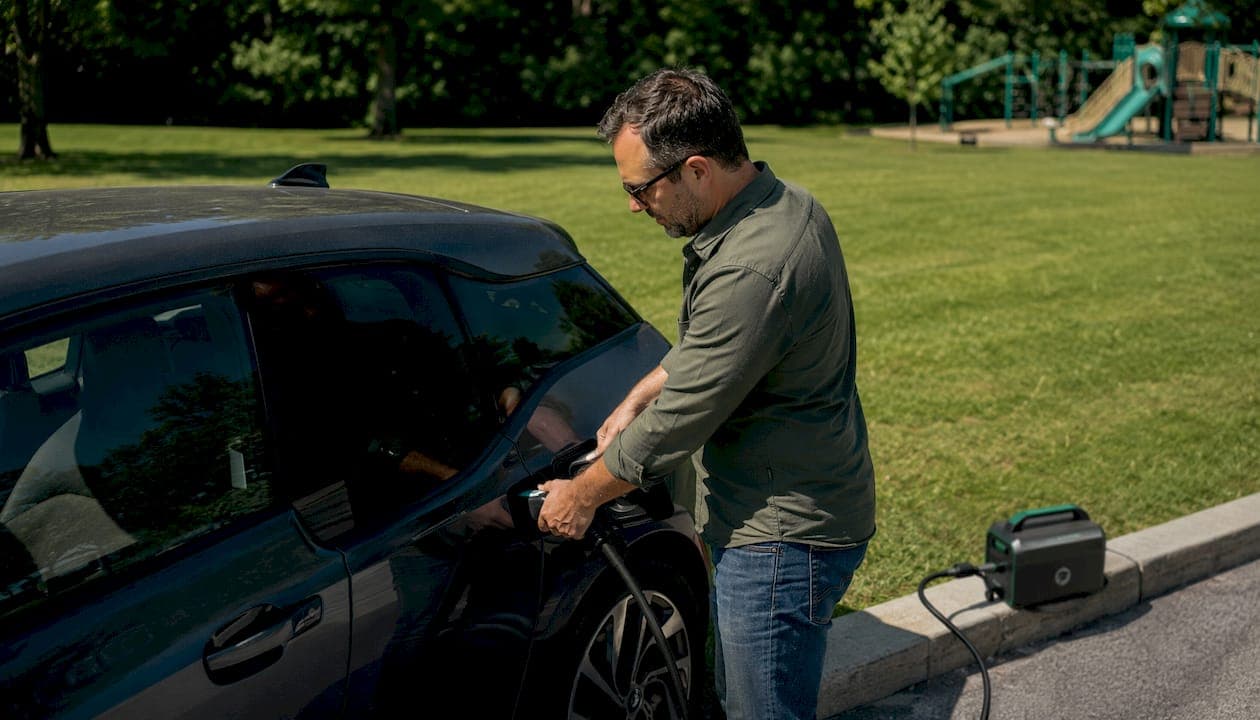
According to AFDC guidance, home charging meets most daily EV needs, which means portable stations fill the gaps fixed chargers can't: off-grid power, appliance backup, and small EV top-ups when you're far from a wall outlet. An MDPI systematic review confirms portable power stations serve flexible, localized energy roles rather than replacing fixed charging infrastructure.
Quick picks by use case:
- Home overnight EV charging: Level 2 fixed charger (240V, dedicated circuit)
- Camping and off-grid power: Portable power station, 500–1,500Wh, solar-compatible
- Emergency backup for appliances and electronics: Portable power station, 1,000–3,000Wh, LiFePO4 chemistry
- Short EV top-up away from home: Portable station, 2,000Wh+, pure sine AC inverter
Table of Contents
- How fixed EV chargers and portable power stations differ
- How portable power stations are technically classified
- What each output type can realistically power
- How to recharge a portable station, and realistic EV charging limits
- How to choose the right portable power station for your needs
- Safety, certifications, and battery care
- Real-world setup examples by scenario
- Environmental impact and battery chemistry sustainability
- Accessories that make portable stations more useful
- Toddra's portable power stations match these needs directly
- Key Takeaways
- Why realistic expectations matter more than raw specs
- Useful sources and further reading
How fixed EV chargers and portable power stations differ
Fixed EV chargers and portable power stations solve different problems. Understanding both helps you spend money in the right place.

| Feature | Fixed EV Chargers (L1/L2/DCFC) | Portable Power Stations |
|---|---|---|
| Primary role | Recharge EV traction battery | Power appliances, electronics, small EV top-ups |
| Typical power output | 1 kW–350 kW | 300W–3,000W continuous |
| Installation | Permanent, requires electrician for L2 | Plug-and-play, no installation |
| Best for | Daily commuting, long-distance travel | Camping, emergencies, off-grid |
| Portability | Fixed location | Carry anywhere |
Level 1 charging stations use a standard 120V outlet and add roughly 3.5–6.5 miles of range per hour. Level 2 chargers run on 240V and add 20–40 miles per hour, making them the practical choice for overnight home charging. DC fast chargers supply DC directly to the battery, bypassing the vehicle's onboard charger, and can bring a battery electric vehicle to approximately 80% charged much faster than Level 2 chargers. Portable stations output AC power, so they can't match those rates — but they go anywhere a fixed charger never could.
How portable power stations are technically classified
Portable stations fall into three technical categories that actually matter for buying decisions: battery chemistry, capacity, and form factor.
Battery chemistry
LiFePO4 (lithium iron phosphate) is the chemistry to prioritize for safety-critical or frequent-use applications. It typically delivers a high number of charge cycles before significant capacity loss, handles heat better than NMC (nickel manganese cobalt), and poses a lower thermal runaway risk. NMC cells pack more energy into a smaller space, so you'll find them in lighter, more compact units — but they have a shorter cycle life and are more sensitive to high temperatures.
| Chemistry | Typical Cycle Life | Thermal Safety | Best Use Case |
|---|---|---|---|
| LiFePO4 | 2,000+ cycles | Excellent | Home backup, frequent use |
| NMC | 500–1,000 cycles | Good | Occasional camping, light travel |
Capacity and power ratings
Watt-hours (Wh) tell you how much total energy a station holds. Watts (W) tell you how fast it can deliver that energy. A 1,500Wh station running a 150W device lasts roughly 10 hours. Continuous watts is the rating that matters most for real-world use — surge watts only applies for the brief startup spike of motors and compressors.
Pro Tip: When comparing spec sheets, prioritize continuous inverter wattage over peak surge. A station rated 2,000W continuous handles far more real loads than one rated 1,000W continuous with a 2,000W surge.
Form factors
Compact battery banks (under 300Wh) fit in a backpack and handle phones, laptops, and small lights. Mid-size stations (500–1,500Wh) cover a weekend camping trip or a few critical appliances during a short outage. Modular and stackable systems (2,000Wh+) let you add expansion batteries for extended home backup — a practical option when you need days of runtime rather than hours.
The AFDC draws a useful distinction: a "station" is the physical site, an "EVSE" or port is the unit delivering power, and the connector is the cable. That same logic applies to portable stations — the box, the inverter output, and the cable are three separate things worth checking on any spec sheet.
What each output type can realistically power
Most portable stations offer four output types: pure sine AC (standard wall-plug equivalent), 12V DC (car-style), USB-A and USB-C PD (devices), and sometimes a dedicated DC barrel port.
- Pure sine AC: Runs sensitive electronics, CPAP machines, refrigerators, power tools
- 12V DC: Powers car accessories, coolers, tire inflators
- USB-C PD (up to 100W): Laptops, phones, tablets, cameras
- USB-A: Phones, small lights, speakers
| Station Capacity | 60W Router | Microwave | 1,200W Window AC |
|---|---|---|---|
| 500Wh | ~7 hours | — | ~20 minutes |
| 1,500Wh | — | — | ~1 hour |
| 3,000Wh | — | — | ~2 hours |
Run-times are approximate and assume 85–90% inverter efficiency.
For EV top-ups, a 3,000Wh station can deliver a limited additional range to a typical EV. This is generally sufficient to reach a proper Level 2 charger, but not to replace one. Portable stations are best understood as emergency power station tools that happen to include an EV top-up capability.
How to recharge a portable station, and realistic EV charging limits
Recharge methods vary widely in speed and convenience.
- AC wall outlet (120V): Most common; typically recharges a 1,500Wh station in 4–8 hours depending on input wattage.
- AC wall outlet with fast-charge input: Some stations accept 1,200–2,400W AC input, cutting recharge to 1–2 hours.
- 12V car outlet: Slow — typically 80–120W input, adding several hours for even a mid-size station.
- Solar panels: Varies by panel wattage and sunlight; 200W of solar can recharge a 1,000Wh station in 5–7 hours of good sun. Pairing panels with a solar battery storage setup extends off-grid capability significantly.
- DC fast input (where supported): Proprietary fast-charge ports on select stations can accept 500W+ DC input from compatible solar or DC sources.
On the EV side, DC fast chargers slow significantly after 80% state of charge to protect battery health — and public DCFCs range from 50 kW to 350 kW or more. A portable station's AC inverter, typically in the hundreds to low thousands of watts, simply can't compete with that scale. AC charging sends current to the vehicle's onboard charger for conversion; DC fast charging bypasses that step entirely, which is why the power gap is so large.
Pro Tip: Use a portable station for EV top-ups only when you need 10–20 miles to reach a proper charger. Pre-charge the station at home before any trip where you might need it, and avoid draining it below 20% to protect the cells.
How to choose the right portable power station for your needs
Work through this checklist before buying.
- List your critical loads and their wattages (check the label on each device).
- Decide how many hours of runtime you need per charge cycle.
- Add up total watt-hours needed (watts × hours), then add 20% buffer for inverter losses.
- Choose a continuous output rating that covers your highest single load.
- Decide on battery chemistry: LiFePO4 for frequent or safety-sensitive use, NMC for lighter occasional use.
- Confirm recharge options: do you need solar input, fast-charge AC, or car charging?
- Check port types: do you need pure sine AC, USB-C PD, 12V DC?
- Verify certifications: look for UL, ETL, or FCC marks.
- Confirm warranty length and whether US-based support is available.
Red flags to avoid:
- No BMS details listed anywhere in the spec sheet
- Missing UL, ETL, or CE certification marks
- Vague cycle life claims ("long-lasting" with no number)
- No surge watt rating separate from continuous rating
Safety, certifications, and battery care
A well-built portable station includes a battery management system (BMS) that handles overcurrent protection, overtemperature shutoff, short-circuit protection, and cell balancing. These aren't optional features — they're what separates a reliable unit from a fire risk. Portable stations are safer than fuel generators indoors because they produce no exhaust, but battery safety still requires attention.
Home Level 2 charger installations require adherence to NEC Article 625 and a dedicated circuit — a 240V outlet alone isn't always sufficient without an electrician verifying panel capacity.
Quick safety checklist:
- Store at 40–60% charge for long-term storage (not full, not empty)
- Keep units away from direct heat sources and out of enclosed hot spaces
- Perform a maintenance charge every 3–6 months during storage
- Never charge a swollen or unusually hot battery
- Check for UL/ETL certification before purchase
- Avoid full-depth discharges repeatedly — stop at 10–15% when possible
Real-world setup examples by scenario
| Scenario | Recommended Wh | Continuous Output | Key Ports | Recharge Option |
|---|---|---|---|---|
| Camping day pack | 300–500Wh | 300W+ | USB-C PD, 12V DC | Car or solar |
| Weekend cabin backup | 1,000–1,500Wh | 1,000W+ | AC, USB-C, 12V | AC wall or solar |
| Home emergency kit | 2,000–3,000Wh | 2,000W+ | AC (pure sine), USB-C | AC fast-charge + solar |
| EV top-up kit | 3,000Wh+ | 2,000W+ | AC (pure sine) | AC fast-charge at home |
For the camping day pack, weight is the main trade-off — units in this range typically weigh 7–12 lbs, which is genuinely backpack-friendly. The weekend cabin setup handles a small fridge, lights, and phone charging comfortably for two nights. The home emergency kit covers a CPAP, router, phone bank, and small fan through a 24-hour outage. The EV top-up kit is the heaviest and most expensive configuration, but it's the only one that meaningfully extends your driving range off-grid. For a deeper look at sizing, Toddra's guide on how long a power station lasts during a blackout walks through the math in plain terms.
Environmental impact and battery chemistry sustainability
LiFePO4 chemistry has a meaningful sustainability advantage over NMC: its longer cycle life means fewer battery replacements over a product's lifetime, reducing the total volume of materials mined and processed. LiFePO4 cells also avoid cobalt, a mineral with significant supply-chain and environmental concerns tied to its primary mining regions.
That said, all lithium-based batteries carry an environmental cost at production and end-of-life. Choosing a station with a longer cycle life and a manufacturer that offers a recycling or take-back program reduces that footprint. Solar recharging compounds the benefit — a station recharged entirely by solar panels over its lifetime avoids the grid emissions associated with AC wall charging. For consumers pairing a portable station with home solar, a turnkey solar installation can make that combination more practical and cost-effective.
Accessories that make portable stations more useful
The right accessories extend what a portable station can do without requiring a bigger, heavier unit.
- Solar panels: The single most useful add-on for camping and emergency use; match panel wattage to the station's maximum solar input rating.
- Carrying cases and padded bags: Protect the unit during transport and make it easier to move quickly during an emergency.
- Extension cords and power strips: Let you run multiple devices from a single AC outlet without adapters.
- 12V car adapters and cigarette lighter cables: Useful for topping off the station during a road trip.
- Anderson connector cables: Common on higher-capacity stations for fast DC input from solar or external battery banks.
- Mounting brackets: Some modular stations support wall or vehicle mounting for RV and van-life setups.
Toddra's portable power stations match these needs directly
Toddra's battery banks and portable power stations are built around the specs this guide recommends: LiFePO4 chemistry for long cycle life and thermal stability, smart BMS protection covering overcurrent and overtemperature, solar compatibility for off-grid recharging, and modular capacity options for consumers who need to scale up.
Every product comes with clear spec sheets listing continuous output, surge wattage, cycle life, and port types — the exact details this checklist asks you to verify. US-based customer support and transparent warranty terms mean you're not on your own after checkout. Whether you're building a home emergency kit or outfitting a weekend camping setup, browse Toddra's full range to find the capacity and inverter rating that fits your load list.
Key Takeaways
Portable power stations fill the gaps fixed EV chargers cannot: off-grid appliances, emergency backup, and short EV top-ups when a wall outlet isn't available.
| Point | Details |
|---|---|
| Fixed vs. portable | Level 1/2/DCFC chargers handle daily EV charging; portable stations cover appliances, emergencies, and top-ups. |
| Chemistry matters | LiFePO4 offers 2,000+ cycles and better thermal safety than NMC for frequent or home backup use. |
| Size to your loads | Calculate total watt-hours needed, add 20% buffer, then match continuous output to your highest single load. |
| EV top-up reality | A 3,000Wh station can provide a limited additional EV range, generally enough to reach a proper charger but not to serve as a replacement for fixed charging. |
| Toddra's fit | Toddra's LiFePO4 stations with smart BMS and solar compatibility align directly with home backup, camping, and emergency use cases. |
Why realistic expectations matter more than raw specs
The most common mistake buyers make is treating watt-hours as the only number that matters. A 3,000Wh station with a 1,000W continuous inverter will fail to run a standard microwave. A 1,500Wh station with a 2,000W pure sine inverter handles far more real-world loads. The spec that limits you in practice is almost always the inverter, not the battery.
Portable stations are genuinely useful tools — for emergencies, camping, and EV top-ups — but only when you match the unit to the actual job. Toddra's resources are built to help you do exactly that: clear specs, honest run-time guidance, and support that answers real questions.
Useful sources and further reading
- Alternative Fuels Data Center (AFDC): Best for charging level definitions, EVSE terminology, and home installation guidance.
- NYSERDA Charging Options: Practical miles-per-hour figures for Level 1 and Level 2 chargers; useful for New York consumers and general reference.
- MDPI Comprehensive Review of Electric Charging Stations: Technical review of charging station architectures and the role of portable power in the broader energy ecosystem.
- Wikipedia — Charging Station: Clear overview of AC vs. DC charging, onboard charger roles, and the 80% SOC tapering principle.
- EVgo Charging Basics: Practical summary of public DC fast-charger power ranges and what to expect at highway charging stops.
- U.S. DOT Charger Types and Speeds: Federal reference for power output, charge times, and connector standards across all three charging levels.