
A portable power station powers home appliances by delivering steady AC output within its continuous wattage and surge limits, making off-grid, emergency, and outdoor use of refrigerators, microwaves, and coffee makers genuinely practical. These units, also called battery-powered inverter generators, store energy in rechargeable battery packs and convert it to usable AC and DC power on demand. The appliances a portable power station runs depend entirely on two numbers: the inverter's continuous watt rating and its surge watt capacity. Brands like Jackery offer models from 300W to 3000W+, covering everything from phone charging to full-size appliance backup.
1. Low-wattage appliances a portable power station runs best
Portable power stations sized 300–500W handle light electronics reliably and represent the most portable category available. These units are ideal for camping trips, day hikes, or keeping essential devices alive during a short outage.
Appliances that run comfortably in this range include:
- LED lights (5–15W each): A single charge can power a string of LED camp lights for 20+ hours on a 500Wh battery.
- Smartphones and tablets (10–25W): Charge multiple devices simultaneously without any concern about overload.
- Laptops (45–90W): Most modern laptops charge via USB-C PD at 65W or less, well within this tier.
- Box fans and desk fans (25–75W): Reliable for sleeping comfort in a tent or during a summer outage.
- Small radios and Bluetooth speakers (5–30W): Perfect for outdoor entertainment or emergency weather alerts.
These appliances draw no meaningful surge power, so even a modest 300W inverter handles them without issue. For families with young children, keeping a 500W station charged means phones, tablets, and a fan stay running through any short-term disruption.
2. Mid-wattage essentials: the sweet spot for most families
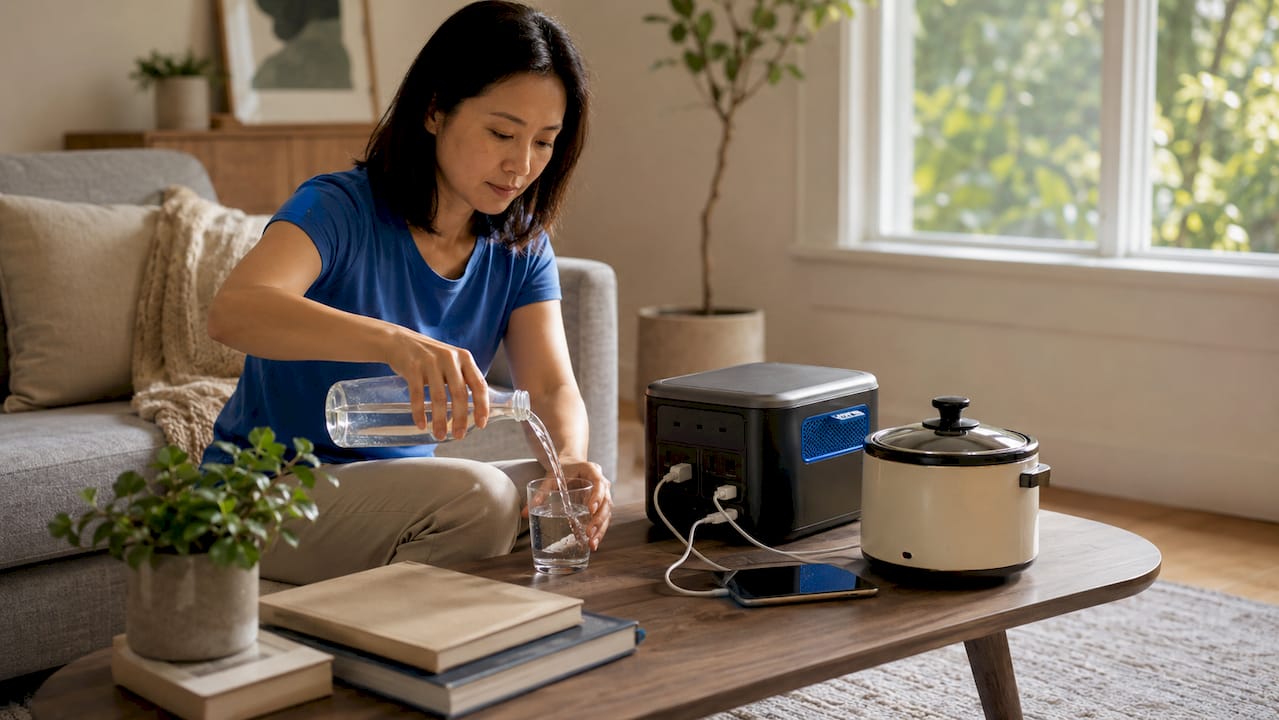
A 1,000W power station powers essentials including laptops, phones, lights, mini-fridges, TVs, and CPAP machines effectively. This capacity tier is where most families find the best balance between portability and real-world usefulness.
Common mid-wattage appliances in the 500W to 1,500W range include:
- Mini-fridges and compact refrigerators (80–150W running, 400–600W surge): The surge requirement is the key variable here, not the running wattage.
- Coffee makers (800–1,200W): A standard drip coffee maker runs for one full brew cycle on a 1,000Wh station with energy to spare.
- Flat-screen TVs (50–150W): A 55-inch LED TV draws roughly 100W, meaning a 1,000Wh battery delivers 8+ hours of viewing.
- CPAP machines (30–60W without heated humidifier): Medical devices like ResMed and Philips Respironics CPAPs run efficiently at this tier.
- Electric skillets and griddles (1,000–1,500W): Practical for campsite cooking when used in short bursts.
Pro Tip: Always check the surge watt rating on any appliance with a motor or compressor. Startup surge wattage often runs 2 to 3 times the running wattage, and a station that cannot meet that spike will trip its overload protection immediately.
3. High-wattage appliances: what 2,000W+ stations unlock
Units rated above 2,000W continuous output handle the appliances most people assume are off-limits for portable power. This tier is where portable power solutions cross from "convenient backup" to genuine home circuit replacement.
High-draw appliances that require 2,000W+ stations include:
- Countertop microwaves (1,000–1,500W running, up to 2,000W surge): A 1,200W microwave needs a station with at least a 2,000W surge rating to start cleanly.
- Full-size refrigerators (150–400W running, 1,200–2,000W surge): The compressor startup is the challenge, not the steady-state draw.
- Portable air conditioners (1,000–1,500W): Window units and portable ACs are feasible on 2,000W+ stations for short cooling cycles.
- Electric space heaters (750–1,500W): These draw consistent wattage with no surge, making them straightforward to run but battery-intensive.
- Power tools (1,200–2,000W): Circular saws and drills have high surge demands, so always verify the station's peak watt rating first.
The inverter's continuous output wattage is the critical limiting factor, not just battery capacity in watt-hours. A large battery paired with a weak inverter cannot start a refrigerator compressor regardless of how much energy is stored.
4. How to calculate how long a power station runs your appliances
Runtime estimation is straightforward once you understand the formula. The standard calculation is: (Battery Wh × 0.85) ÷ Appliance watts = estimated hours of operation. The 0.85 multiplier accounts for inverter efficiency losses that reduce theoretical runtime in real-world conditions.
Here are three practical scenarios using a 1,000Wh station:
- Mini-fridge at 100W running: (1,000 × 0.85) ÷ 100 = 8.5 hours of continuous operation.
- Coffee maker at 1,000W: (1,000 × 0.85) ÷ 1,000 = 0.85 hours (about 51 minutes), enough for several brew cycles.
- Microwave at 1,200W: (1,000 × 0.85) ÷ 1,200 = 0.7 hours (about 42 minutes of actual microwave-on time).
Refrigerators and freezers do not run continuously. They cycle on and off, so real-world runtime for a mini-fridge on a 1,000Wh station is typically 12 to 16 hours. Disabling optional features also extends runtime meaningfully. Turning off a CPAP's heated humidifier can cut power draw from 100W to under 40W, nearly tripling the runtime on the same battery.
Pro Tip: When planning for emergencies, calculate runtime for your single most critical appliance first, then layer in secondary devices. This prevents the common mistake of running a battery flat on low-priority devices before the refrigerator needs power.
5. Why port types and inverter ratings matter for appliance compatibility
The number and types of output ports are essential for efficiently powering multiple or diverse appliances. A station with only two AC outlets creates real friction when you need to run a fridge, charge a laptop, and power a light simultaneously.
The ports that matter most for families include:
- AC outlets (120V): Required for virtually every standard household appliance. Look for at least two to three outlets on any station you plan to use for home backup.
- USB-C PD ports (60–100W): Enable fast charging of laptops, tablets, and newer smartphones without using an AC outlet. This preserves AC capacity for higher-draw devices.
- 12V DC ports (car-style): Useful for CPAP machines, car-style coolers, and 12V lighting systems common in RVs and campers.
- Anderson Powerpole or XT60 ports: Found on higher-end stations, these support direct solar panel connections and DC-to-DC charging.
Surge watt ratings must meet the startup needs of any motor-driven device on your list. A station rated 1,000W continuous but 2,000W surge handles a mini-fridge startup cleanly. One rated 1,000W continuous and 1,200W surge may trip on the same appliance. Always compare the station's surge rating against the appliance's listed startup wattage, not just its running wattage.
Pass-through charging lets portable power stations charge while simultaneously powering appliances, preventing power interruptions during extended use. Not every model offers this feature, so confirm it before purchasing if uninterrupted power is a priority.
6. Battery chemistry and safety features for long-term appliance powering
The battery inside a portable power station determines how long it lasts over years of use, not just hours per charge. LiFePO4 battery chemistry offers 3,000 to 4,000+ cycles compared to the 500 to 800 cycles typical of older ternary lithium batteries. For a family using a station weekly, that difference translates to roughly 10 years of service versus under 2 years.
| Feature | LiFePO4 | Ternary Lithium (NMC) |
|---|---|---|
| Cycle life | 3,000–4,000+ cycles | 500–800 cycles |
| Thermal stability | High (safer at high temps) | Moderate (risk of thermal runaway) |
| Energy density | Moderate | Higher (lighter per Wh) |
| Best use case | Home backup, off-grid, frequent use | Occasional use, weight-sensitive travel |
| Long-term value | Excellent | Lower due to faster degradation |
LiFePO4 is the preferred chemistry for home backup and off-grid scenarios because its thermal stability reduces fire risk. Ternary lithium packs more energy into a lighter package, which matters for backpackers but is less relevant for families keeping a station in the garage or truck bed. Surge protection and automatic overload shutdown are safety features worth confirming on any unit, as they protect both the station and the connected appliances from damage during unexpected power spikes.
7. Comparing portable power station capacity tiers for running appliances
Choosing the right capacity tier prevents both underpowering your needs and overspending on capacity you will never use.
| Capacity tier | Continuous watts | Best for | Typical runtime (mini-fridge) |
|---|---|---|---|
| 300–500Wh | 300–500W | Phones, laptops, fans, lights | 3–5 hours |
| 1,000–1,500Wh | 1,000–1,500W | CPAP, TV, mini-fridge, coffee maker | 10–15 hours |
| 2,000–3,000Wh | 2,000–3,000W | Full-size fridge, microwave, AC unit | 20–30 hours |
| 3,000Wh+ | 3,000W+ | Multiple high-draw appliances, home circuits | 30+ hours |
Recharge times range from 3 to 7 hours depending on input power and battery size, and units with multiple inputs (wall AC, solar, 12V car) offer the most flexibility during extended outages. A solar panel connector kit adds renewable recharging capability, which is particularly valuable when grid power is unavailable for multiple days. For families managing a multi-day outage, a 2,000Wh station with solar input is the most practical combination of capacity and self-sufficiency.
Key takeaways
A portable power station runs the appliances you need most when you match the unit's continuous watt rating and surge capacity to each device's actual power requirements.
| Point | Details |
|---|---|
| Match watts, not just watt-hours | The inverter's continuous watt rating determines which appliances can run, not battery size alone. |
| Surge wattage is non-negotiable | Motor-driven appliances need 2–3x running watts at startup; always verify the station's surge rating. |
| LiFePO4 lasts far longer | LiFePO4 batteries deliver 3,000–4,000+ cycles versus 500–800 for older lithium chemistries. |
| Use the runtime formula | Estimate hours with (Battery Wh × 0.85) ÷ Appliance watts for realistic planning. |
| Port variety prevents bottlenecks | AC outlets, USB-C PD, and 12V DC ports together cover the full range of family appliance needs. |
What I've learned from using portable power stations with real appliances
The mistake I see most often is people buying a station based on battery capacity in watt-hours, then discovering it cannot start their refrigerator because the inverter's surge rating is too low. Watt-hours tell you how long a device can run. The inverter rating tells you whether it can run at all. Those are two completely different questions, and conflating them leads to expensive disappointment.
My honest recommendation for families preparing for emergencies: prioritize a LiFePO4 station in the 1,500 to 2,000Wh range with a 2,000W continuous and 4,000W surge inverter. That combination covers a mini-fridge, CPAP, phone charging, and a few lights simultaneously, which covers the genuine needs of most households through a 24 to 48-hour outage.
Port mix matters more than most buyers realize. A station with four AC outlets, two USB-C PD ports at 100W each, and a 12V DC port handles a family's full device list without anyone unplugging something critical to charge something else. I have seen families in real outage situations make triage decisions about which device gets power because their station only had two outlets. That stress is avoidable with a little planning upfront.
One more thing worth knowing: pass-through charging is not a universal feature. If you plan to keep a station plugged in as a home backup that also powers appliances during normal use, confirm that the model supports it. Some units require you to choose between charging and discharging, which defeats the purpose of a standby backup system.
— Jackson
Power your home appliances with confidence using Toddra
Toddra carries a carefully selected range of portable power stations and solar generators suited for every capacity tier, from compact 300W units for camping to 3,000W+ stations built for home backup and off-grid living. Every unit in the Toddra catalog is chosen for quality, safety, and real-world reliability, with LiFePO4 options available across multiple capacity levels. You can also find Jackery power stations with the port variety and surge ratings your appliances actually need. Toddra's US-based customer support team is ready to help you match the right station to your specific appliance list, so you never have to guess about compatibility.
FAQ
What appliances can a 1,000W portable power station run?
A 1,000W station reliably powers laptops, phones, LED lights, mini-fridges, flat-screen TVs, and CPAP machines. It can also run a coffee maker for a full brew cycle, provided the station's surge rating meets the appliance's startup demand.
How long can a portable power station run a refrigerator?
Using the formula (Battery Wh × 0.85) ÷ Appliance watts, a 1,000Wh station powers a 100W mini-fridge for roughly 8.5 continuous hours. Because refrigerators cycle on and off, real-world runtime is typically 12 to 16 hours on a 1,000Wh battery.
Can a portable power station run a microwave?
Yes, but the station must have a continuous watt rating of at least 1,200W and a surge rating of 2,000W or higher. A 2,000W+ station handles most countertop microwaves without tripping the overload protection.
What is the best battery chemistry for a portable power station?
LiFePO4 is the best choice for home backup and frequent use, offering 3,000 to 4,000+ charge cycles and superior thermal safety compared to ternary lithium batteries. The longer cycle life delivers significantly better long-term value for families relying on the station regularly.
Do portable power stations work with solar panels?
Most mid-range and high-capacity stations include a solar input port, and recharge times via solar depend on panel wattage and available sunlight. Pairing a station with a compatible solar panel connector extends off-grid capability indefinitely during daylight hours.