
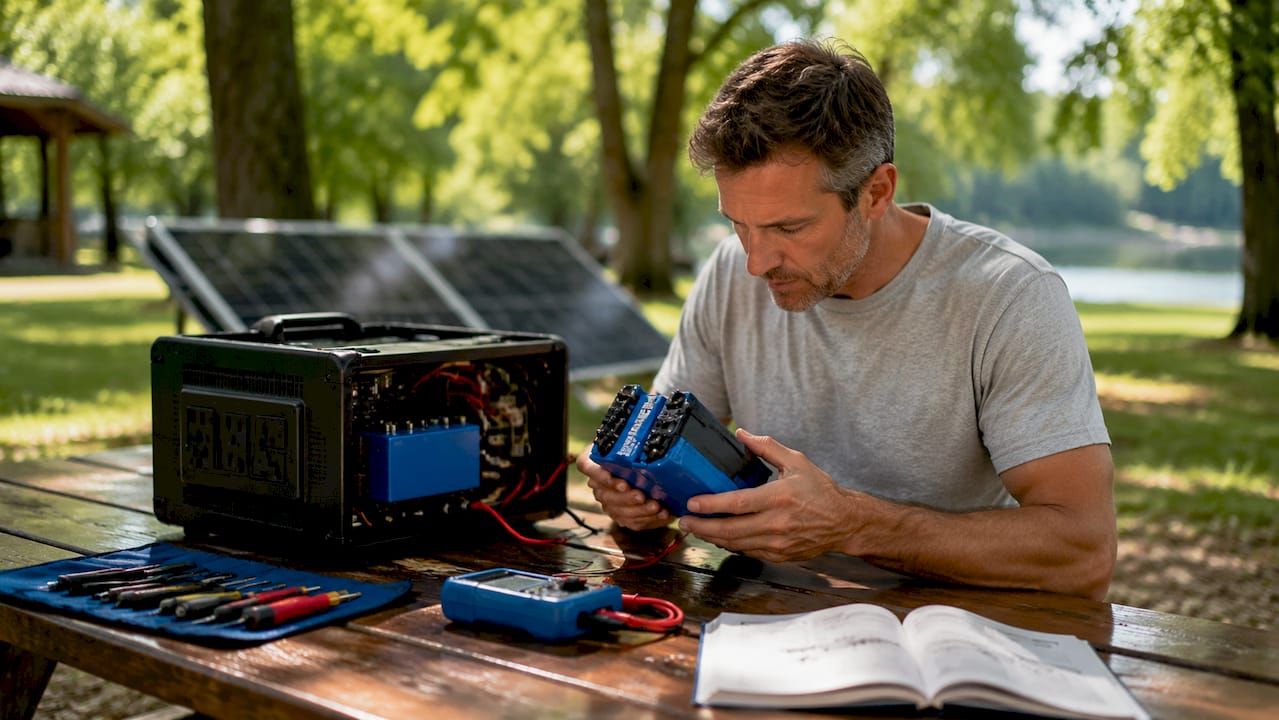
A solar generator is a portable, all-in-one power system that captures sunlight, stores it in a battery, and converts it into usable AC electricity without fuel, exhaust, or combustion. The industry term for the most common configuration is a portable power station paired with solar panels, though "solar generator" has become the widely accepted shorthand. Understanding what a solar generator is and how it works can help you make a confident decision about emergency backup, off-grid adventures, or apartment-safe power. Modern units use LiFePO4 batteries, MPPT charge controllers, and pure sine wave inverters to deliver reliable, clean electricity wherever you need it.
How does a solar generator work?
A solar generator operates through a four-step energy conversion chain. Each component plays a specific role, and understanding the chain helps you size and use your system correctly.
- Solar panels capture sunlight. Photovoltaic cells in the panels convert sunlight into direct current (DC) electricity. Panel wattage determines how fast energy flows into the system.
- The charge controller regulates voltage. This component protects the battery from overcharging and optimizes energy input. MPPT (Maximum Power Point Tracking) controllers improve energy capture by 20–30% compared to older PWM (Pulse Width Modulation) controllers, especially under cloudy or low-angle light conditions.
- The battery stores energy as DC. The battery bank holds power for use when sunlight is unavailable. LiFePO4 (Lithium Iron Phosphate) batteries are the current standard, offering 3,000 to 5,000 charge cycles with no thermal runaway risk.
- The inverter converts DC to AC. The inverter transforms stored DC power into 120V AC electricity that standard appliances and electronics can use. Pure sine wave inverters are critical here. Modified sine wave inverters can damage sensitive electronics like CPAP machines, medical devices, and motors.
The entire process is silent and fuel-free. With enough sunlight, a solar generator can theoretically run indefinitely, recharging during the day and powering devices at night.
Pro Tip: If you live in a region with frequent overcast days, prioritize a system with an MPPT controller and a larger battery capacity. The controller squeezes more power out of weak sunlight, and the bigger battery covers the gaps.
Solar generator vs. traditional generator: key differences
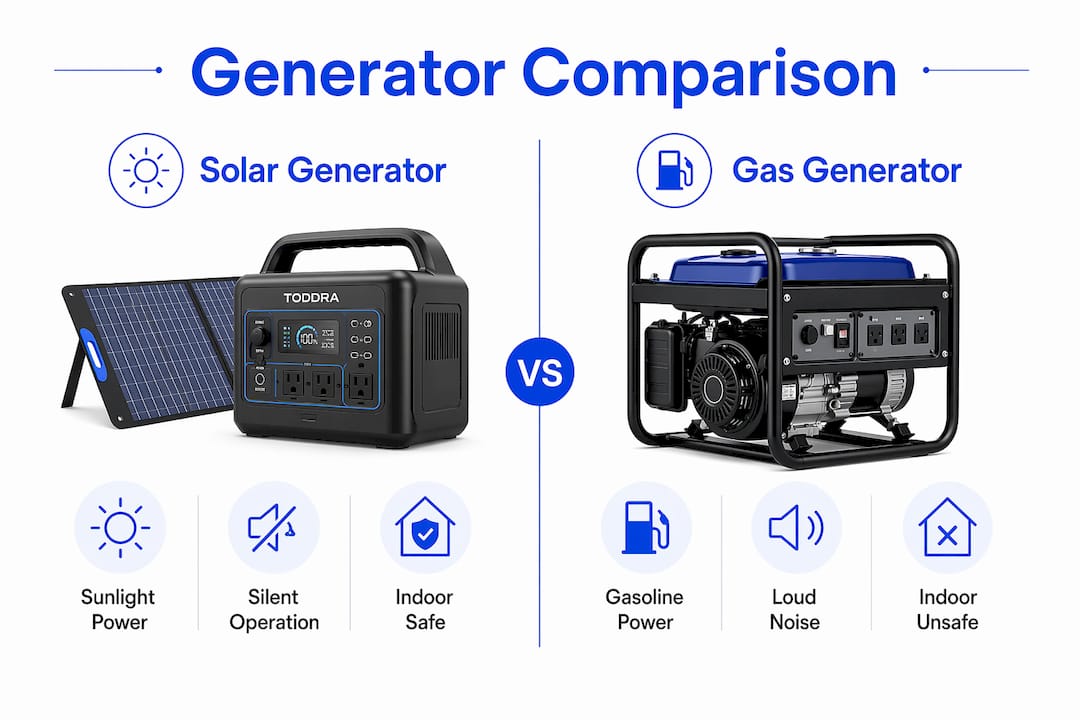
The comparison between a solar generator and a gas-powered generator comes down to safety, convenience, and cost of ownership over time.
- No fuel required. Solar generators recharge from sunlight, wall outlets, or car ports. Gas generators require a constant fuel supply and storage.
- Indoor-safe operation. Solar generators produce no exhaust and carry no carbon monoxide risk. Gas generators must always be used outdoors, making them useless for apartment dwellers or anyone without outdoor access.
- Near-zero maintenance. Since solar generators have no moving parts or combustion, they need only occasional solar panel cleaning. Gas generators require oil changes, fuel stabilizer, spark plug replacements, and regular run-tests.
- Quiet operation. Solar generators run silently. Gas generators typically produce 60–80 decibels of noise, comparable to a lawnmower.
- Limited output for heavy loads. Solar generators are best for critical small loads like phones, laptops, CPAP machines, and small refrigerators. Gas generators can power whole-home systems, well pumps, and electric ranges.
| Feature | Solar Generator | Gas Generator |
|---|---|---|
| Fuel source | Sunlight, wall, car | Gasoline or propane |
| Indoor safe | Yes | No |
| Noise level | Silent | 60–80 decibels |
| Maintenance | Minimal | Regular (oil, fuel, parts) |
| Best use | Critical loads, short outages | Whole-home, extended outages |
| Carbon monoxide risk | None | Yes |
Pro Tip: For apartment living or any indoor emergency scenario, a solar generator is the only safe backup power option. Gas generators kill people indoors every year from carbon monoxide poisoning. A solar generator eliminates that risk entirely.
What are the types of solar generators?
Solar generators vary by battery chemistry, inverter quality, and system configuration. Knowing the differences helps you pick the right setup for your needs.
LiFePO4 vs. older battery chemistries
LiFePO4 batteries are the clear leader in 2026. They deliver 3,000–5,000 charge cycles, compared to 300–500 cycles for older lead-acid batteries and 500–1,000 for standard lithium-ion. LiFePO4 chemistry is also electrochemically stable, meaning no swelling, no thermal runaway, and no fire risk under normal use. This makes them the right choice for home backup and long-term reliability.
Pure sine wave vs. modified sine wave inverters
Pure sine wave inverters produce smooth, clean AC power identical to what comes from your wall outlet. Modified sine wave inverters produce a stepped approximation that can cause audible buzzing, overheating, or outright damage in sensitive devices. Medical equipment, variable-speed motors, and modern electronics all require pure sine wave output. Any solar generator you consider for serious use should include a pure sine wave inverter as a standard feature.
Portable power stations with solar panels
The most common solar generator configuration today pairs a portable power station with compatible solar panels. Units like the Jackery Explorer 2000 Plus combine a 2,042Wh LiFePO4 battery with a 3,000W pure sine wave inverter in a single portable unit. You connect solar panels via standardized connectors, and the system manages charging automatically.
Expandable battery systems
Some systems allow you to add expansion battery packs to increase total storage capacity without replacing the core unit. This modular approach lets you start with a base system and grow it as your power needs increase. It is a practical way to manage upfront cost while keeping future flexibility.
| Configuration | Best For | Key Advantage |
|---|---|---|
| Compact portable station | Camping, travel, small loads | Lightweight and easy to carry |
| Mid-size station + panels | Emergency backup, RVs | Balanced capacity and portability |
| High-capacity + expansion packs | Extended outages, off-grid cabins | Scalable storage |
Who should use a solar generator and for what?
Solar generators work best when matched to the right situation. Buying one without understanding your actual power needs leads to disappointment.
Where solar generators genuinely shine:
- Emergency backup for essentials. A mid-size solar generator handles CPAP machines, smartphones, tablets, LED lighting, and a small refrigerator through a short outage. These are the loads that matter most when the grid goes down.
- Camping and overlanding. Portable units recharge from roof-mounted or ground-deployed solar panels, giving you clean power at a campsite without a noisy generator disturbing the area.
- RV and van life. Solar generators integrate cleanly into RV electrical systems, powering lights, fans, and small appliances without propane or shore power.
- Apartment and urban living. Solar generators are the only viable indoor-safe backup for people without outdoor space. No exhaust, no noise, no fire hazard.
Where solar generators fall short:
Solar generators are not designed to power central air conditioning, electric water heaters, electric ranges, or whole-home heating systems. These appliances draw thousands of watts continuously, draining even large battery packs within hours. If whole-home backup is your goal, a solar generator supplements rather than replaces a whole-home standby system.
Sizing your system correctly:
Add up the wattage of every device you plan to power simultaneously. Multiply by the number of hours you need to run them. That gives you your minimum battery capacity in watt-hours. Then factor in your solar panel input to estimate daily recharge. A 200W solar panel in full sun produces roughly 800–1,000Wh per day, depending on your location and season.
Pro Tip: Always size your battery 20–30% larger than your calculated minimum. Real-world conditions like partial shade, temperature extremes, and battery aging reduce effective capacity. That buffer keeps you covered when conditions are not ideal.
Maintenance for solar generators is genuinely minimal. Wipe down solar panels monthly to remove dust and debris. Check cable connections twice a year. Store the battery at 50–80% charge if you are not using the unit for extended periods. That is the full maintenance list for most LiFePO4-based systems.
Key takeaways
A solar generator is the most practical indoor-safe backup power option available, combining LiFePO4 battery storage, MPPT charge control, and pure sine wave inverter technology into a portable, fuel-free system.
| Point | Details |
|---|---|
| Core definition | A solar generator captures sunlight, stores it in a battery, and delivers AC power without fuel or exhaust. |
| Best battery chemistry | LiFePO4 batteries offer 3,000–5,000 cycles and eliminate thermal runaway risk. |
| Inverter quality matters | Always choose pure sine wave inverters to protect sensitive electronics and medical devices. |
| Right-size your system | Calculate your watt-hour needs and add 20–30% buffer for real-world conditions. |
| Indoor safety advantage | Solar generators are the only backup power option safe for apartment and indoor use. |
Why i think most people buy the wrong solar generator
I have spent years watching people make the same mistake: they buy a solar generator based on price alone, then feel let down when it cannot power their refrigerator through a two-day outage. The disappointment is not the technology's fault. It is a sizing and expectation problem.
The most common misconception I encounter is that any solar generator can replace a gas generator for whole-home backup. It cannot, and it was never designed to. A solar generator is a precision tool for critical loads, not a brute-force power source. Once you accept that framing, the technology becomes genuinely impressive.
What I always tell people: prioritize the inverter and the battery chemistry before you look at price. A cheap modified sine wave inverter will damage your CPAP machine or your laptop charger. A lead-acid battery will give you 300 cycles before it degrades noticeably. Neither is a good deal at any price. LiFePO4 and pure sine wave output are non-negotiable for serious use.
The other thing most buyers underestimate is solar input. A 100W panel sounds like a lot until you realize it produces maybe 400Wh on a good day. Pair that with a 2,000Wh battery and a two-day outage, and you are doing math you did not plan for. Size your panels generously, and use a system with an MPPT controller to get every watt available.
Solar generators have earned their place as a genuinely reliable backup and off-grid power source. The technology in 2026 is mature, safe, and dependable. You just need to match the right system to your actual needs, and then trust it.
— Jackson
Find your solar generator at Toddra
Ready to put clean, quiet backup power in your hands? Toddra carries a carefully selected range of portable power stations and solar generators built around LiFePO4 battery technology and pure sine wave inverters.
The Jackery Explorer 2000 Plus delivers 2,042Wh of storage and 3,000W of output, making it one of the most capable portable units available for home backup and off-grid use. You can also browse the full Jackery power station collection to compare capacities and find the right fit for your needs. Toddra offers US-based customer support, secure checkout, and product options that grow with you as your power needs change. Shop confidently knowing every product is backed by a team that genuinely cares about your experience.
FAQ
What is a solar generator used for?
A solar generator powers critical devices like CPAP machines, smartphones, laptops, and small refrigerators during outages, camping trips, or off-grid situations. It is especially useful for apartment dwellers who cannot safely use gas generators indoors.
How long does a solar generator last on a full charge?
Runtime depends on battery capacity and the wattage of connected devices. A 2,000Wh battery running a 50W CPAP machine will last roughly 40 hours, while a 400W refrigerator would drain it in about 5 hours.
Are solar generators worth it for home backup?
Solar generators are worth it for powering essential devices during short outages without fuel costs or maintenance. They are not the right choice for whole-home backup involving high-wattage appliances like central air conditioning or electric ranges.
What battery type is best in a solar generator?
LiFePO4 (Lithium Iron Phosphate) is the best battery chemistry for solar generators in 2026. It delivers 3,000–5,000 charge cycles, operates safely without thermal runaway risk, and maintains performance across a wide temperature range.
Can a solar generator charge indoors?
Yes. Solar generators can recharge from a standard wall outlet or a car's 12V port in addition to solar panels. Unlike gas generators, they produce no exhaust and are completely safe to use and charge indoors.