
TL;DR:
- Reliable brands like Anker, EcoFlow, and Bluetti offer better build quality and long-term support than Aferiy. Aferiy’s affordable LiFePO4 units have limited app features, slower charging, and unproven support. The best options depend on surge needs, battery chemistry, and US-based customer service for long-term reliability.
If you're researching aferiy.com alternatives, the short answer is this: Anker (SOLIX series), EcoFlow (DELTA series), and Bluetti lead the field for reliability and long-term support, while Pecron and OUPES offer trustworthy budget options. Here's a quick orientation before we go deeper:
- Anker SOLIX series — premium build quality, polished app, strong US customer support
- EcoFlow DELTA series — fast charging, large capacity, extensive accessory ecosystem
- Bluetti — LiFePO4 cells with high cycle life, excellent expansion options
- Jackery — widely available, user-friendly, well-established support channels
- Pecron — dependable budget pick with solid warranty terms
- OUPES — cost-effective backup power with good performance per dollar
- AFERIY P210 — the baseline: decent specs, but limited app polish and slower charging
These brands consistently appear in expert reviews from sources like The Solar Lab and Portable Power Geek as safer long-term investments than Aferiy for most US consumers.
What does Aferiy actually offer, and where does it fall short?
Aferiy launched in 2020 and has built a lineup centered on competitive pricing and LiFePO4 battery chemistry. Its main models in the US market include the P210, P280, and P310, with capacities and outputs designed for typical portable power needs. Each unit supports solar input and carries a mix of AC, USB-A, USB-C, and DC ports.
The appeal is real. Aferiy packs LiFePO4 cells into units priced well below comparable Bluetti or EcoFlow models, and the P280 even supports expansion up to 10 kWh with a 7-year warranty claim. For camping, van life, or occasional home backup, the specs look attractive on paper.
The trade-offs show up in practice, though.
that Aferiy units lag behind established brands in app connectivity, output voltage consistency under load, and warranty handling. The P010 has no app at all, while the 700 Wh Bluetti AC50B and 1,000 Wh EcoFlow River 2 Max both include one. Charging speed is another recurring complaint: Aferiy units tend to charge more slowly than similarly priced competitors.Key Aferiy features at a glance:
- Battery chemistry: LiFePO4 across most models
- Surge capacity: High on paper, but output can drop under heavy loads
- App/software: Available on P210 and P280, but reviewers flag limited polish
- Solar input: Supported across the lineup
- Warranty: Up to 7 years claimed, though real-world fulfillment is unproven for a young brand
- Charging speed: Slower than EcoFlow and Anker equivalents
For buyers on a tight budget who need basic backup power and don't rely on app control, Aferiy delivers reasonable value. For anyone who needs fast recharging, a refined software experience, or confidence in post-purchase support, the alternatives below are worth the extra investment.
How do the top Aferiy alternatives compare on features?
The brands most frequently recommended as alternatives to Aferiy share a common thread: better build quality, more polished apps, and stronger long-term support than newer discount brands. The table below maps each option across the dimensions that matter most for US buyers.

| Brand / Model | Energy Output & Surge | Capacity (Wh) | Expansion Options | App / Ecosystem | Build & Durability | Support & Warranty | Best For |
|---|---|---|---|---|---|---|---|
| Anker SOLIX series | High output, strong surge | 1,000–2,000+ | Modular add-ons | Polished, full-featured | Premium materials | US-based, responsive | Tech-forward reliability |
| EcoFlow DELTA series | Very high, fast AC | — | Extensive ecosystem | Best-in-class app | Excellent | Large US network | Off-grid and fast recharge |
| Bluetti | High, stable | 1,000+ | Wide range of batteries | Good, improving | Premium LiFePO4 | Solid warranty | Battery longevity |
| Jackery | Mid to high | — | Explorer series add-ons | User-friendly | Reliable | Wide retail support | Everyday consumers |
| Pecron | Mid-range | — | Limited | Basic | Solid | Good for price tier | Budget buyers |
| OUPES | Mid-range | — | Some expansion | Basic | Decent | Adequate | Value-focused backup |
| AFERIY P210 | High surge on paper | — | Expansion battery available | Limited polish | Solid but unrefined | Unproven long-term | Cost-limited buyers |
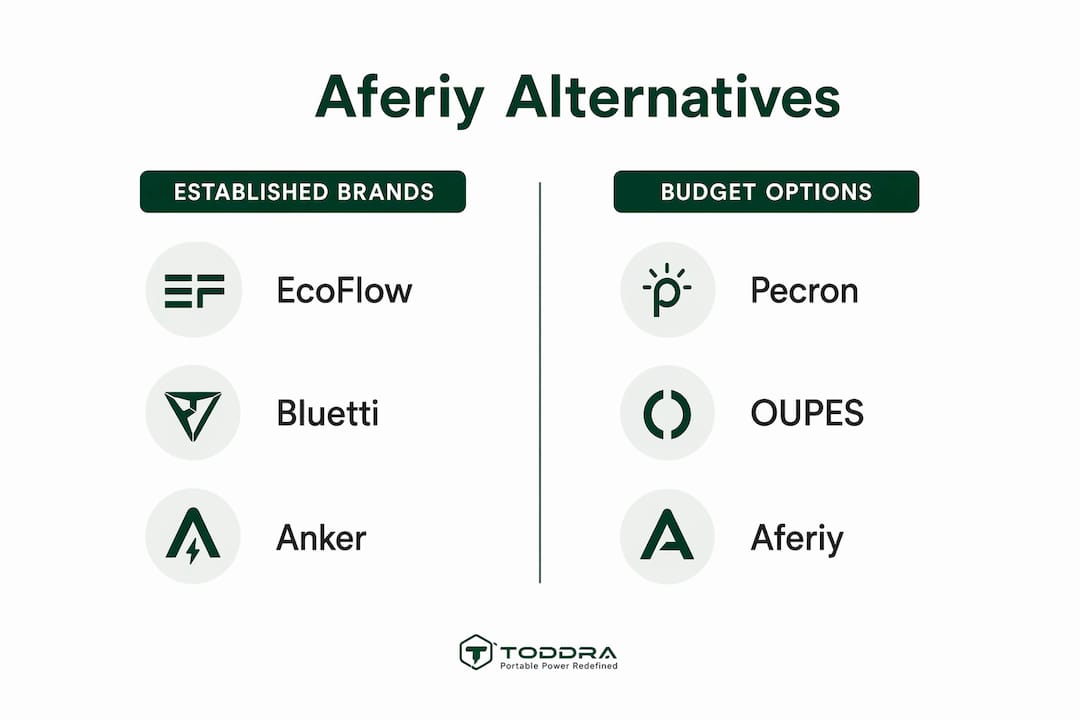
A few things stand out when you look at this side by side. EcoFlow's DELTA series leads on charging speed and ecosystem depth. Bluetti's LiFePO4 cells deliver some of the highest cycle counts in the category, which matters if you plan to use your unit daily for years. Anker's SOLIX lineup earns its premium price through a genuinely polished app and US-based customer service that Trustpilot reviews consistently highlight as responsive.
Standout advantages by brand:
- EcoFlow DELTA: Fastest AC recharge times in the category; app supports scheduling, remote monitoring, and firmware updates
- Bluetti: Highest cycle life ratings among LiFePO4 competitors; strong expansion battery compatibility
- Anker SOLIX: Surge capacity meets real-world device demands reliably; app ecosystem rivals EcoFlow
- Jackery: Widest US retail footprint; easiest setup for first-time buyers
- Pecron: The E1500 LFP is a trusted discount pick recommended by The Solar Lab over the Aferiy P210
- OUPES: The Mega 2 Power Station offers better tested reliability than the P210 at a comparable price point
Pricing varies considerably. EcoFlow and Anker SOLIX units sit at the higher end, while Pecron and OUPES compete directly with Aferiy on price. Jackery occupies the middle ground and benefits from frequent sales at major US retailers including Amazon, Costco, and Best Buy.
How to choose the best portable power station for your needs
The right alternative depends almost entirely on what you're actually powering and how often. Start there, not with brand names.
Surge capacity comes first. Every motor-driven device, from a refrigerator to a power tool, draws two to three times its running wattage at startup. Ignoring surge ratings leads to undersized purchases that can't handle device demands reliably. List every device you plan to run, note its running and startup wattage, and choose a unit whose surge rating clears the highest startup load with room to spare.
Battery chemistry shapes long-term value. LiFePO4 cells, used by Bluetti, EcoFlow, Anker SOLIX, and Aferiy, offer far more charge cycles than older lithium-ion chemistries. Premium LiFePO4 cells in established brands lead to better battery longevity compared to budget alternatives that may use lower-grade cells despite similar marketing language. If you're buying for home backup or frequent off-grid use, cycle count matters as much as capacity.
Charging speed affects real-world usability. A 2,000 Wh unit that takes 12 hours to recharge from the wall is a liability during a power outage. EcoFlow's X-Stream technology and Anker's SOLIX fast-charge systems cut recharge times dramatically. For solar charging, verify the maximum solar input wattage and whether the unit accepts multiple panels simultaneously.
Customer service is not a secondary concern. Brands with real, reachable US-based service outperform smaller manufacturers when something goes wrong. Warranty claims, firmware issues, and replacement parts all require a responsive support team. Aferiy's warranty terms look generous on paper, but the brand is young and its fulfillment track record is limited.
Essential buying criteria:
- Surge capacity exceeds your highest startup load
- LiFePO4 chemistry confirmed, not just advertised
- Total watt-hour capacity sized for your actual runtime needs
- Solar input wattage matches your panel setup
- App or display provides real-time monitoring
- Warranty terms are clearly documented and the brand has a US support contact
Pro Tip: Add up the running wattage of every device you plan to power simultaneously, then multiply the highest single device's running wattage by 2.5 to estimate its startup surge. Your power station's surge rating must exceed that number, not just its continuous output rating.
For home backup specifically, the backup power station home circuit guide covers how to size a unit for whole-home versus circuit-level use, which changes the math considerably.
What do real users say about Aferiy and its alternatives?
User sentiment on Aferiy is genuinely mixed, and the pattern is consistent across Reddit threads and review platforms. Buyers who use the P210 or P280 for simple tasks like camping or occasional device charging tend to be satisfied with the value. The complaints cluster around a few specific areas.
App reliability comes up repeatedly. Users report that Aferiy's app loses connection, provides inconsistent readings, and lacks the feature depth of EcoFlow's or Anker's equivalents. Output voltage under heavy load is another friction point: the P280 has been documented capping output by dropping voltage rather than maintaining stable power delivery, which can affect sensitive electronics.
Contrast that with the feedback on EcoFlow and Anker. Both brands receive consistent praise for build quality and, critically, for customer service that actually responds. Trustpilot reviews in the portable power category reveal frequent communication issues with lesser-known brands, and Aferiy appears in that pattern more than its established competitors.
Budget alternatives like Pecron and OUPES occupy an interesting middle ground. The Solar Lab's hands-on testing found both brands outperformed the Aferiy P210 on reliability and consistency, despite similar price points. That's a meaningful finding for buyers who want to save money without accepting Aferiy's specific trade-offs.
Common user feedback patterns:
- Aferiy positives: Competitive price, LiFePO4 chemistry, decent port selection
- Aferiy negatives: App instability, slow charging, voltage inconsistency under load, unproven warranty support
- EcoFlow and Anker: Praised for fast charging, app quality, and responsive after-sales service
- Pecron and OUPES: Trusted by reviewers as more reliable than Aferiy at comparable prices
- Jackery: Consistently rated well for ease of use and retail accessibility
Statistic callout: Trustpilot data from the portable power category shows that communication failures with lesser-known brands are a frequent driver of negative reviews, with buyers citing delayed responses and unresolved warranty claims as their primary frustrations.
Long-term ownership experience shapes brand reputation more than any spec sheet. Buyers who need a power station for emergency preparedness or frequent off-grid use consistently migrate toward EcoFlow, Anker, or Bluetti after one or two budget purchases that didn't hold up. For those exploring portable vs stationary emergency power options, that pattern is worth factoring in early.
Toddra carries the alternatives worth buying
If you've read this far, you know which brands deliver on their promises and which ones leave you waiting on hold. Toddra brings those carefully selected brands together in one place, with US-based customer support and a secure checkout process designed around your peace of mind.
Rather than navigating multiple brand sites and hoping for consistent service, Toddra gives you access to trusted portable power solutions, including high-capacity options like the Jackery Battery Pack 5000 Plus, all backed by the same responsive support team. Whether you're preparing for a power outage, planning an off-grid trip, or building out a solar backup setup, Toddra's product range covers the full spectrum of reliable, LiFePO4-based power solutions. Shop with confidence knowing that quality and support come together in one trusted place.
Key Takeaways
The strongest alternatives to Aferiy are established brands with verified US support, LiFePO4 chemistry, and fast-charging capability that Aferiy's lineup currently can't match.
| Point | Details |
|---|---|
| Surge capacity is the first filter | Your power station's surge rating must exceed your highest device startup load, not just its running wattage. |
| LiFePO4 quality varies by brand | Premium cells in Bluetti, EcoFlow, and Anker deliver better cycle life than budget alternatives using similar marketing language. |
| App and support matter long-term | Brands with reachable US-based service outperform smaller manufacturers when warranty claims or firmware issues arise. |
| Pecron and OUPES beat the Aferiy P210 | The Solar Lab's testing found both budget brands more reliable than the P210 at comparable price points. |
| Toddra stocks top alternatives | Toddra offers carefully selected portable power brands, including Jackery, with US-based support and secure checkout. |