TL;DR:
- Choosing between portable and stationary emergency power depends on household needs, fuel management, and outage duration.
- Stationary generators start automatically and are suitable for extended, whole-home backup, while portable units require manual setup and handling gasoline safely outside.
- A hybrid approach combining both systems offers comprehensive coverage for critical appliances and sensitive electronics during outages.
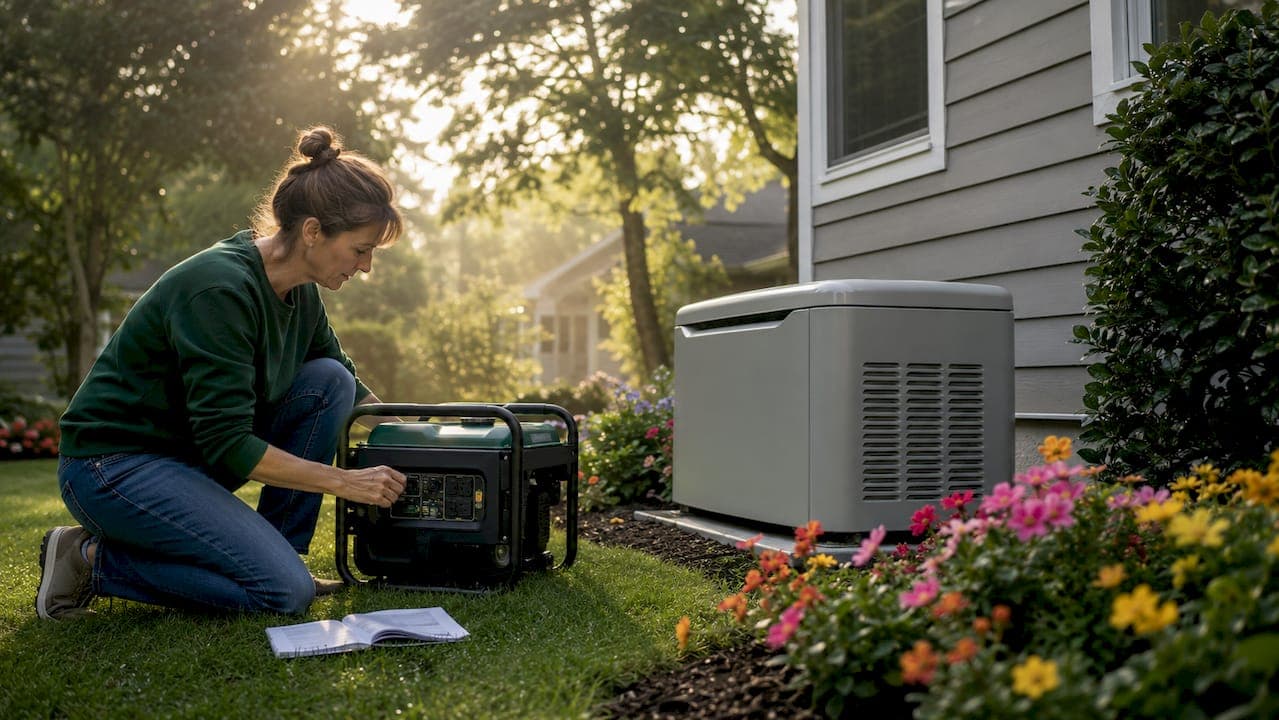
Choosing between portable and stationary emergency power is one of the most consequential decisions you can make for home preparedness. Portable generators are mobile, manually operated units that run on gasoline or propane and handle short-term outages. Stationary standby generators are fixed, automated systems connected to natural gas or propane lines that restore whole-home power within seconds. A third category, portable power stations, uses battery technology like LiFePO4 to deliver silent, emission-free backup indoors. Understanding why portable vs stationary emergency power matters comes down to three factors: how much power you need, how hands-on you want to be, and how long your outages typically last.
Why portable vs stationary emergency power: how each system works
The most important operational difference between these systems is automation. Stationary generators start automatically within 10–15 seconds of detecting an outage, with no human intervention required. A transfer switch handles the switchover, so your refrigerator, HVAC, and sump pump keep running even while you sleep.
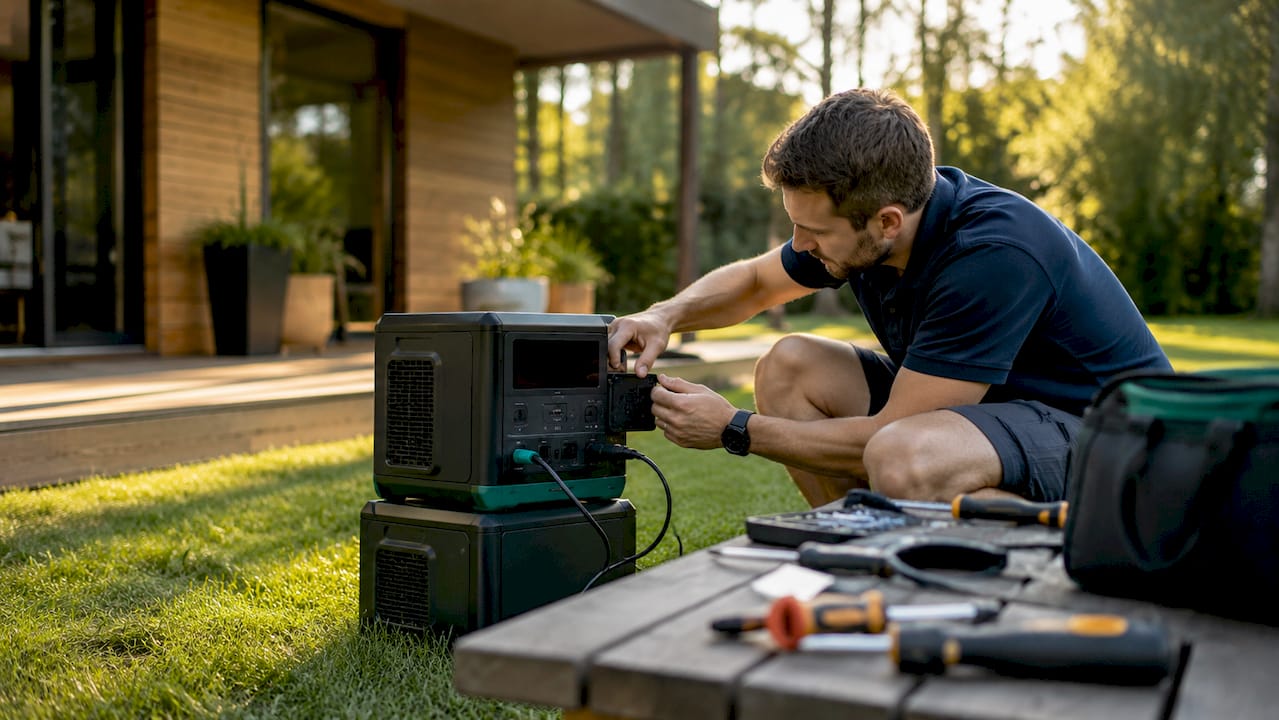
Portable generators work the opposite way. You pull them out of storage, carry them outside, add fuel, and connect your appliances manually. That process takes time, and it carries a serious safety risk.
- Portable generators must be placed 15–20 feet from your home to prevent deadly carbon monoxide poisoning. CO is colorless and odorless, and it builds up fast in enclosed spaces.
- Stationary standby generators have fixed, professionally installed exhaust systems that direct fumes away from living areas, significantly reducing CO risk.
- Portable power stations produce zero emissions and operate silently, making them fully safe for indoor use. They carry no CO risk at all.
Pro Tip: Install a battery-operated CO detector on every floor of your home if you use any fuel-burning generator, portable or stationary. CO poisoning can occur even when a generator is placed outdoors if wind conditions push fumes toward windows or vents.
The safety gap between these systems is real. Portable generators demand careful outdoor placement every single time you use them, regardless of weather. Stationary units remove that variable entirely.
What power capacity differences should you expect?
Power capacity is where the three emergency power categories separate most clearly. Stationary standby generators are sized for whole-home use. They handle high-startup surge loads like central air conditioning, electric water heaters, and sump pumps without hesitation. Stationary generators handle high-surge appliances far more reliably than portable units, which need to be sized with 20–30% additional capacity above the surge load to avoid tripping the inverter protection. That means a portable generator rated at 5,000 watts may not reliably start a 3-ton central AC unit.
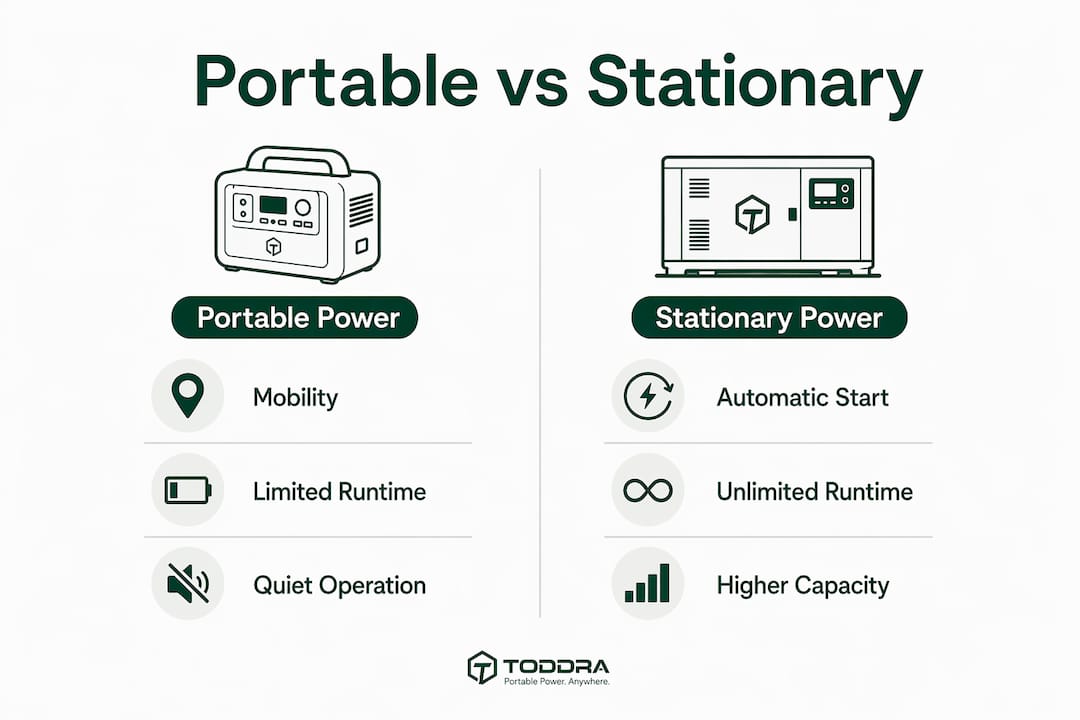
Portable power stations sit at the other end of the spectrum. They excel at powering sensitive electronics like laptops, phones, CPAP machines, and LED lighting. They struggle with high-surge motor loads. Understanding what appliances a power station can run before an emergency prevents unpleasant surprises.
| Power system | Best for | Surge load handling | Fuel source | Outage duration |
|---|---|---|---|---|
| Stationary standby generator | Whole-home backup | Excellent | Natural gas or propane | Extended, days to weeks |
| Portable gasoline generator | Essential circuits | Moderate, needs oversizing | Gasoline or propane | Short to medium, limited by fuel |
| Portable power station | Electronics and small appliances | Limited | Solar or grid charging | Short to medium, limited by battery |
Stationary generators connect to natural gas lines for continuous fuel supply, which means they can run for days or weeks during extended outages without any refueling. That is a meaningful advantage during major weather events or grid failures that last longer than a few hours. Portable generators depend entirely on your stored fuel supply, and carrying extra gasoline during a disaster is both inconvenient and hazardous.
How does maintenance and user involvement differ?
Stationary standby generators require professional installation and scheduled maintenance, typically an annual service that includes oil changes, filter replacements, and load testing. The tradeoff is that they operate completely hands-free during an actual outage. You do nothing. The system handles everything.
Portable generators demand more from you on every level:
- Transport and setup. You physically move the unit outdoors before each use, which is genuinely difficult in rain, snow, or ice. Mandatory outdoor placement during bad weather is one of the most underappreciated drawbacks of portable generators.
- Fueling. You store and manage gasoline, which degrades over time. Fuel stabilizer extends shelf life, but stale fuel causes starting problems at the worst possible moment.
- Runtime monitoring. Portable generators need refueling every 8–12 hours depending on load, which means waking up in the middle of the night during a storm.
- Seasonal maintenance. Carburetors clog, spark plugs wear, and oil needs changing. Skipping maintenance leads to a generator that won't start when you need it most.
Portable power stations have minimal mechanical maintenance, but they are not truly "set and forget." Battery health requires periodic charging every 3–6 months when the unit sits in storage. Neglecting this leads to battery degradation and inaccurate charge readings during an actual emergency. Proper power station storage practices protect your investment and keep the unit ready when you need it.
Pro Tip: Set a calendar reminder every three months to top off your portable power station's charge. A battery stored at 20% for six months will lose capacity faster than one kept at 50–80%.
How do cost, portability, and environmental factors compare?
Cost is the first thing most people look at, and the gap between portable and stationary systems is significant. Entry-level portable generators start at a few hundred dollars. Stationary standby generators, including professional installation and transfer switch, typically cost several thousand dollars. Portable power stations fall in a wide range depending on capacity.
The financial picture shifts when you factor in long-term costs:
- Portable generators burn gasoline, which adds up quickly during extended outages and requires safe storage.
- Stationary generators on natural gas eliminate fuel storage concerns and run at a predictable cost per hour.
- Portable power stations charged by solar panels have near-zero operating costs once purchased. Solar compatibility is a genuine long-term advantage for home battery backup ROI.
Noise is a real quality-of-life factor that rarely gets enough attention. Portable gasoline generators produce 65–75 decibels of noise at typical operating distance. That is roughly as loud as a vacuum cleaner running continuously. Stationary generators are quieter but still audible. Portable power stations are completely silent.
Emissions matter beyond just safety. Gasoline generators produce carbon dioxide, nitrogen oxides, and particulate matter. For families with asthma, young children, or elderly members, this is a meaningful health consideration. Portable power stations produce zero emissions at the point of use, which is why they are the preferred choice for indoor emergency power in health-sensitive households.
What hybrid approaches give you the best emergency coverage?
The most prepared households do not choose between portable and stationary power. They use both in complementary roles. Hybrid emergency power setups combining stationary generators for whole-home needs and portable power stations for critical electronics provide coverage that neither system delivers alone.
A stationary generator keeps your HVAC, refrigerator, and sump pump running. A portable power station keeps your laptops, phones, and medical devices charged safely indoors without fuel or fumes. Together, they cover every scenario a single system cannot.
The practical integration works like this. Your stationary generator handles the heavy loads automatically. Your portable power station, ideally solar-charged, handles sensitive electronics and serves as a backup if the generator needs maintenance or runs out of fuel. This approach also gives you a mobile power source for outdoor use, camping, or helping neighbors during a community-wide outage.
Cost effectiveness improves with this approach too. You do not need to oversize your stationary generator to cover every small device. A mid-capacity standby unit paired with a quality portable power station often costs less than a large whole-home generator sized to cover everything.
Key takeaways
The best emergency power setup matches your specific outage history, household load requirements, and willingness to manage fuel and maintenance.
| Point | Details |
|---|---|
| Automation favors stationary units | Standby generators restore power in 10–15 seconds with no manual steps required. |
| Safety rules favor power stations indoors | Portable power stations produce zero emissions and carry no CO risk for indoor use. |
| Surge loads favor stationary generators | High-startup appliances like HVAC and sump pumps run most reliably on stationary units. |
| Maintenance effort varies widely | Portable generators need the most hands-on care; power stations need periodic charging only. |
| Hybrid setups cover the most ground | Pairing a stationary generator with a portable power station handles both heavy loads and sensitive electronics. |
What I've learned from watching people choose the wrong system
Most people underestimate two things when choosing emergency power: how bad the weather will be when they actually need it, and how much they hate dealing with gasoline. I've seen homeowners buy portable generators with the best intentions, then discover during their first real outage that dragging a 200-pound unit outside in a January ice storm at 2 a.m. is not something they will do twice.
The CO risk with portable generators is also more serious than most buyers realize. The 15–20 foot placement rule sounds simple until you factor in wind direction, nearby windows, and the fact that most people are stressed and sleep-deprived during an actual emergency. Stationary units remove that variable entirely, and that peace of mind has real value.
What surprises me most is how often people overlook portable power stations as a serious part of their emergency plan. They are not a replacement for a whole-home generator. But for the majority of what most households actually need during a 24–48 hour outage, a quality LiFePO4 power station handles it quietly, safely, and without any fuel management. The safety advantages over gas generators are significant and often underweighted in buying decisions.
My honest recommendation: if you own a home and live in an area with regular outages lasting more than 24 hours, invest in a stationary generator. If your outages are shorter or you want flexible power for both home and outdoor use, a high-capacity portable power station is the smarter starting point. And if you want genuine peace of mind, build a hybrid setup over time.
— Jackson
Reliable emergency power from Toddra
Toddra carries a carefully selected range of portable power stations and solar generators built for exactly the scenarios covered here: quiet, emission-free backup for your home, reliable power for sensitive electronics, and flexible energy for outdoor use.
The Jackery Solar Generator 2000 Plus delivers 2,042Wh of LiFePO4 capacity with 3,000W output, solar compatibility, and zero emissions. It handles refrigerators, CPAP machines, and electronics without noise or fumes. For those building a more complete setup, Toddra's full solar generator collection includes options at multiple capacity levels to match your household's actual needs. Every product ships with US-based customer support and secure checkout.
FAQ
What is the main difference between portable and stationary generators?
Stationary standby generators start automatically within 10–15 seconds and connect to a permanent fuel supply. Portable generators require manual setup, outdoor placement, and fueling each time you use them.
Are portable power stations safe to use indoors during an outage?
Yes. Portable power stations produce zero emissions and operate silently, making them completely safe for indoor use. Gasoline and propane generators must always be used outdoors at least 15–20 feet from your home.
How long can a stationary generator run during an extended outage?
Stationary generators connected to natural gas lines can run continuously for days or weeks without refueling. Runtime is limited only by scheduled maintenance intervals, not fuel storage.
Do portable power stations need maintenance?
Portable power stations need periodic charging every 3–6 months during storage to protect battery health. Neglecting this leads to capacity loss and inaccurate charge readings when you need the unit most.
Can a portable power station replace a whole-home generator?
A portable power station handles electronics, lighting, and small appliances well but cannot replace a whole-home generator for high-surge loads like central AC or electric water heaters. A hybrid setup using both systems provides the most complete coverage.