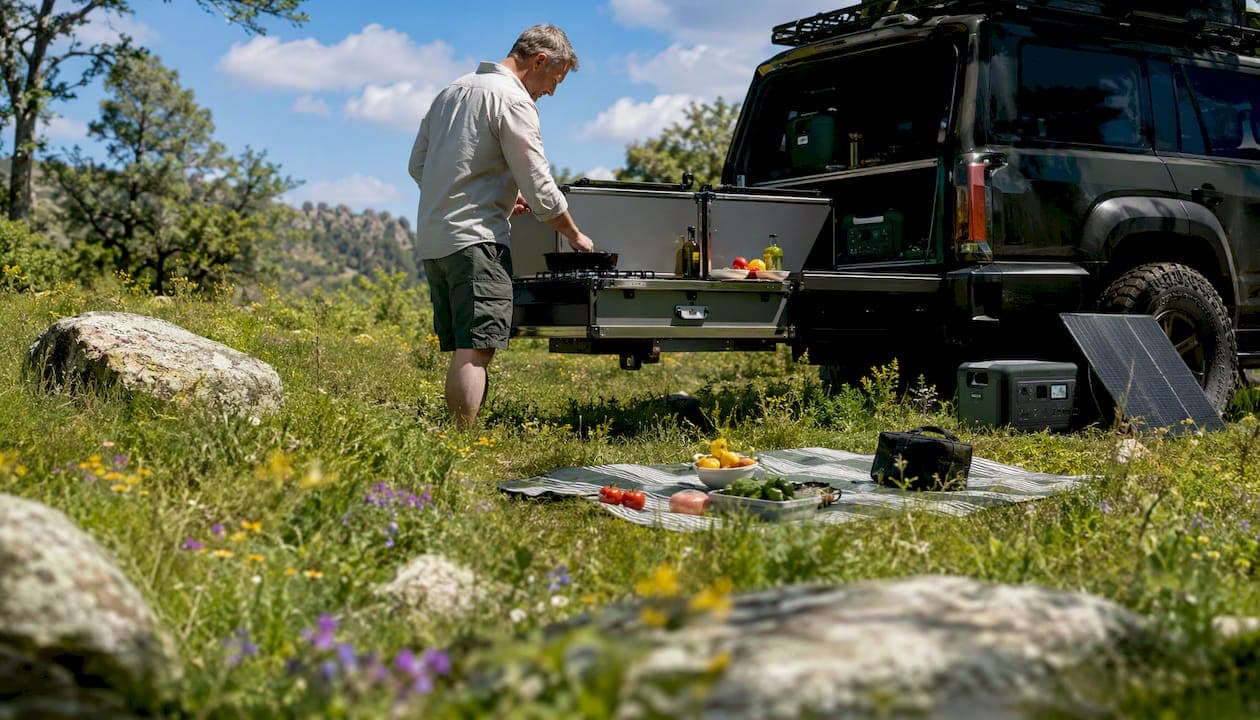
For weekend car camping, a chuck-box style all-in-one unit sets up in seconds and keeps everything organized in one case. For multi-day overland trips, a freestanding module with dual burners and running water is worth the extra weight. Vanlife and rig-build setups call for a vehicle-mounted kitchen with integrated plumbing. Minimalist car campers do well with a folding prep table paired with a compact stove.
Here are the top picks by trip type:
- Toddra-powered electric camp kitchen (Toddra power station + compact cook station): best for campers who want a fridge, coffee maker, and USB faucet running reliably all weekend. A suitable mid-capacity station covers coffee, a fridge, and one or two hot meals without solar. KickAss power stations can provide comparable power levels.
- All-in-one chuck-box (Yoke Outdoors Chuck Box, VOZ Camp Kitchen style): $150–$400. Best for car campers who want fast setup and organized storage in one case.
- Freestanding overland module (HitchFire Camp Kitchen style): $400–$900+. Best for overlanders who need dual burners, running water, and a broad prep surface at camp.
- Folding cook station (GCI Outdoors Slim-Fold, Camco Deluxe Grill Table style): $40–$120. Best for budget-conscious campers or tailgaters who cook simple meals.
All-in-one systems convert from storage to cooking in seconds, though real-world time depends on whether you need to connect fuel lines or a water tank.
Table of Contents
- How do the main portable camp kitchen types compare?
- How to choose the right outdoor cooking station for your trips
- What leading camp kitchen models actually include
- What to expect for size, weight, and setup time
- Powering integrated accessories: what you need to know
- Key Takeaways
- The case for thinking about your kitchen in two separate systems
- Toddra portable power for your camp kitchen setup
- Where to find full specs and trusted reviews
How do the main portable camp kitchen types compare?
The table below maps the most common outdoor kitchen types, including where Toddra fits as a power partner, against the dimensions that matter most for buying decisions.
| Option | Best for | Weight / packed size | Burners | Integrated water | Storage | Price range | Vehicle fit |
|---|---|---|---|---|---|---|---|
| Toddra power + compact kitchen | Electric accessories: fridge, pump, coffee | Varies by station | Electric or gas (paired) | USB pump compatible | Depends on paired unit | Mid-range price | Any vehicle or freestanding |
| All-in-one chuck-box (Yoke Outdoors, VOZ style) | Fast car-camp setup | — | 1–2 gas burners | Some models include USB faucet | High: 30+ tools possible | $150–$400 | Truck bed, SUV, ground |
| Freestanding overland module (HitchFire style) | Full-featured overland cooking | 40–45 lbs | Dual ~10,000 BTU | Yes, integrated | High | $400–$900+ | Hitch, truck bed, freestanding |
| Portable camp kitchen island (Stoic, aluminum frame) | Stable prep surface | — | None (separate stove) | No | Moderate | — | Ground, any vehicle |
| Folding cook station (GCI Slim-Fold, Camco style) | Budget / occasional use | 12–15 lbs | 1 burner or grill mount | No | Low | $40–$120 | Ground, tailgate |
| Compact sink-box with USB faucet | Cleanup-focused campers | — | Separate | Yes, USB pump | Moderate | $150–$400 | Ground, truck bed |
| Modular cook station (removable components) | Frequent overlanders, field cleaning | 40–45 lbs | 1–2 gas burners | Optional | High | $400–$900+ | Ground, van, truck |
| Aluminum folding prep table | Extra prep space, small groups | 12–15 lbs | None | No | Low–moderate | $40–$120 | Ground, any vehicle |
Quick trade-off summary:
- Chuck-box all-in-ones win on setup speed and organization but can feel cramped for multi-course meals.
- Freestanding overland modules offer the most functionality but cost more and weigh more.
- Folding stations keep things light and affordable; they give up storage and water entirely.
- Toddra power stations unlock electric accessories (pumps, fridges, coffee makers) across any of these kitchen types.
Quick-buy guide: If you cook two or more courses and need running water, go freestanding overland. If you want everything in one case and cook simple meals, choose a chuck-box. If you just need a surface and a burner, a folding station works fine.
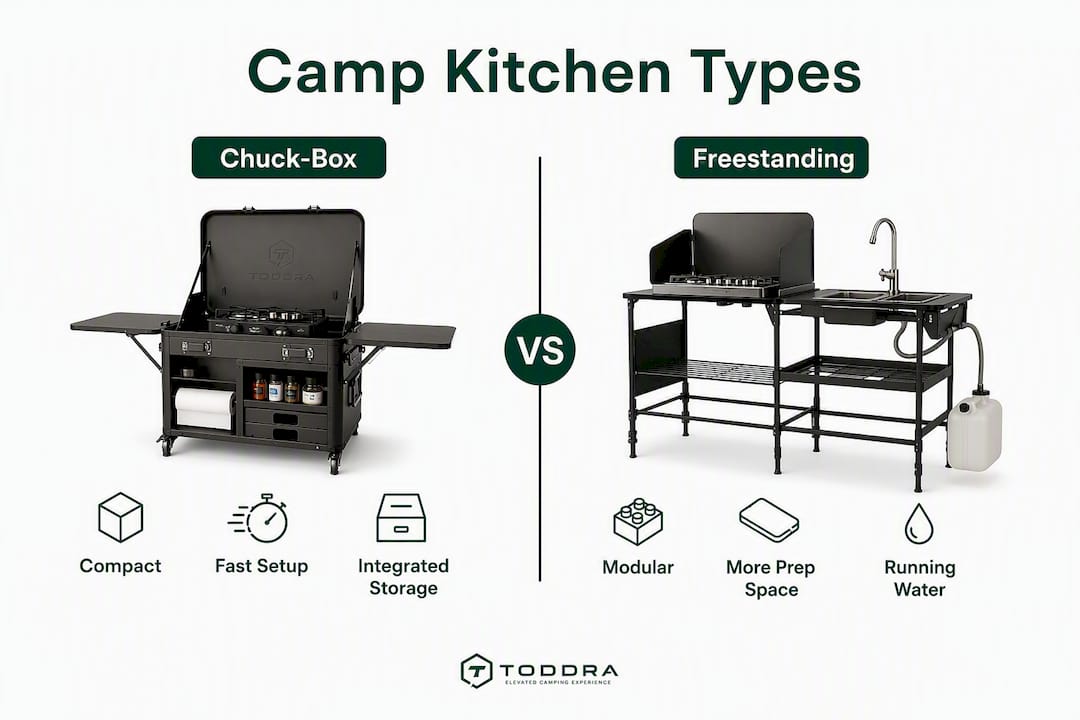
How to choose the right outdoor cooking station for your trips
The buying checklist
A well-planned camp kitchen covers five zones: stove surface, food-safe prep area, wash basin or sink, storage, and lighting. Before you buy, confirm each zone is covered, either by the unit itself or by a companion piece you already own.
- Burners: How many, and at what BTU? Dual burners let you boil water and cook protein at the same time. Mid-range and premium freestanding units typically include dual burners rated around 10,000 BTU each.
- Prep surface area: Is it large enough for your group size? A single-burner chuck-box can feel tight for four people. Consider whether a side shelf or folding table will supplement it.
- Integrated sink or wash basin: Does the unit include a removable basin or a plumbed faucet? Powered faucets speed cleanup significantly compared to a manual bucket system.
- Storage capacity: Count the compartments. Some all-in-one boxes include 30+ tools and utensils; others ship empty.
- Lighting: A built-in LED lamp or a mount point for a lantern keeps you cooking after dark.
- Materials: Aluminum frames and solid tabletops hold up in field conditions better than plastic-heavy builds.
- Electric accessory compatibility: If you plan to run a fridge, coffee maker, or USB faucet pump, confirm the unit's power requirements and pair it with an appropriately sized power station.
Questions to ask before you buy
- What fuel type does the stove accept? (Propane, butane, or dual-fuel?)
- Are replacement parts and burner heads available from the manufacturer?
- What is the warranty period, and does it cover water-system components?
- Are water-system parts removable for cleaning and replacement?
- What accessories are included versus sold separately?
Red flags to watch for
- Non-removable water tanks or plumbing that cannot be drained and dried in the field.
- Vague surge-watt specs on electric accessories (a pump or faucet with no stated startup draw).
- Plastic tabletop surfaces marketed as "food-safe" without a material specification.
- No stated fuel compatibility or regulator type.
Price bands
| Tier | Typical price | What you get |
|---|---|---|
| Budget | $40–$120 | Folding table or basic cook station, no water, minimal storage |
| Mid-range | $150–$400 | Chuck-box or prep island, 1–2 burners, some storage, possible USB faucet |
| Premium | $400–$900+ | Freestanding overland module, dual burners, integrated water, broad prep area |
What leading camp kitchen models actually include
Here is a compact profile of each major entrant, focused on what you actually get out of the box and who it suits best.
| Model | Packed weight | Burners | Water | Key accessories included |
|---|---|---|---|---|
| Yoke Outdoors Chuck Box | Moderate weight | 1–2 gas | No | Organizer panels, utensil slots |
| Trail Kitchens | Moderate weight | Modular | Optional | Modular trays, lightweight frame |
| HitchFire Camp Kitchen | Heavier weight | Dual high-output burners | Yes, integrated | Hose, water tank, prep surface |
| Stoic Portable Camp Kitchen Island | — | None | No | Aluminum frame, tabletop |
| Cabela's Deluxe Camp Kitchen | — | 2 gas | No | Shelves, storage bags |
| GCI Outdoors Slim-Fold Cook Station | ~12–15 lbs | 1 (grill mount) | No | Folding legs, side tables |
| SylvanSport Dine O Max Camp Kitchen | — | 1–2 gas | No | Modular shelves, organizer |
| Camco Deluxe Folding Grill Table | 12–15 lbs | Grill mount | No | Folding frame, side shelves |
Yoke Outdoors Chuck Box suits car campers who want everything organized in one case. The panel system keeps utensils accessible without digging through a bag. It does not include running water, so pair it with a separate basin or a compact sink-box.
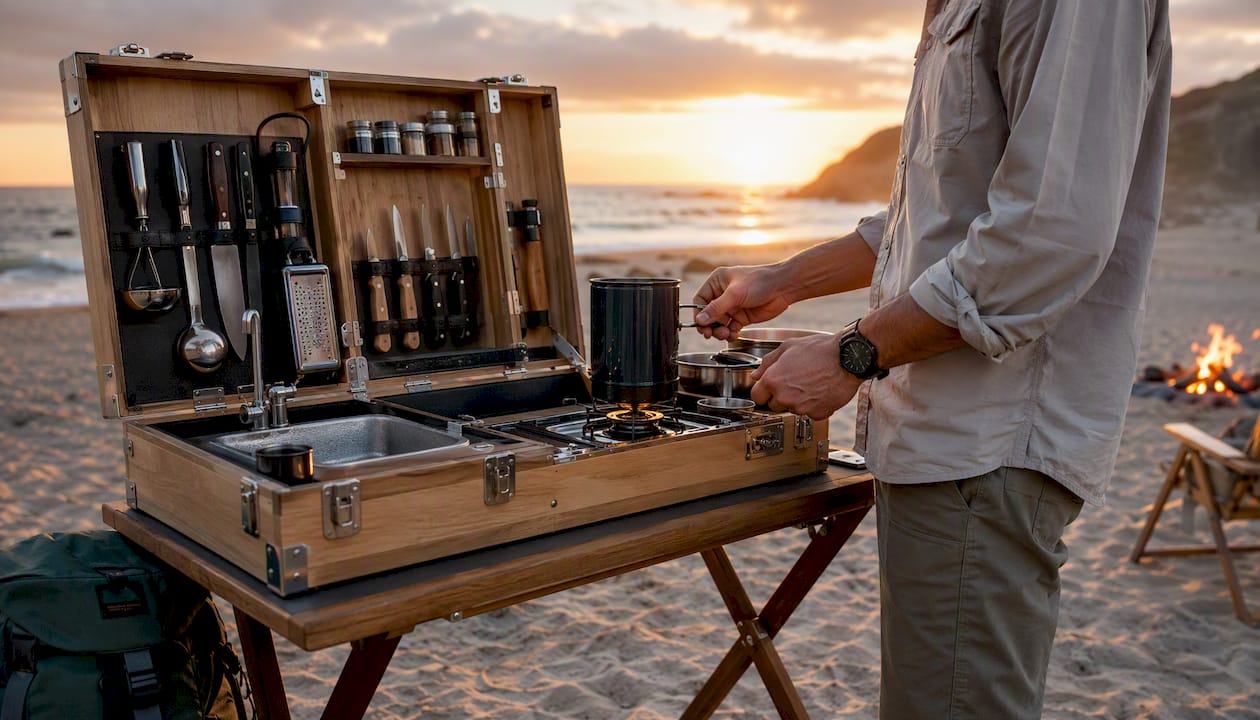
Trail Kitchens takes a modular approach: individual trays and frames pack flat and assemble at camp. Experienced overlanders often prefer this separation because cooking and cleanup can run at the same time on different surfaces. The trade-off is more packing pieces.
HitchFire Camp Kitchen is the most full-featured option here. Dual burners and integrated running water push its weight into the 40–45 lb range, but it delivers a genuine on-site kitchen experience. It is currently listed as backordered with an estimated ship date of June 2026, so plan accordingly.
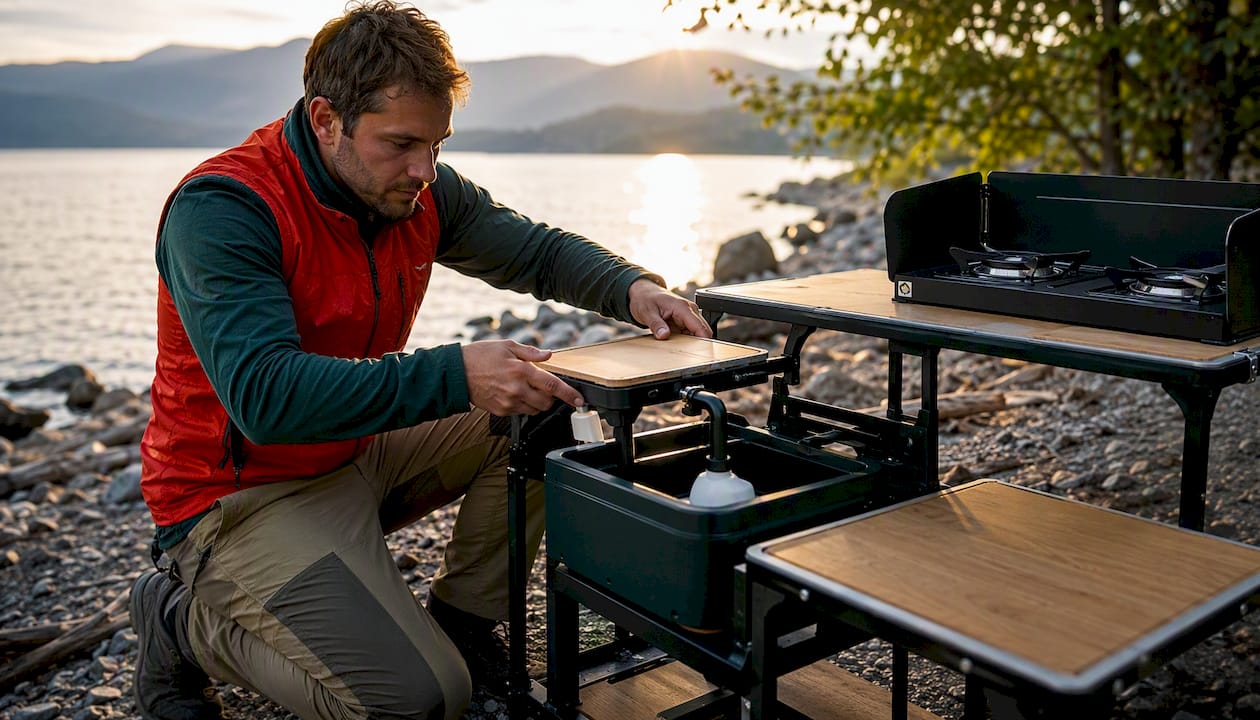
Stoic Portable Camp Kitchen Island provides a stable aluminum prep surface without a built-in stove. It works well as a companion piece to a separate burner setup, giving you dedicated prep space away from the heat source.
Cabela's Deluxe Camp Kitchen is a familiar choice for car campers who shop at Cabela's. Two gas burners and built-in shelving make it practical for group cooking, though it skips integrated water.
GCI Outdoors Slim-Fold Cook Station folds flat and sets up fast. At roughly 12–15 lbs, it is one of the lightest options here. The grill-mount design suits simple one-burner cooking; it is not built for complex meals.
SylvanSport Dine O Max Camp Kitchen offers modular shelving that adapts to different group sizes. It is a solid mid-range pick for campers who want more organization than a basic folding table but do not need integrated water.
Camco Deluxe Folding Grill Table is the budget anchor of this list. It is light, affordable, and does exactly one thing well: give you a stable surface for a grill or camp stove. No storage, no water, no frills.
Pro Tip: The most common regret among first-time buyers is underestimating prep surface area. If your unit's tabletop feels tight at home, it will feel even tighter at camp. Add a folding side table to any chuck-box or island setup before your first trip.
What to expect for size, weight, and setup time
Typical ranges by category
| Category | Packed weight | Setup time (advertised) | Real-world setup note |
|---|---|---|---|
| Compact chuck-box | — | 15–30 seconds | Add 2–5 min if connecting water tank or fuel line |
| Freestanding overland module | 40–45 lbs | 1–3 minutes | Water and fuel hookup adds time |
| Prep island / folding table | 12–15 lbs | Under 1 minute | Legs and locks only |
| Folding cook station | 12–15 lbs | Under 30 seconds | Unfold and latch |
Some all-in-one boxes advertise setup in 15 seconds using snap-open hinges and magnetized latches. That claim holds for the case itself. If your model includes a water tank, a fuel line, or a separate accessory tray, budget a few extra minutes.
Transport tips
- Handles matter. Confirm the unit has a carry handle or molded grip before buying. A 40 lb overland module without a handle is a two-person job every time.
- Measure your vehicle first. Truck beds and van floors vary. A unit that fits a full-size truck bed may not clear the wheel wells of a mid-size.
- Protect sensitive parts in transit. Wrap glass components and USB faucet heads in a small towel or foam sleeve. Vibration on rough roads can crack fittings.
- Wheels help on flat ground but add weight. For trail-end campsites with uneven terrain, a carry handle is more practical.
Pro Tip: Stage your kitchen at home the night before a trip. Confirm every latch, fuel connection, and water fitting works before you are 60 miles from the nearest hardware store.
Powering integrated accessories: what you need to know
Running a fridge, coffee maker, USB faucet pump, or LED lamp from a portable power station requires a bit of planning. Here is a practical checklist.
- List every electric accessory you plan to run: fridge, coffee maker, induction cooktop, USB faucet pump, LED lamp. Note each appliance's continuous wattage and, if listed, its startup (surge) wattage.
- Check surge wattage first. Appliance startup spikes can exceed continuous ratings, and a smart BMS will shut down the station if the surge exceeds its rated capacity. Match your station's surge rating to the highest startup draw in your kit.
- Size your battery capacity. A station in the 700–1,500 Wh range handles most camp kitchen loads. For a weekend trip running a fridge plus coffee maker, a 768–1,024 Wh unit is a practical starting point.
- Plan solar input for multi-day trips. Battery capacity alone limits you to what you carried in. Solar panels extend your range. The panel's input ceiling, measured in watts, determines how much you recover each day. See Toddra's solar panel campsite charging guide for sizing examples.
- Verify inverter compatibility. If your cook station uses an AC-powered induction element, confirm the power station's inverter output matches the cooktop's wattage requirement.
Safety note: Keep power stations and battery banks in ventilated areas away from direct flame. Never run an inverter inside an enclosed van or tent without adequate airflow. LiFePO4 chemistry is more thermally stable than older lithium-ion cells, but outdoor placement and basic ventilation remain good practice.
Pro Tip: Before a multi-day trip, run your full accessory load at home for two hours and check how much capacity the station uses. That real-world draw number is more reliable than spec-sheet estimates for planning solar recovery needs.
Toddra's power station wattage sizing guide walks through the math for common camping loads, including fridges and coffee makers, so you can size your station with confidence before you buy.
Key Takeaways
The right portable camp kitchen depends on your trip length, vehicle, and how much cooking complexity you want at camp.
| Point | Details |
|---|---|
| Setup speed varies by type | Chuck-box all-in-ones set up in 15–30 seconds; freestanding overland modules take 1–3 minutes with plumbing. |
| Weight range is wide | Compact folding stations start around 12–15 lbs; full-featured overland modules reach 40–45 lbs. |
| Power sizing matters | A 700–1,500 Wh station covers most camp kitchen electric loads; check surge watts before buying. |
| Modularity aids cleanup | Removable basins and modular trays make field cleaning practical on long trips; fixed plumbing does not. |
| Toddra as power partner | Toddra portable power stations and battery banks pair with any kitchen type to run fridges, pumps, and coffee makers reliably. |
The case for thinking about your kitchen in two separate systems
Most buyers treat a camp kitchen as one purchase. The smarter frame is two: the cooking and prep unit, and the power system that runs everything electric. These are genuinely separate decisions with different trade-offs, and conflating them is where most buyers go wrong.
An all-in-one chuck-box that includes a USB faucet is only as good as the power source feeding that faucet. A freestanding overland module with integrated plumbing still needs a pump, and that pump needs watts. The kitchen unit determines your prep space, burner count, and storage. The power station determines whether your fridge stays cold on day three, whether your coffee maker works at 6 AM, and whether your USB faucet has pressure.
The practical lesson: choose your kitchen type first based on trip length and vehicle space, then size your power station to the electric accessories you actually plan to run. A modular setup where the power station is a discrete, swappable component gives you more flexibility than a system where power is baked in and non-upgradeable. That flexibility matters most on longer trips, where conditions change and a dead battery at noon is a real problem, not a minor inconvenience.
One field tip worth applying immediately: bring a small folding table even if your main unit has a prep surface. Cooking and cleanup compete for the same space in every all-in-one design. A separate surface for dirty dishes keeps your prep area clean and your cooking faster.
Toddra portable power for your camp kitchen setup
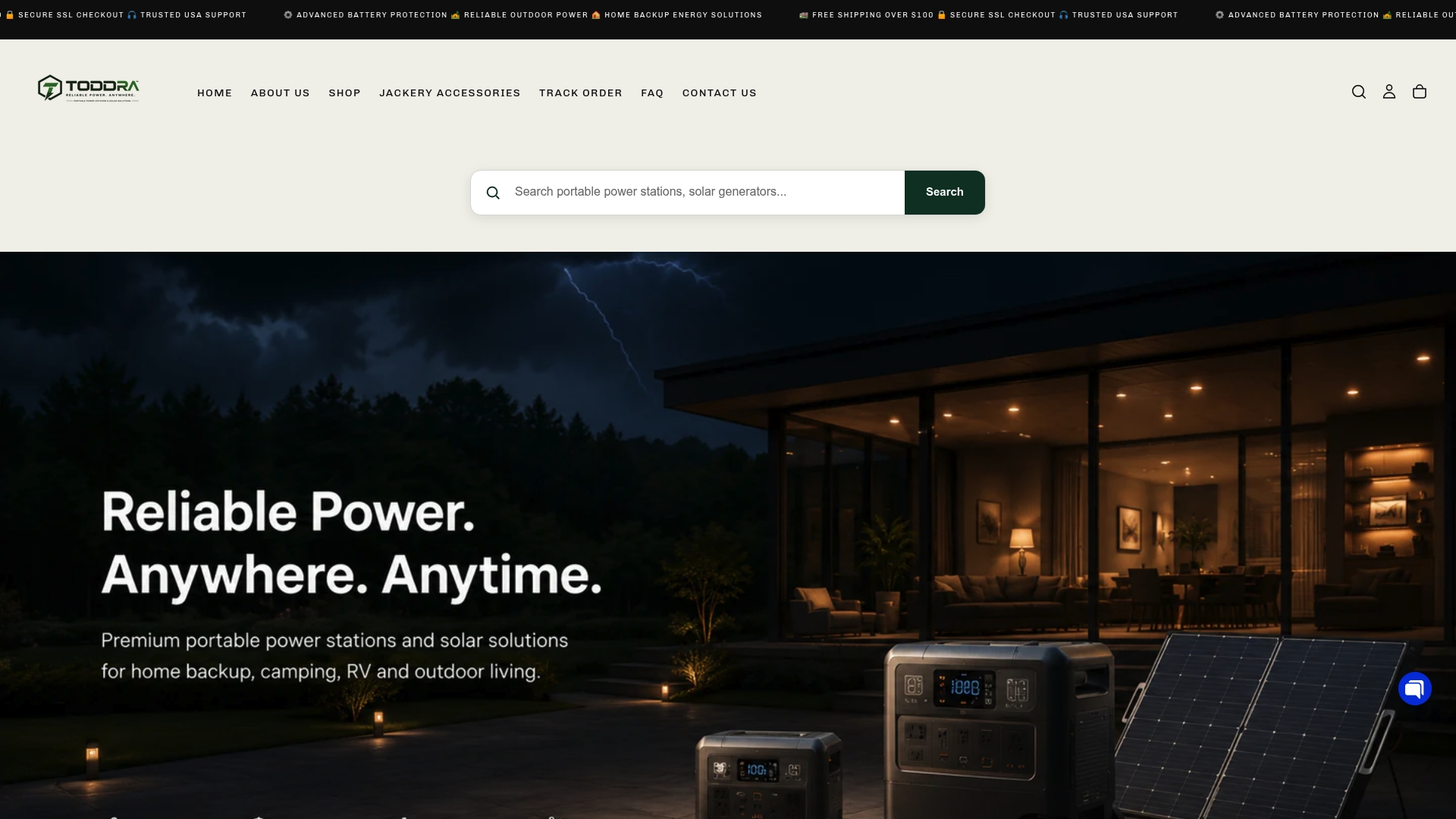
Every camp kitchen type covered in this article, from a basic folding station to a full freestanding overland module, benefits from a reliable power source the moment you add a fridge, a USB faucet, or a coffee maker. Toddra's portable power stations and battery banks are built for exactly this kind of outdoor load, with LiFePO4 battery options, solar compatibility, and smart BMS protection that handles the surge spikes common in camp kitchen appliances.
For a weekend trip, a compact Toddra station in the 700–1,000 Wh range covers a fridge, coffee maker, and USB pump without needing solar. For multi-day overland trips, pairing a larger station with solar panels keeps you self-sufficient across several days of cooking. Toddra's solar-powered camping setup guide shows real capacity examples for common camp kitchen loads.
Browse Toddra portable power stations and solar generators to find the right capacity for your kitchen setup, or check the battery bank collection for compact options suited to shorter trips.
Where to find full specs and trusted reviews
These sources are worth bookmarking for deeper research before you buy.
- REI Camp Kitchen Checklist: A thorough breakdown of the five zones every camp kitchen should cover, with gear recommendations and packing tips from REI's outdoor experts.
- Camp Kitchen Power Guide (Backup Power Hub): Detailed guidance on sizing power stations for camp kitchen loads, with surge watt explanations and capacity examples for weekend and multi-day trips.
- CleverHiker: Best Camping Cookware: Tested cookware reviews with material and durability notes; useful for choosing cooksets to pair with your kitchen unit.
- GearJunkie Camp Cooking Gear Guide: First-hand field perspective on building a camp kitchen system over multiple seasons, with gear evolution notes.
- HitchFire Camp Kitchen product page: Full specs, included accessories, and current availability for the HitchFire freestanding overland unit.
- Toddra Solar Camping Setup Guide: Real capacity examples and panel-sizing guidance for campers who want solar-assisted power at camp.
- Toddra Power Station Wattage Guide: Step-by-step wattage math for sizing a station to your specific camp kitchen appliance list.