TL;DR:
- A 300W-class portable power station offers reliable, silent backup power suitable for camping, CPAP use, and brief outages. It features adjustable wattage, high-quality LiFePO4 batteries, and multiple charging ports, with capacity and surge ratings critical for device compatibility. Proper selection and storage extend its lifespan, making it a practical, safe, and versatile energy solution for various outdoor and emergency needs.
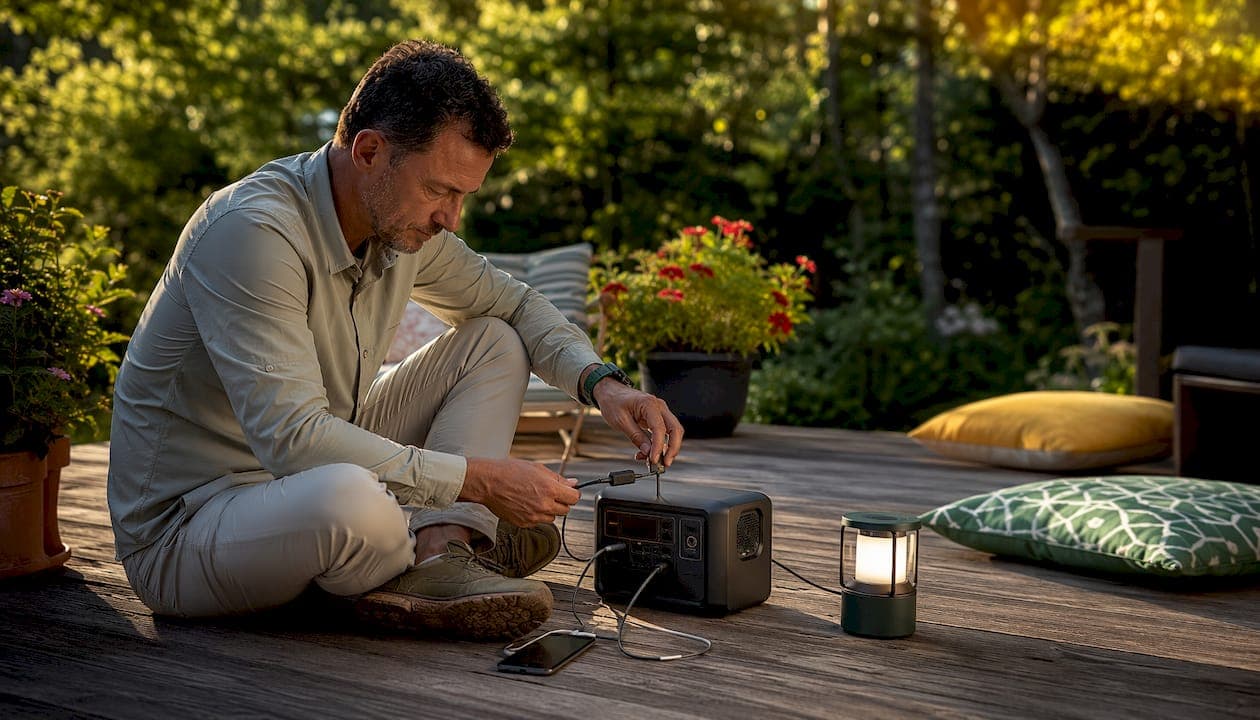
A power station 300 is a compact, battery-based portable power station that delivers roughly 300 watts of continuous AC output and stores approximately a typical range of effective watt-hours of energy storage. It runs silently, produces zero emissions, and recharges from a wall outlet, car port, or solar panels — making it a genuinely practical choice for weekend campers, CPAP users, and anyone who wants reliable backup power during short outages.
Best for: weekend campers, CPAP overnight support, phone and laptop charging for 1–2 days, and short home outages of a few hours.
Before you compare models, check these four specs immediately:
- Wh capacity (250–320 Wh is the typical range for this class)
- Continuous watts (should be at or above your highest steady-load device)
- Surge/peak watts (typically 600W for a 300W-class unit — critical for motor-start loads)
- Battery chemistry (LiFePO4 lasts far longer and runs cooler than older lithium-ion)
- Weight (many quality units in this class weigh around 10 lbs or less)
- USB-C PD rating (look for at least 60W; 100W is better for laptops)
Table of Contents
- How to read a 300W-class spec sheet
- Realistic runtimes and how to calculate your own
- How to choose the right 300W-class station for your needs
- Recharging methods and realistic recharge times
- Battery chemistry, safety, and how to make your station last
- Real-world use cases and portability tradeoffs
- Key Takeaways
- Why LiFePO4 is at the center of everything we build
- Toddra's 300W-class stations, built around your checklist
- Useful sources and further reading
How to read a 300W-class spec sheet
Understanding two pairs of numbers will save you from buying the wrong unit.
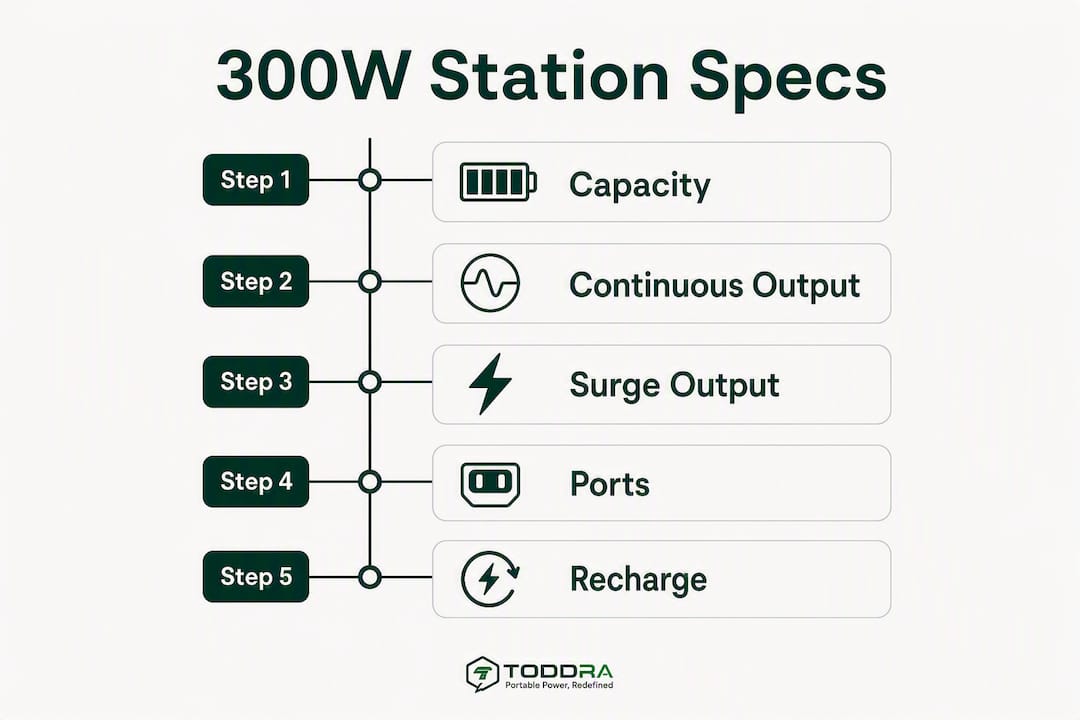
Wh vs. W: Watt-hours (Wh) measure how much energy is stored — think of it as the fuel tank. Watts (W) measure how fast that energy flows out. A 288 Wh station with a 300W inverter can, in theory, run a 300W load for just under an hour. Match Wh to how long you need power, and match W to what you need to run.

Continuous watts vs. surge watts: Continuous watts is the steady output your inverter can sustain indefinitely. Surge (peak) watts is the short burst the inverter can handle at startup — motors in mini-fridges and power tools often draw 2–3× their running wattage for a fraction of a second. A unit rated 300W continuous / 600W surge handles that spike; one with no published surge rating is a red flag.
Ports you should expect on a ~300W station
| Port type | Typical limit | Notes |
|---|---|---|
| AC outlet | 300W continuous | Pure-sine inverter preferred |
| USB-C PD | 60–100W | Confirm laptop compatibility |
| USB-A | 5–10W | Standard charging |
| car port | 10A | DC accessories, tire pumps |
| DC barrel | varies | Some models include this |
Weight and recharge options are also spec items worth noting. Portable power stations store energy in a battery pack and convert it through a built-in inverter — the quality of that inverter directly affects which devices run cleanly.
Pro Tip: Watch for advertised Wh figures that reflect total cell capacity rather than usable capacity. Inverter losses and battery management overhead typically reduce usable energy to 85–90% of the stated number. A unit labeled "300 Wh" may deliver closer to 255–270 Wh at the outlet.
Realistic runtimes and how to calculate your own
The runtime formula is straightforward: (Wh × inverter efficiency) ÷ device watts = hours of runtime. Using a 288 Wh unit at 87% efficiency: 288 × 0.87 = ~251 usable Wh. Divide that by your device's watt draw and you have your estimate.
| Device | Typical draw | Estimated runtime (288 Wh, 87% efficiency) |
|---|---|---|
| Smartphone charging | 10W | 14–24 hours |
| Laptop (mid-range) | 45–65W | 4–6 hours |
| CPAP (no heat, no humidifier) | 30–50W | 5–8 hours |
| LED camp lights (string) | 10–20W | 12–24 hours |
| Mini-fridge (cycling) | 40–60W avg | 4–6 hours |
| Camera battery charger | 15–20W | 10–16 hours |
A few things affect whether a device will run at all, not just for how long:
- Check peak draw vs. surge rating. A mini-fridge compressor may spike to 400–500W at startup. If your station's surge rating is only 300W, the compressor won't start.
- Confirm continuous draw stays under the inverter limit. A device rated at 280W continuous is right at the edge of a 300W station — leave some headroom.
- Factor in simultaneous loads. Running a laptop and charging a phone at the same time adds their draws together.
- Use the manufacturer's rated wattage, not the maximum. Most devices run well below their label wattage under normal conditions.
The Rambler 300 is a real-world example of how these specs publish: 288 Wh capacity, 300W AC output with a 600W surge rating, and two USB-C PD ports at 100W and 20W respectively.
How to choose the right 300W-class station for your needs
Start with one decision rule: match continuous watts to your highest steady-load device, and match Wh to the number of hours you need it to run. Everything else on the checklist flows from there.
- Continuous watts — your most power-hungry device sets the floor. A CPAP needs 30–50W; a laptop needs 45–65W; a mini-fridge needs 40–60W average.
- Surge/peak watts — any motor-driven device requires a surge rating above its startup draw. Confirm this before buying.
- Wh capacity — multiply your device's watt draw by the hours you need and divide by 0.87 to find the minimum Wh you need.
- Port mix — does it have USB-C PD at the wattage your laptop requires? Check the spec sheet, not just "USB-C PD" as a label.
- Recharge options — does it support solar input? What is the maximum solar input wattage? Can it charge via car port while you drive?
- Pass-through/UPS capability — critical for CPAP users and anyone protecting sensitive electronics. UPS/pass-through allows automatic switching during outages, but not all models support simultaneous charging and AC output on every port.
- Battery chemistry — LiFePO4 is the recommended choice for safety and long cycle life, especially for emergency preparedness and frequent outdoor use.
- Weight and carryability — most quality 300Wh-class units weigh under 10 lbs, which is manageable for car camping but heavy for backpacking.
- Warranty and certifications — look for UL listing, UN38.3 transport certification, and a warranty of at least one year (two is better).
Questions to ask before you buy:
- "Can it run my CPAP all night without the humidifier?" (Needs ~250 Wh minimum at 87% efficiency for an 8-hour night at 30W draw.)
- "Does the USB-C PD port actually deliver 65W or 100W to my specific laptop?"
- "Does pass-through work on the AC outlet, or only on USB ports?"
Red flags to avoid: vague or missing Wh figures, no published surge rating, no UL or UN38.3 certification, and warranty terms that require you to ship the unit internationally for service.
For a deeper look at when a portable station beats a stationary backup system, Toddra's portable vs. stationary emergency power guide walks through the tradeoffs clearly.
Recharging methods and realistic recharge times
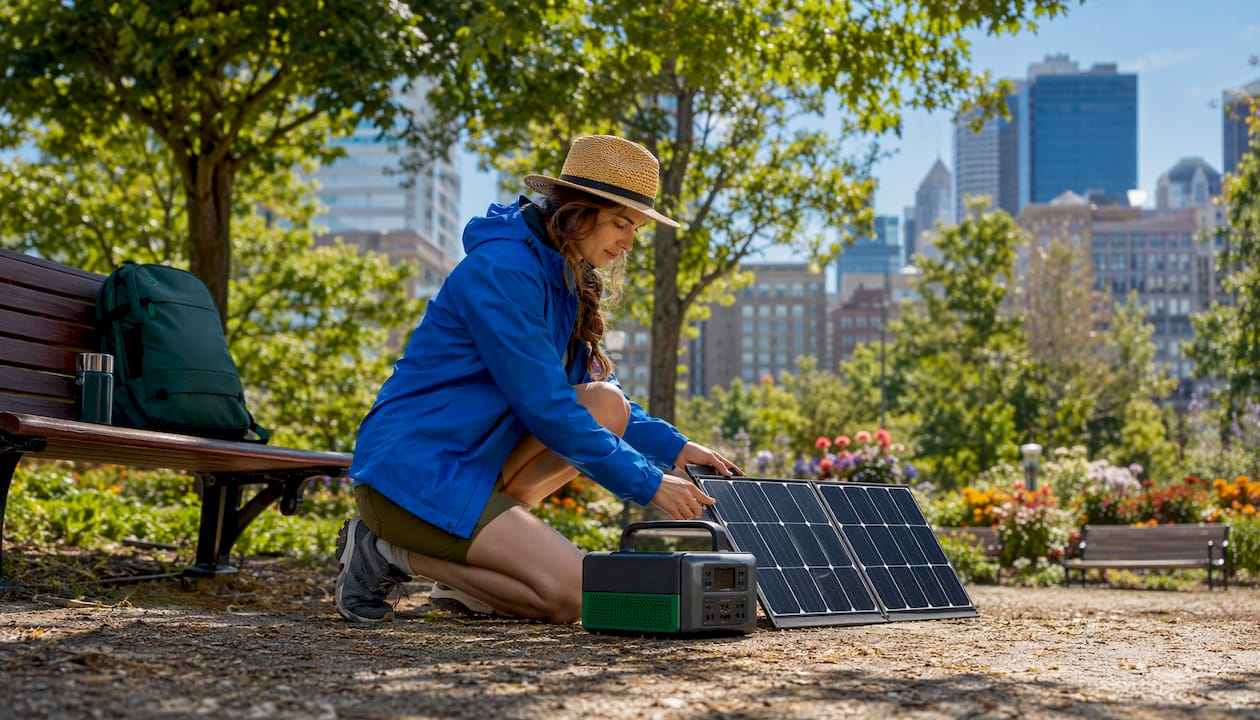
Portable power stations recharge from three sources: wall AC, car port, and solar. Each has a very different speed profile.
| Input source | Typical input wattage | Estimated recharge time (288 Wh unit) |
|---|---|---|
| Wall AC (standard) | 100–200W | 2–3 hours |
| car port | 60–100W | 3–5 hours |
| Solar (30W panel) | ~25W | 10 hours |
| Solar (100W panel) | ~80W usable | 3.5 hours |
| Solar (200W panel) | ~160W (if input allows) | 2 hours |
The key constraint is the station's maximum solar input rating — if the unit caps solar input at 60W, a 200W panel won't charge it any faster than a 60W panel. MPPT (Maximum Power Point Tracking) charge controllers extract more usable power from a panel than older PWM controllers, so MPPT-equipped stations get meaningfully faster solar recharge under the same panel.
Pro Tip: Size your solar panel larger than you think you need. Real-world solar output is typically 70–80% of panel rating due to angle, shade, temperature, and cloud cover. To replace 288 Wh of daily use with solar alone, a 100W panel in full sun for 4–5 hours is a reasonable minimum — and that assumes no simultaneous device loads drawing from the station while it charges.
For step-by-step guidance on matching panels to your station, Toddra's guide on charging with solar panels covers sizing and setup in practical detail.
Battery chemistry, safety, and how to make your station last
LiFePO4 (lithium iron phosphate) is the chemistry recommended by experts for safety and long cycle life in emergency and outdoor use. It offers lower combustion risk, greater thermal stability, and a much longer service life than older lithium-ion (NMC or NCA) chemistries — even if the upfront cost is slightly higher.
| Chemistry | Typical cycle life | Thermal stability | Energy density | Best for |
|---|---|---|---|---|
| LiFePO4 | several thousand cycles | Excellent | Moderate | Emergency, daily use, outdoor |
| Li-ion (NMC) | hundreds to low thousands of cycles | Good | High | Compact, light-use devices |
A cycle is one full charge-discharge. LiFePO4 stations typically offer substantially longer cycle life than NMC batteries, often lasting many years under regular use before reaching 80% of original capacity. The LiFePO4 advantage is most pronounced when the station sits on standby for months between uses — a common pattern for emergency backup.
Certifications to check on the spec sheet:
- UL listing (UL 2743 for portable power stations) — confirms safety testing to a recognized US standard
- UN38.3 — required for lithium battery transport; signals the cells passed abuse testing
- BMS (Battery Management System) — should include overcharge, over-discharge, short-circuit, and temperature protection
Pro Tip: Store your station at approximately 50% state of charge (SOC) in a cool, dry location when not in use. Storing at 100% SOC for extended periods accelerates cell aging in all lithium chemistries. Most quality units display SOC on a screen or LED indicator — charge to full, use it briefly, then store at half.
Maintenance is minimal but meaningful: recharge every 3–6 months during storage, keep the unit away from temperatures below 32°F (0°C) during charging, and avoid leaving it in a hot car for extended periods.
Real-world use cases and portability tradeoffs
Compact 300Wh-class stations typically weigh under 10 lbs and are roughly the size of a lunch box — genuinely portable for car camping, tailgating, and keeping in a closet for emergencies. Backpacking is a different story; 7–10 lbs is a real weight penalty on a multi-day trail.
- Weekend car camping: Charges phones and a laptop for 2 days, runs LED lights all night, and handles a small camera. A mini-fridge is possible for a few hours but will drain the station by morning.
- CPAP support: A 300Wh station comfortably runs a CPAP without heat or humidifier for a full 8-hour night. With humidifier, runtime drops to 4–5 hours — plan accordingly or bring a DC cable to bypass the inverter.
- Short home outages (2–4 hours): Keeps phones, a router, and a laptop running through a brief grid interruption. Not sized for a full refrigerator or window AC unit.
- Tailgating and outdoor events: Powers a small speaker, phone charging station, and LED lighting without noise or fumes — one of the clearest advantages of a battery station over a fuel generator.
- RV and van use: Works well as a supplemental power source for lighting and device charging; not a replacement for a dedicated house battery bank on longer trips.
Temperature and environmental limits: Most units charge safely between 32°F and 104°F (0°C–40°C) and discharge between 14°F and 113°F (–10°C–45°C). Charging in freezing temperatures can permanently damage lithium cells — always let the unit warm up before plugging in on a cold morning. Storage humidity should stay below 80% non-condensing.
For more practical scenarios, Toddra's emergency power station examples covers real outage situations in useful detail.
Key Takeaways
A 300W-class portable power station with LiFePO4 chemistry, a verified surge rating, and USB-C PD support covers most camping and short-outage needs reliably for years.
| Point | Details |
|---|---|
| Right size for short needs | A 300W station fits weekend camping, CPAP overnight support, and outages of 2–4 hours. |
| Match watts before Wh | Confirm continuous and surge watts cover your highest-draw device before checking capacity. |
| LiFePO4 lasts far longer | LiFePO4 delivers several thousand cycles vs. 500–1,000 for NMC — a decade of use vs. a few years. |
| Store at 50% SOC | Storing at roughly half charge in a cool, dry place is the single best habit for battery longevity. |
| Toddra's LiFePO4 lineup | Toddra's 300W-class stations feature LiFePO4 chemistry, pass-through capability, and US-based support. |
Why LiFePO4 is at the center of everything we build
At Toddra, we made a deliberate choice to focus on LiFePO4-based portable power stations because the chemistry aligns with what our customers actually need: a station that's safe to store in a bedroom closet, reliable after sitting unused for six months, and still performing well years from now. We've seen too many buyers get burned by units that degraded quickly or raised safety concerns — and we don't think that's an acceptable tradeoff for saving a few dollars upfront. Our US-based support team is here to help you choose the right station, troubleshoot charging questions, and make sure your purchase works the way you expect it to. If you want to go deeper on the chemistry or use-case tradeoffs, our LiFePO4 advantages guide is a good next read.
Toddra's 300W-class stations, built around your checklist
Every spec on the checklist in this guide — continuous watts, surge rating, USB-C PD wattage, LiFePO4 chemistry, pass-through capability, and solar input — is something Toddra evaluates carefully before adding a product to our lineup. Our 300W-class stations ship with verified surge ratings, pure-sine inverters, and BMS protection that covers overcharge, over-discharge, and temperature extremes. US-based customer support is included, not an add-on, and our return process is straightforward.
If you've worked through this guide and know a 300W station fits your needs, the next step is simple: browse Toddra's portable power station collection to compare models side by side, or check out our expansion battery options if you're already thinking about scaling up your setup. Every product page lists the full spec sheet — continuous watts, surge watts, Wh, port wattages, and warranty terms — so you can match specs to your needs before you check out.
Useful sources and further reading
- How Portable Power Stations Work: A Beginner's Guide — Reliant Energy's clear explainer on how battery stations store and convert power, recharge options, and pass-through behavior.
- The 8 Best Portable Power Stations of 2026, Tested by Popular Mechanics — Hands-on testing notes covering LiFePO4 vs. NMC tradeoffs, portability limits, and what compact stations can and cannot do.
- Rambler 300 Power Station — A published spec sheet showing how a real 300W-class unit lists capacity, surge rating, port wattages, and recharge time.
- LiFePO4 Battery Advantages for Outdoor Use in 2026 — Toddra's deep dive into why LiFePO4 outperforms older chemistries for safety, cycle life, and outdoor reliability.
- Portable vs. Stationary Emergency Power: Your 2026 Guide — Toddra's guide to deciding between a portable station and a fixed backup system for home emergencies.
- How to Charge a Backup Power Station With Solar Panels — Practical steps for sizing solar panels, understanding MPPT vs. PWM, and calculating expected recharge times.
- Emergency Power Station Uses: Practical Examples for 2026 — Real outage and outdoor scenarios showing exactly how a portable station performs when the grid goes down.