TL;DR:
- A solar generator home backup system combines solar panels, batteries, and an inverter to power homes during outages without emissions. Proper sizing of batteries and solar input is essential for reliable, multi-day backup, especially for critical loads. Portable units offer immediate shelter, while hybrid systems provide long-term, automated whole-home power backup.
A solar generator home backup setup is a system that combines solar panels, battery storage, and an inverter to deliver clean, quiet power to your home when the grid goes down. Unlike gas generators, these systems produce zero emissions, run silently, and qualify for the 30% Residential Clean Energy Credit available through 2032. The industry standard term for a fully installed version is a hybrid solar backup system, though portable solar generators serve the same core purpose at a lower entry cost. Getting the sizing right from the start is what separates a system that actually works from one that fails you during a three-day outage.
How to calculate your home's energy needs for a solar generator home backup setup
Accurate sizing starts with listing every appliance you plan to run during an outage. Write down the wattage of each device and estimate how many hours per day you will use it. Multiply wattage by hours to get watt-hours per device, then add them all together for your daily total.
Critical loads for most homeowners include:
- Refrigerator: 150W running, 4–6 hours of compressor time daily = 600–900Wh
- LED lighting (5 bulbs): 50W total, 6 hours = 300Wh
- Wi-Fi router and modem: 20W, 24 hours = 480Wh
- Phone and laptop charging: 100W combined, 3 hours = 300Wh
- Medical device (CPAP, for example): 30–60W, 8 hours = 240–480Wh
A typical critical-load setup lands between 2,000Wh and 3,500Wh per day. That number is your baseline, not your target.
Experts recommend adding a 20% buffer on top of your daily total to account for shading, battery degradation, and conversion losses. That buffer is the difference between a system that barely keeps up and one that handles a cloudy day without drama. For a 3,000Wh daily need, your effective target becomes 3,600Wh of usable battery capacity.
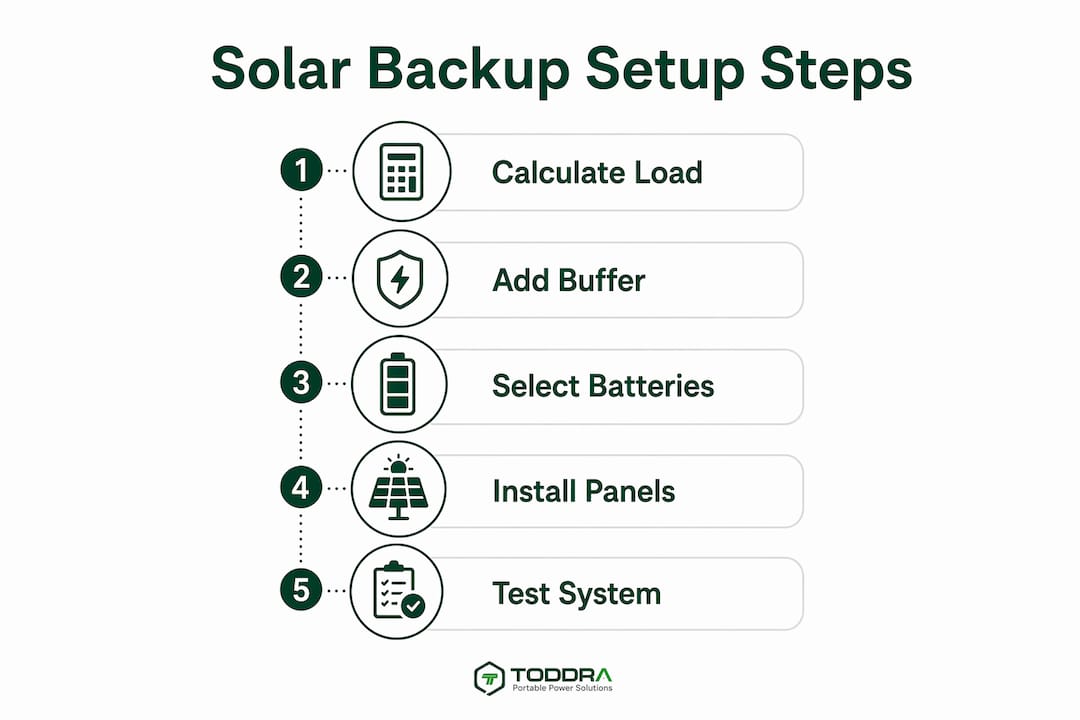
Plan for 2–3 days of battery autonomy to survive extended outages without sun. Multiply your buffered daily need by 2 or 3 to get your minimum battery bank size. A 3,600Wh daily need with a 3-day goal means you need at least 10,800Wh of storage.
Pro Tip: Separate your "critical loads" from your "comfort loads." Running a refrigerator, lights, and medical devices costs a fraction of what it takes to run an air conditioner or electric stove. Sizing for critical loads only can cut your system cost by 50% or more.
What components do you need for a home solar backup system?
Battery types and capacity
LiFePO4 (lithium iron phosphate) batteries are the preferred choice for home backup. They deliver 2,000–4,000 charge cycles, tolerate deeper discharge than standard lithium-ion, and carry a strong safety record. Standard lithium-ion packs cost less upfront but degrade faster under daily cycling. For a backup system you plan to use regularly, LiFePO4 is the better long-term investment.

Solar panels: rigid vs. portable
Monocrystalline rigid panels offer the highest efficiency, typically 20–23%, and work best for permanent rooftop or ground-mount installations. Portable folding panels sacrifice some efficiency for convenience and suit renters or homeowners who want a flexible setup. Oversizing your panel wattage by 8–20% above your calculated need compensates for real-world losses and ensures your batteries recharge fully even on shorter winter days.
Inverters and transfer switches
The inverter converts stored DC battery power into the AC power your appliances use. Hybrid inverters do double duty: they manage solar input, battery charging, and grid connection in one unit, and they include an automatic transfer switch. Hybrid inverters switch in milliseconds, delivering what the industry calls "blinkless" backup. That speed matters because a slow switchover resets your router, clears your refrigerator's temperature memory, and interrupts any device mid-cycle.
Inverter surge capacity must handle appliance startup demands, which run 3–5 times the running wattage. A refrigerator that draws 150W running may spike to 600W at startup. Size your inverter's surge rating to cover the highest-surge appliance you plan to run.
| Component | Best option for backup | Key spec to check |
|---|---|---|
| Battery chemistry | LiFePO4 | Cycle life (2,000+ cycles) |
| Solar panels | Monocrystalline | Efficiency (20%+) |
| Inverter type | Hybrid with transfer switch | Surge rating (3–5x running watts) |
| Portable option | All-in-one solar generator | UPS/EPS auto-switching mode |
Pro Tip: When buying a portable solar generator, confirm it has a UPS or EPS mode. Without it, the unit does not switch automatically during an outage. You will need to manually plug devices in, which defeats the purpose during a nighttime power failure.
How to set up solar backup: a step-by-step installation guide
Tools and safety equipment
Before you touch a wire, gather the right gear. Here is what a safe installation requires:
| Item | Purpose |
|---|---|
| Multimeter | Verify voltage and polarity before connections |
| Wire strippers and crimpers | Prepare and secure cable connections |
| MC4 connectors and cables | Connect solar panels to charge controller |
| Torque screwdriver | Tighten terminal connections to spec |
| Insulated gloves and safety glasses | Protect against accidental discharge |
| Transfer switch (if not built in) | Isolate home circuits from the grid |
Installation steps
- Mount solar panels. Position panels at the correct angle for your latitude, facing south in the Northern Hemisphere. Secure mounting hardware before connecting any wiring.
- Run panel cables to the charge controller or hybrid inverter. Keep cable runs short to minimize resistance losses. Use the correct wire gauge for your system's amperage.
- Connect the battery bank. Wire batteries in the configuration your inverter requires (series, parallel, or series-parallel). Double-check polarity before making the final connection.
- Install the inverter. Mount it in a ventilated, dry location. Connect the battery terminals first, then the AC output wiring to your load panel or transfer switch.
- Install the transfer switch. This step is critical. Grid-tied solar panels shut off automatically during outages to protect utility workers from backfeeding. A proper transfer switch isolates your home circuits from the grid before your backup system activates.
- Test the system. Simulate an outage by switching off your main breaker. Confirm your critical loads receive power and that the transfer switch operates correctly.
The most dangerous mistake in any solar backup installation is skipping the transfer switch or using an improper isolation method. Backfeeding live power onto a utility line puts lineworkers at serious risk and violates National Electrical Code requirements. Always use a listed transfer switch and, for installed hybrid systems, hire a licensed electrician for the grid-connection step.
Pro Tip: For renters or homeowners who want a no-permit portable setup, skip the transfer switch entirely. Plug your critical appliances directly into the solar generator's AC outlets during an outage. It is manual, but it is safe, legal, and requires zero installation.
What does a solar generator home backup system cost?
Cost depends almost entirely on whether you choose a portable unit or a fully installed hybrid system. Portable solar generators range from $500 to $3,500 depending on capacity. Installed hybrid home systems run $10,000 to $25,000 including panels, batteries, inverter, and labor. That is a wide range, and the right starting point depends on your outage risk and budget.
The 30% Residential Clean Energy Credit applies to qualifying solar and battery systems through 2032. On a $15,000 installed system, that credit returns $4,500 directly off your federal tax bill. Check with a tax professional to confirm your specific system qualifies.
Factors that push costs higher include larger battery banks, complex roof installations, panel upgrades, and adding a whole-home transfer switch. Factors that keep costs lower include starting with a portable unit, limiting backup to critical loads, and using a simple manual plug-in setup.
Financial options worth exploring:
- Federal tax credit: 30% of total system cost for qualifying installations through 2032
- State and utility rebates: Many states offer additional incentives on top of the federal credit
- PACE financing: Property Assessed Clean Energy loans spread costs over 10–25 years
- Manufacturer financing: Many solar generator brands offer 0% APR promotional periods
- Phased installation: Start with a portable unit now, add a hybrid system later as budget allows
Comparing solar vs. fuel costs over a 5-year period consistently favors solar, especially as gas prices fluctuate.
Common mistakes and expert tips for optimizing your solar backup system
The single most common error is undersizing the battery bank. Battery capacity determines how long your system runs without sun. A battery sized for one day of critical loads leaves you powerless on day two of a winter storm. Aim for 2–3 days of autonomy as your design target, not your minimum.
Recharge bottlenecks are the second most overlooked problem. Insufficient solar input wattage means your batteries never fully recover between cloudy days, and each successive day of the outage leaves you with less capacity. Size your panel array to recharge your full battery bank within 4–6 peak sun hours.
Best practices for a reliable system:
- Test monthly. Run your system on battery power for 30 minutes each month to confirm everything works before you actually need it.
- Check connections annually. Loose terminals cause resistance, heat, and eventual failure.
- Monitor battery state of charge. Never discharge LiFePO4 batteries below 20% regularly. It shortens cycle life significantly.
- Know your inverter's surge rating. Before adding an appliance to your backup circuit, confirm the inverter can handle its startup spike.
- Understand your switching mode. Portable units require manual intervention unless they include a UPS or EPS mode. Hybrid installed systems switch automatically.
Pro Tip: Run a full load test once a year by disconnecting from the grid and running your critical loads for two hours. This reveals weak batteries, undersized wiring, and inverter limitations before a real outage does.
Key takeaways
A reliable solar backup system requires accurate load calculation, a 20% inefficiency buffer, LiFePO4 battery storage sized for 2–3 days of autonomy, and a proper transfer switch to prevent dangerous backfeeding.
| Point | Details |
|---|---|
| Size with a buffer | Add 20% to your daily watt-hour total to cover shading, losses, and degradation. |
| Plan for 2–3 days | Battery banks sized for one day fail during extended outages without sun. |
| Match inverter surge rating | Choose an inverter rated for 3–5x the running watts of your highest-draw appliance. |
| Use a transfer switch | Proper grid isolation is required by code and protects utility workers from backfeeding. |
| Start portable, scale up | A $500–$3,500 portable unit gives immediate backup while you plan a full hybrid system. |
What I've learned from real solar backup setups
The gap between a system that looks good on paper and one that actually works during a three-day outage is almost always the battery bank. Homeowners consistently underestimate how much capacity they need once they factor in a refrigerator cycling every 20 minutes through the night. I have seen well-intentioned setups with beautiful panel arrays paired with batteries that run dry by midnight of day one.
The layered approach works best in practice. A portable solar generator handles immediate needs and costs under $2,000. A hybrid installed system handles whole-home backup for the long term. Starting with the portable unit also teaches you exactly which loads matter most, which makes sizing the permanent system far more accurate.
Maintenance is where most people fall short after installation. A solar backup system that sits untested for two years will surprise you when you need it most. Monthly checks take five minutes and catch problems early. The peace of mind that comes from a tested, well-sized system is genuinely different from the anxiety of hoping it works when the lights go out.
One more thing: the 30% federal tax credit changes the math significantly for installed systems. Homeowners who dismiss hybrid systems as too expensive often recalculate after factoring in the credit plus avoided fuel costs over five years. The emergency charging advantages for families with medical devices or young children make the investment even more compelling.
— Jackson
Toddra's solar generators for reliable home backup power
Toddra carries a carefully selected range of solar generators built for exactly this kind of backup need, from compact portable units for renters to high-capacity systems for whole-home coverage.
The Jackery Solar Generator 2000 Plus delivers 2,042Wh of LiFePO4 storage with a 3,000W inverter and supports expandable battery packs for multi-day autonomy. For homeowners who want an all-in-one solution with automated switching, the E5000 Plus bundle with Smart Transfer Switch includes solar panels and handles the grid isolation step automatically. Toddra's US-based support team is available to help you match the right system to your specific load calculations and outage goals. Browse the full solar generator collection to find the right fit for your home.
FAQ
What is a solar home backup system?
A solar home backup system combines solar panels, a battery bank, and an inverter to power your home during grid outages. Installed hybrid versions switch automatically in milliseconds; portable units require manual connection unless they include a UPS or EPS mode.
How many solar panels do I need for home backup?
Panel count depends on your battery capacity and daily sun hours in your area. Size your array to fully recharge your battery bank within 4–6 peak sun hours, and oversize by 8–20% to compensate for shading and cloudy days.
What is the best solar generator for home backup?
The best solar generator for home backup is one sized for your critical loads with LiFePO4 batteries, a surge-rated inverter, and either automatic switching or a clear manual process. Capacity needs typically start at 2,000Wh for basic critical loads.
Does the 30% tax credit apply to portable solar generators?
The 30% Residential Clean Energy Credit applies to qualifying solar and battery systems installed at your primary residence through 2032. Portable units that are not permanently installed may not qualify. Consult a tax professional to confirm eligibility for your specific setup.
How long will a solar generator run my home during an outage?
Runtime depends on battery capacity and your load. A 2,000Wh battery running 1,500Wh of daily critical loads lasts roughly one day. Sizing for 2–3 days of autonomy, as experts recommend, requires 4,000–6,000Wh of storage minimum.