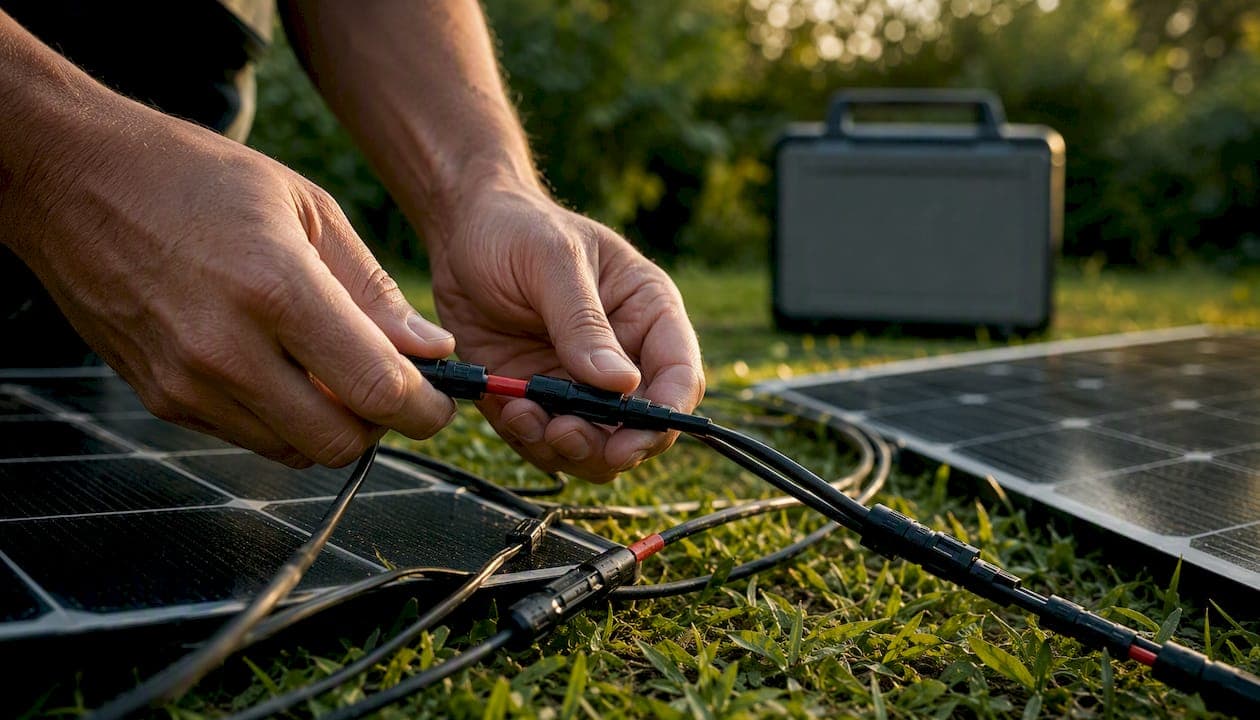
Choose series wiring when your system uses an MPPT charge controller or string inverter with a high-voltage input window, your panels share the same orientation, and your wire runs are long. Choose parallel wiring when you're working with a PWM controller, a low-voltage 12V or 24V battery bank, a portable power station, or a heavily shaded array. When neither alone fits, a series-parallel hybrid balances both.
Quick self-check before you read further:
- Check your inverter or charge controller's PV input window: What is the maximum Voc it accepts? What is its MPPT voltage range? What is the maximum input current?
- Check your site conditions: Are your panels shaded at any point during the day? Are they on a single roof face, or spread across multiple orientations? How far is the array from the controller?
Key Takeaways
Series wiring raises voltage and suits MPPT controllers and long runs; parallel wiring raises current and suits PWM controllers, low-voltage banks, and shaded arrays.
| Point | Details |
|---|---|
| Series raises voltage | Voltages add across panels; current stays near a single panel's Imp, reducing wire size on long runs. |
| Parallel raises current | Currents add across panels; voltage stays near one panel's Vmp, suiting 12V/24V PWM systems and shaded arrays. |
| Check cold Voc before finalizing | Multiply string Voc by your temperature correction factor; the result must stay below your inverter's or controller's maximum input Voc. |
| MLPE changes the tradeoff | Microinverters and power optimizers eliminate shade mismatch in series strings but add hardware cost. |
| Toddra stations define the choice | A portable power station's PV input voltage and current limits tell you directly whether to wire panels in series or parallel. |
Table of Contents
- How series and parallel wiring change voltage and current
- How series wiring behaves in real systems
- How parallel wiring behaves in real systems
- Series vs parallel: a side-by-side comparison
- How to choose series, parallel, or series-parallel for your system
- Series-parallel hybrids, microinverters, and power optimizers
- Worked examples for three common setups
- Safety, code considerations, and wiring best practices
- How to tell whether your panels are wired in series or parallel
- A practical perspective on wiring decisions
- Portable power stations and the series vs parallel decision
- Sources
How series and parallel wiring change voltage and current
The core electrical difference between series and parallel solar configurations comes down to one rule: series adds voltage, parallel adds current. Total power stays the same either way, because P = V × I.
Here's what that means in practice:
- Series: Connect the positive terminal of one panel to the negative terminal of the next. Each panel's voltage adds to the string. Current through the string stays roughly equal to a single panel's rated current (Imp or Isc).
- Parallel: Connect all positive terminals together and all negative terminals together. Each panel's current adds to the total. Voltage across the array stays roughly equal to a single panel's voltage (Vmp or Voc).
A quick numeric example makes this concrete. Say you have three 100W panels, each rated at 20V Vmp and 5A Imp:
- Wired in series: String Vmp = 20 + 20 + 20 = a voltage three times that of one panel. String Imp = the same current as one panel. Total power equals the sum.
- Wired in parallel: Array Vmp = roughly the voltage of one panel. Array Imp = three times the current of one panel. Total power equals the sum.
The wattage is identical. What changes is the voltage-to-current ratio, and that ratio determines which controllers, inverters, and wire gauges work safely and efficiently.
How series wiring behaves in real systems
Wiring panels in series means chaining them positive-to-negative until you reach the string's target voltage. The inverter or MPPT charge controller sees the sum of all panel Vmp values as its operating voltage, and the sum of all Voc values as the open-circuit voltage it must not exceed.
A worked example: Three 40V Vmp panels wired in series produce a 120V Vmp string. Their combined Voc might be 3 × 48V = 144V. If your inverter's maximum input Voc is 150V, that string will trigger an overvoltage fault or, worse, damage the input stage.
Series wiring is the practical winner in several scenarios:
- Long wire runs from array to controller: Higher voltage means lower current for the same wattage, which lets you use thinner wire with less voltage drop. Series strings reduce current and allow smaller conductor AWG over long distances, a real cost and efficiency advantage.
- MPPT charge controllers and string inverters: These devices are designed to operate within a specific voltage window. A higher-voltage series string keeps Vmp inside that window across temperature extremes.
- Unshaded, same-orientation arrays: When all panels face the same direction and receive the same irradiance, series strings perform at their rated efficiency.
Shade behavior is the critical weakness. Because current is shared across the entire series string, the weakest panel limits the whole string's output. A single shaded panel can cut string current dramatically. Bypass diodes inside each panel's junction box redirect current around a shaded cell group, but they don't fully recover lost output. Partial shading on one panel in a series string can greatly reduce the whole string's output; parallel strings or module-level electronics limit that loss but add cost.
Pro Tip: *Before finalizing your string length, multiply each panel's Voc by the number of panels, then apply the manufacturer's temperature coefficient for voltage at your coldest expected temperature.
How parallel wiring behaves in real systems
In a parallel array, every panel's positive lead connects to a common positive bus and every negative lead connects to a common negative bus. The controller or inverter sees a voltage close to a single panel's Vmp, while the total current equals the sum of all panel Imp values.
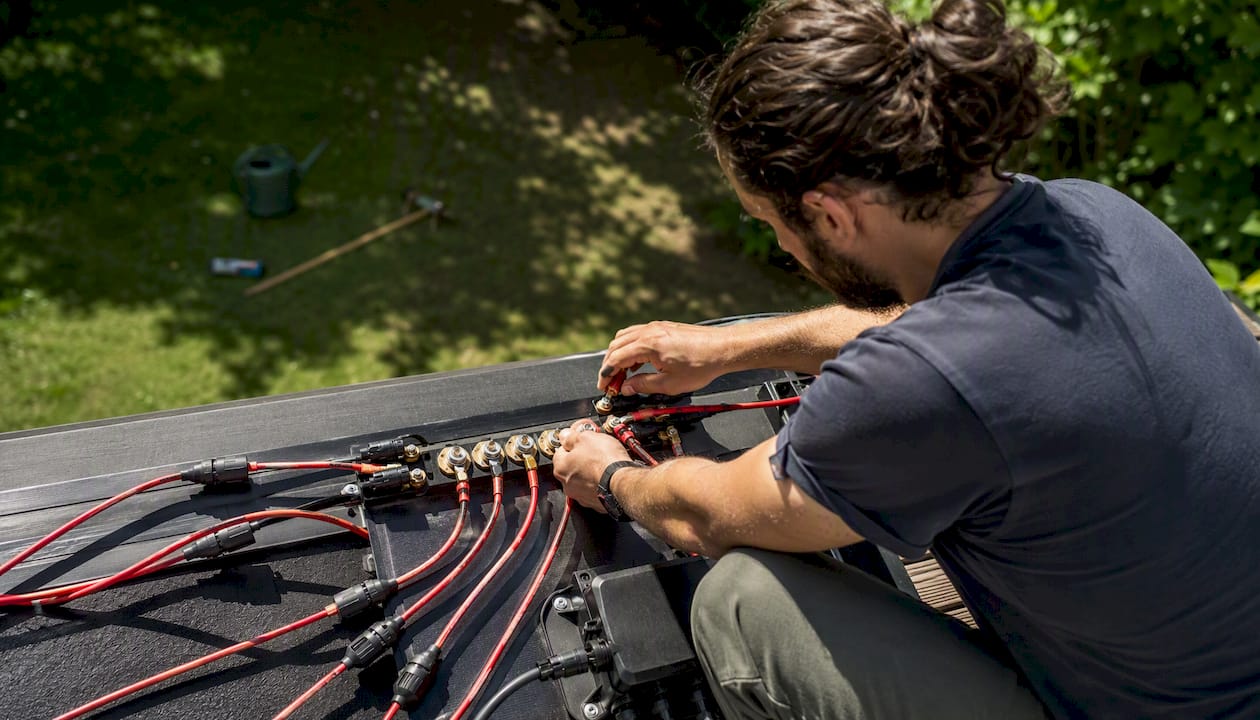
Using the same three 100W, 20V/5A panels from earlier: a parallel array delivers 20V at 15A. That 15A is a meaningful number. Thicker wire is required to carry it safely, and each parallel branch typically needs its own fuse to prevent backfeed from the other panels if one branch develops a fault.
Parallel wiring is the right choice when:
- You're using a PWM charge controller: PWM controllers expect array voltage close to battery voltage and don't step voltage down the way an MPPT does. Wiring panels in series to a PWM controller wastes the extra voltage as heat.
- Your system runs a 12V or 24V battery bank: Parallel keeps array voltage at panel Vmp, which is close enough to battery charging voltage for a PWM controller to work correctly.
- Panels face different directions or experience frequent shading: Each parallel branch operates independently. A shaded panel on one branch doesn't pull down the others.
- You're building a portable or RV system: Shade and orientation vary constantly in mobile setups. Parallel wiring keeps the system producing even when one panel is partially blocked.
Safety requirements for parallel arrays: Branch fusing is not optional when three or more strings are paralleled. A combiner box with properly rated fuses or breakers protects each string from backfeed current. MC4 connectors and branch connectors must be rated for the combined current they carry. The National Electrical Code (NEC) Article 690 governs residential PV installations and specifies conductor ampacity, fusing, and disconnect requirements.
Series vs parallel: a side-by-side comparison
| Criterion | Series wiring | Parallel wiring |
|---|---|---|
| Effect on voltage | Voltages add; current stays at one panel's Imp | Voltage stays at one panel's Vmp; currents add |
| Effect on current | Low combined current | High combined current |
| Best use case | Long wire runs, MPPT/string inverter, unshaded arrays | Short runs, PWM controller, 12V/24V banks, shaded or mixed-orientation arrays |
| Controller compatibility | MPPT charge controllers, string inverters | PWM controllers, microinverter-adjacent low-voltage inputs |
| Single-panel fault or shade | One shaded/failed panel reduces entire string output | Other branches continue operating independently |
| Wire gauge and cost | Thinner wire, lower conductor cost over long runs | Thicker wire, higher conductor cost; combiner box needed |
| Fusing requirements | Typically one string fuse or breaker | Branch fuse per parallel string required at combiner |
| Safety consideration | Must verify cold Voc stays below inverter max | Must verify combined Isc stays within combiner and conductor ratings |
How to choose series, parallel, or series-parallel for your system
Work through these steps in order. Each one narrows your options before you touch a single connector.
-
Check your inverter or charge controller's PV input specifications. Find the maximum Voc (absolute limit), the MPPT voltage range (Vmin to Vmax), and the maximum input current. These three numbers define the electrical box your array must fit inside. Most residential arrays use a mix of series and parallel so the array hits the inverter's voltage window while keeping combined current manageable.
-
Map your shading and roof orientation. Group panels that share the same azimuth and tilt into the same series string. Never mix a south-facing panel with an east-facing one in the same string; the mismatch will drag down the whole string's output.
-
Calculate your wire run and voltage drop. Longer runs favor series wiring because higher voltage means lower current for the same wattage, and voltage drop scales with current. A rough rule: for runs over 50 feet, series wiring typically saves meaningful wire cost and reduces resistive losses.
-
Plan for expandability. Series-parallel lets you add capacity by paralleling a new matched-length string rather than redesigning the whole array. Series-parallel provides a scalable expansion path: add a matched string in parallel and fuse it at the combiner.
Component compatibility at a glance:
| Controller / inverter type | Preferred wiring | Notes |
|---|---|---|
| MPPT charge controller | Series (or series-parallel) | Keep Vmp inside MPPT window; check cold Voc |
| PWM charge controller | Parallel (or single string) | Array Vmp should be close to battery voltage |
| String inverter | Series strings | Verify string Voc against inverter max Voc |
| Microinverter (e.g., Enphase-style) | One panel per microinverter | No string wiring needed; each panel is independent |
| Power optimizer + string inverter | Series strings | Optimizer handles per-panel MPP; string sees optimized voltage |
Series-parallel hybrids, microinverters, and power optimizers
A series-parallel configuration, sometimes written as 2S2P or 3S2P, combines both approaches. You wire two or three panels in series to form a string, then parallel two or more identical strings together. A 2S2P array of 20V/5A panels produces 40V at 10A, for example.
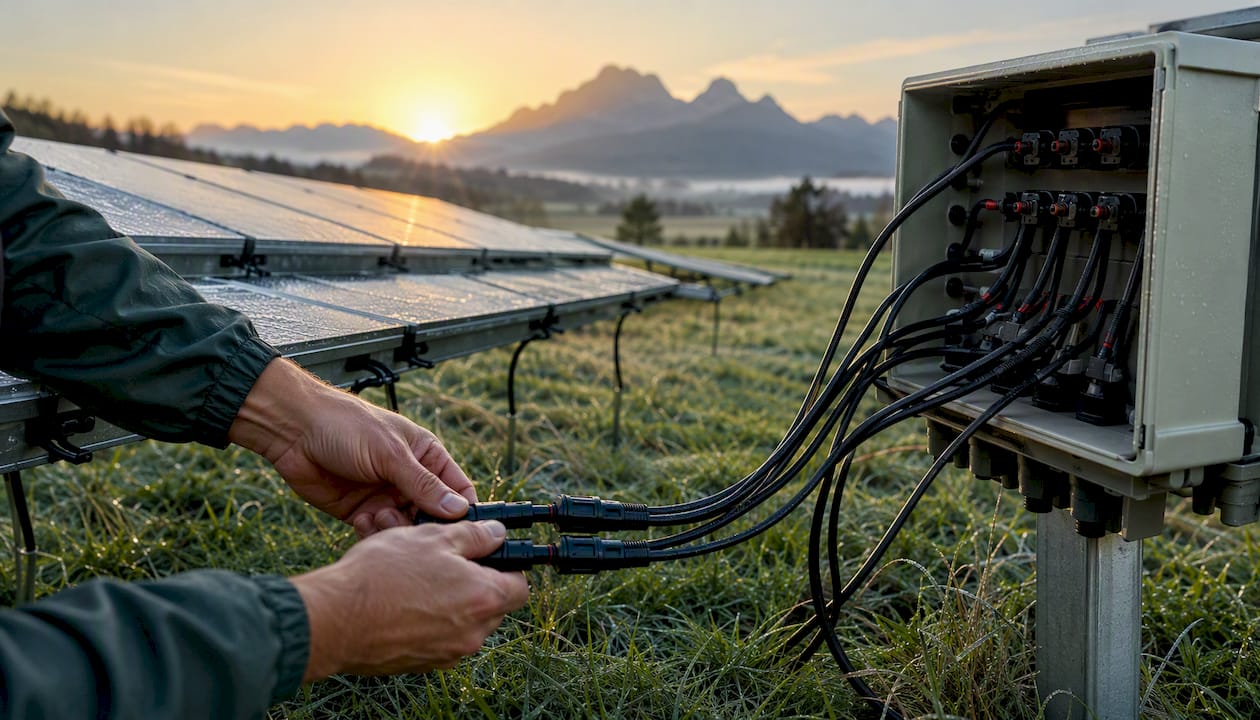
The rules for series-parallel are strict: strings must be identical in panel count, panel model, and ideally panel age. Mismatched strings create voltage imbalances that reduce output and can stress panels. Each parallel string needs its own fuse at the combiner box to prevent backfeed.
Module-level power electronics (MLPE) change the decision entirely. Microinverters, like those in the Enphase IQ series, attach to each panel individually and convert DC to AC at the module. Power optimizers, like those from SolarEdge, perform per-panel maximum power point tracking before feeding a string inverter. MLPE improve shade performance and simplify mismatch, but they increase hardware cost and introduce their own installation requirements.
When MLPE makes sense:
- Mixed roof orientations where panels face different directions and can't be grouped into clean strings.
- Heavy partial shading from trees, chimneys, or neighboring structures.
- Per-panel monitoring is a priority for the system owner.
When MLPE is harder to justify:
- Clean, unshaded, single-orientation arrays where a well-designed series string already captures nearly all available power.
- Budget-constrained portable or off-grid systems where the cost premium doesn't return enough yield improvement.
Worked examples for three common setups
Example 1: Portable power station with two folding panels
You have a portable power station with a PV input rated at 12–30V, 10A maximum. Two 100W folding panels, each rated at 18V Vmp and 5.5A Isc.
- Wired in series: 18 + 18 = 36V Vmp. That exceeds the station's 30V maximum. Series is out.
- Wired in parallel: 18V Vmp, 11A combined Isc. The voltage fits, but the current slightly exceeds the 10A limit. You'd need to check whether the station's input protection handles brief overcurrent, or use a single panel at a time.
- Best approach: Check the station's PV input specifications before connecting. Many portable stations accept a single panel or two panels in parallel within their voltage window. Use MC4-compatible connectors and the correct parallel branch adapter.
Pro Tip: Always read your power station's PV input label before wiring. The voltage window is the hard constraint. A single mismatched series connection can trigger overvoltage protection or permanently damage the charge circuit.
Example 2: 10-panel rooftop array with a string inverter
Ten 400W panels, each rated at 40V Vmp and 48V Voc, feeding a string inverter with a 200–600V MPPT range and 600V maximum Voc.
- 10 panels in series: Vmp = 400V, Voc = 480V. Both values sit comfortably inside the inverter's window. Cold-weather Voc at, say, +15% = 552V, still below 600V. This string works.
- Wire gauge: At 10A string current over a 60-foot run, 10 AWG solar cable handles the load with acceptable voltage drop.
- Expandability: Add a second identical 10-panel string in parallel at the inverter's second string input, if the inverter supports it.
For a deeper look at MPPT benefits for off-grid systems, including how voltage headroom improves efficiency across temperature swings, Toddra's guide covers the key tradeoffs.
Example 3: Small off-grid 48V battery bank, 2S2P layout
Four 200W panels, each rated at 24V Vmp and 8.5A Imp, feeding a 48V MPPT charge controller.
- 2S2P layout: Two panels in series per string (48V Vmp, 8.5A Imp), two strings in parallel. Combined: 48V, 17A into the controller.
- Combiner fusing: Each string needs a 15A fuse at the combiner box to protect against backfeed from the parallel string.
- Cold Voc check: Each panel's Voc is, say, 30V. Two in series = 60V Voc. At coldest temperature (+15%) = 69V. Confirm the MPPT controller's maximum PV input Voc exceeds 69V before finalizing.
For campsite and portable solar setups that mirror this kind of layout, Toddra's practical guide walks through hardware selection and connector choices in detail.
Safety, code considerations, and wiring best practices
A well-designed array that violates a safety rule is still a hazard. Work through this checklist before energizing any PV system.
- Never exceed inverter or controller maximum Voc. Calculate cold-weather Voc using the panel's temperature coefficient for voltage (typically listed on the datasheet as %/°C) and your site's record low temperature. Apply a safety factor of at least 1.10.
- Fuse each parallel string. NEC Article 690 requires overcurrent protection for each source circuit when three or more strings are paralleled. Use fuses or breakers rated for DC PV service, not standard AC fuses.
- Size conductors for the application. Series strings carry low current; 10 AWG or 12 AWG solar cable typically handles most residential string currents. Parallel arrays carry the sum of all string currents; size up accordingly and verify ampacity against NEC 690.8.
- Use solar-rated MC4-compatible connectors. Standard electrical connectors are not rated for outdoor UV exposure or the DC arc energy in PV circuits. Renogy and Rich Solar both supply MC4-compatible branch connectors and extension cables designed for PV use. Never mix connector brands without confirming compatibility, as mismatched MC4-style connectors can arc or loosen over time.
- Install a DC disconnect. A readily accessible DC disconnect between the array and the charge controller or inverter lets you safely de-energize the array for maintenance.
- Label all conductors. Mark polarity clearly at every junction, combiner box, and disconnect point.
How to tell whether your panels are wired in series or parallel
-
Visual inspection first. Trace the wiring from the panels. In a series string, you'll see a cable running from the positive of one panel to the negative of the next, daisy-chaining across the array. In a parallel array, you'll see branch connectors (T or Y connectors) combining all positives on one cable and all negatives on another.
-
Measure open-circuit voltage at the array output. With the controller or inverter disconnected and the array in full sun, measure Voc at the end of the array cable. If the reading is close to one panel's Voc, the panels are in parallel. If it's a multiple of one panel's Voc, they're in series.
-
Measure short-circuit current (with appropriate equipment). A clamp meter around the positive conductor shows Isc. Close to one panel's Isc means series; a multiple means parallel. Only perform this measurement with proper DC-rated test equipment.
-
Troubleshoot underperformance by isolating strings. If one string is underperforming, disconnect it at the combiner and measure its Voc independently. A low reading points to a shaded, failed, or reversed panel within that string.
Warning: Never disconnect or reconnect MC4 connectors under load. Always isolate the string from the controller or inverter first, and use insulated tools. PV circuits remain live as long as light hits the panels.
A practical perspective on wiring decisions
The series-versus-parallel debate gets more complicated than it needs to be in most online discussions. Two rules of thumb cover the vast majority of real systems: use series strings for long runs and unshaded, same-orientation arrays feeding an MPPT controller or string inverter; use parallel wiring or MLPE wherever shade, mixed orientations, or low-voltage battery banks are involved.
What gets underestimated is the cold-Voc check. Designers who skip it often discover their string trips the inverter's overvoltage protection on the first cold, clear morning of the year. That's a frustrating and avoidable problem. Build the margin in at the design stage, not after installation.
For portable power users, the decision is usually simpler: the power station's PV input window makes the choice for you. Most portable stations accept a narrow voltage range that favors one or two panels in parallel. Checking that window before buying panels saves a lot of connector frustration in the field.
Portable power stations and the series vs parallel decision

Portable power stations simplify the series-versus-parallel question for small systems because the unit's PV input specifications define the answer directly. Most stations list a maximum PV input voltage between 12V and 60V and a maximum input current between 8A and 15A. Those two numbers tell you immediately whether your panels should be wired in series, parallel, or used one at a time.
If your panels' Vmp in series exceeds the station's voltage ceiling, parallel is the answer. If parallel pushes combined Isc above the current limit, you may need to use a single panel or check whether the station's MPPT input handles the current safely. Folding solar panels designed for portable use typically come in 12V–24V Vmp ranges that pair naturally with parallel wiring into a portable station.
Toddra's lineup of portable power stations and solar generators is built with clearly documented PV input windows, LiFePO4 battery chemistry, and solar compatibility designed for exactly these setups. Whether you're powering a campsite, preparing for an outage, or running an off-grid workspace, you can browse Toddra's full range at Toddra and match a station to your panel configuration with confidence.
Sources
The following sources informed this guide and are worth consulting when sizing strings, selecting wire gauge, or verifying controller compatibility:
- How to Wire Solar Panels in Series or Parallel: Voltage, Current, Shade, and Safety — NerdVolt
- How to connect two or multiple solar panels together - A1 SolarStore Magazine
- Solar Panel Wiring: Series vs Parallel vs Series-Parallel Explained | SunForgeLab
- Do you wire solar panels series or parallel? — SolarReviews