TL;DR:
- Solar charging provides renewable, silent power to critical loads during grid failures, ensuring energy independence. A properly sized hybrid system with solar panels, batteries, and an inverter can support essential household needs for days and handle surge demands effectively. Vehicle-integrated photovoltaics enhance disaster recovery by offering mobility and continuous charging, reducing battery depletion in prolonged outages.
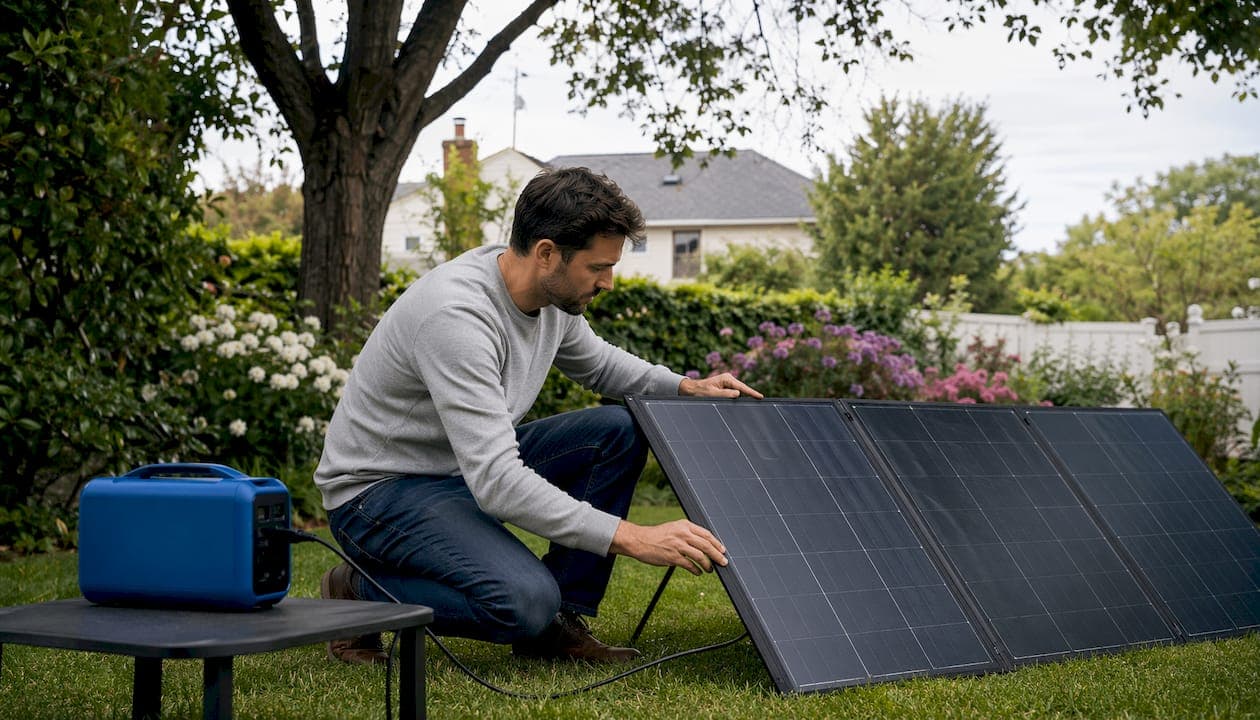
Solar charging in a grid-down scenario is defined as the use of photovoltaic panels and battery storage to sustain essential electrical loads when the utility grid fails. The role of solar charging in a grid-down scenario goes beyond simple convenience. It provides a renewable, silent power source that keeps refrigerators running, communications active, and lights on during outages that can last days or weeks. A properly sized system, built around a solar array, a battery bank, and a well-planned load list, gives you real energy independence when the grid cannot. This guide covers system sizing, common pitfalls, grid-tied limitations, and the emerging use of solar electric vehicles (SEVs) in disaster recovery.
What makes an effective solar charging system for grid-down preparedness?
An effective off-grid solar solution starts with two numbers: array wattage and battery capacity. A 2,000W solar array paired with a 10 kWh battery bank is the recognized baseline for supporting essential 24/7 household loads across multiple days. That combination keeps a refrigerator, basic lighting, and communications running without requiring you to ration power aggressively.
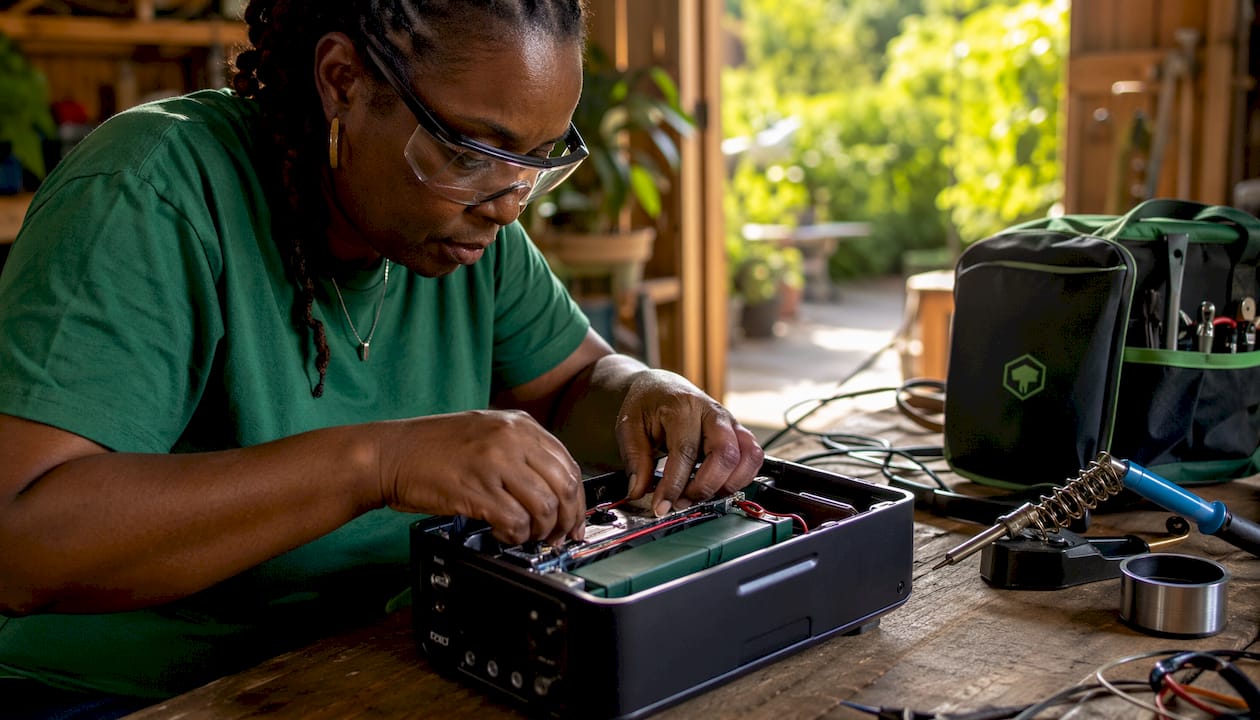
Battery capacity is not just about total kilowatt-hours. It determines how many cloudy days you can survive without meaningful solar input. A 10 kWh bank gives you a meaningful buffer, but the math only works if you know your critical loads and stick to them. Prioritizing loads means identifying which devices are non-negotiable: refrigerator, medical equipment, phone charging, and a router.
Surge capacity is the detail most people overlook. Refrigerator compressors surge up to 2,200W at startup, even though the continuous draw is only around 150W. An inverter sized for continuous wattage will trip the moment the compressor kicks on. Your inverter must be rated to handle startup surges, not just steady-state consumption.
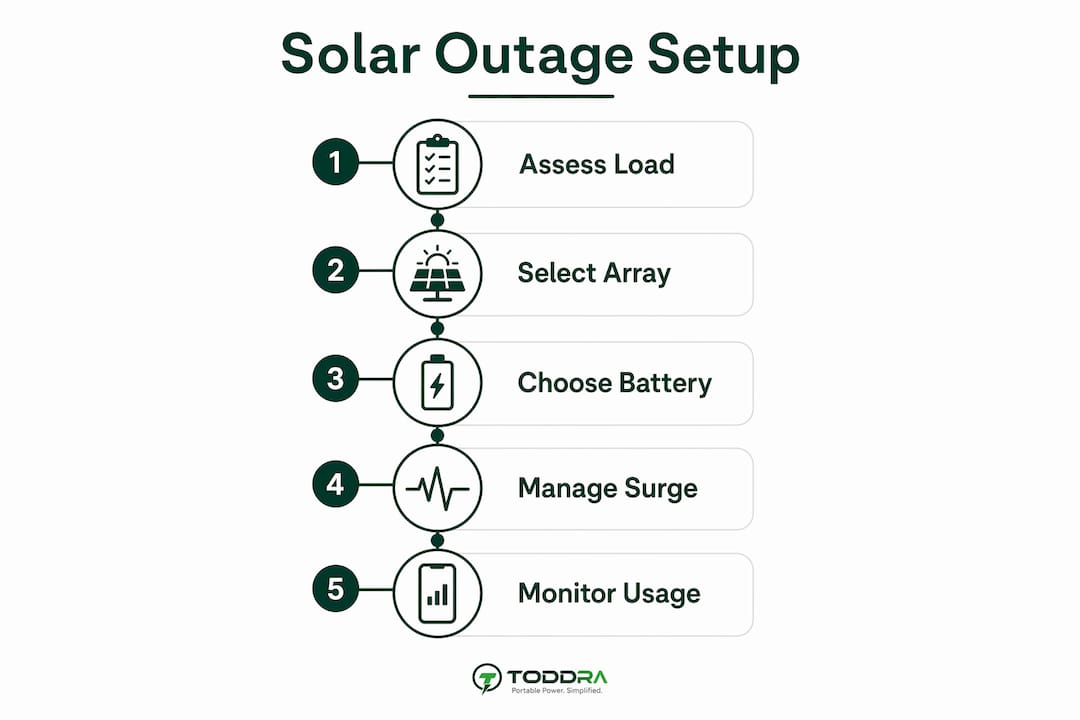
Pro Tip: Size your inverter to at least twice the continuous wattage of your highest-surge appliance. A 3,000W inverter handles a 2,200W compressor surge with room to spare.
Here is a quick sizing reference based on household scale:
| Household size | Recommended solar array | Recommended battery bank | Critical loads supported |
|---|---|---|---|
| 1–2 people | 1,000–1,500W | 5–7 kWh | Fridge, lights, phones |
| 3–4 people | 2,000W | 10 kWh | Fridge, lights, router, fans |
| 5+ people | 3,000W+ | 15 kWh+ | Fridge, HVAC, medical, comms |
Key components every system needs:
- Solar panels rated for your array wattage target
- A charge controller (MPPT type for best efficiency)
- A battery bank with enough capacity for at least three days of critical loads
- An inverter rated above your highest surge load
- A critical load subpanel to isolate essential circuits
For a detailed walkthrough of putting these pieces together, the solar generator home backup setup guide covers configuration steps for different home sizes.
Why do grid-tied solar systems fail during outages?
Grid-tied solar systems automatically shut down the moment the utility grid goes offline. This is not a flaw. It is a required safety feature. If a grid-tied inverter kept pushing power onto a dead grid, utility workers repairing lines could be electrocuted. Grid-tied inverters shut down automatically during outages to protect line crews, which means your rooftop panels produce nothing for you during the exact emergency you installed them for.
The fix is a hybrid inverter with a dedicated backup load port. Hybrid inverters can isolate a critical load subpanel from the main grid connection. When the grid drops, the inverter switches to battery and solar power for that subpanel only. The rest of the house goes dark, but your refrigerator, router, and lights stay on.
Three system types and their outage readiness:
- Grid-tied only: Shuts down completely during outages. Zero backup capability without additional hardware.
- Hybrid (solar + battery + grid connection): Maintains power to a critical load subpanel during outages. The most practical upgrade for existing grid-tied owners.
- Full off-grid: Operates entirely independent of the utility grid. Highest resilience, highest upfront cost, and requires careful sizing.
Properly sized off-grid solar systems can support EV charging, home HVAC, and other loads while treating the grid as a secondary backup rather than the primary source. That mindset shift, viewing solar as your primary source, is what separates prepared households from those caught off guard.
How do solar electric vehicles boost disaster recovery?
Solar electric vehicles (SEVs) represent one of the most practical and underappreciated tools in disaster energy recovery. Unlike a standard battery electric vehicle that depletes and stays depleted, SEVs provide continuous photovoltaic input that reduces the risk of full discharge even when no charging infrastructure is available.
The mobility advantage is significant. A stationary solar array cannot move away from a fallen tree or a flooded roof. An SEV can reposition to find unobstructed sunlight, drive to a neighborhood that needs power, or serve as a mobile charging hub for neighbors without any setup. SEVs are most effective when road access is restored before grid power, which is the typical sequence in most natural disasters. Roads clear before power lines get repaired.
Pro Tip: If you own an SEV, park it in an open area during a multi-day outage. Even partial sun exposure keeps the battery topped up and the vehicle ready to move or share power.
Practical advantages of SEVs in grid-down conditions:
- Continuous solar charging reduces battery depletion risk during extended outages
- Repositioning capability avoids shading from storm debris or damaged structures
- Vehicle-to-load (V2L) ports on many modern EVs allow direct appliance powering
- Mobile delivery of power to neighbors or community members without their own systems
Limitations are real and worth acknowledging. Vehicle damage from the same storm that caused the outage is a genuine risk. Charging infrastructure for non-solar EVs collapses during grid failures, which is exactly why the solar integration matters. For flexible setups that combine mobility with solar generation, the solar-powered camping setups guide shows real-world configurations that translate directly to emergency use.
What strategies maximize solar charging during prolonged outages?
Battery management during a multi-day outage follows one core rule: match your consumption to your production window. Running high-draw appliances like washing machines or power tools during peak solar hours, roughly 10:00 AM to 3:00 PM, keeps your battery bank from depleting overnight. Nighttime draws should be limited to the lowest-wattage critical loads only.
Cloudy days are the real test of any solar charging system. Systems need at least three days of battery capacity to endure extended low-production periods without a recharge. A single cloudy day is manageable. Three consecutive overcast days will drain an undersized bank completely. Build your battery capacity around worst-case weather, not average conditions.
A hybrid solar and generator approach solves the cloudy-day problem without requiring a massive battery bank. Hybrid systems combining solar, battery storage, and a propane generator maximize resilience by letting each component do what it does best. Solar runs silently during the day. Batteries cover the night. The generator handles extended cloudy stretches or high-demand moments. A well-dimensioned hybrid system reduces generator runtime by 60–70%, which stretches your fuel supply significantly.
Here is a practical daily management sequence for a multi-day outage:
- Morning check: Review battery state of charge before running anything beyond essentials.
- Midday window: Run high-draw appliances (laundry, cooking, power tools) during peak solar hours.
- Afternoon: Confirm battery is charging toward full before sunset.
- Evening: Switch to low-draw mode. Refrigerator, minimal lighting, phone charging only.
- Generator trigger: Start the generator only when battery drops below 20% state of charge on a cloudy day.
- Fuel discipline: Run the generator to charge batteries to 80%, then shut it off. Do not idle it for continuous power.
Pro Tip: Underestimating surge loads is the most common reason solar systems fail during outages. Before any emergency, run each major appliance and note the startup current on a clamp meter. Size your inverter and battery to that number, not the nameplate wattage.
The benefits of solar versus gas during emergencies are clearest in this hybrid context. Solar handles the quiet, predictable baseline. The generator handles the spikes. Together, they cover nearly every scenario a prolonged outage can produce.
Key Takeaways
Solar charging in a grid-down scenario works best when solar panels, a properly sized battery bank, and a hybrid inverter combine to cover critical loads through both sunny and cloudy periods.
| Point | Details |
|---|---|
| System sizing baseline | A 2,000W array with a 10 kWh battery bank supports essential loads for multiple days. |
| Grid-tied limitation | Grid-tied inverters shut down during outages; a hybrid inverter with a backup port solves this. |
| Surge load planning | Size your inverter above the highest startup surge, not just continuous wattage. |
| Cloudy-day buffer | Build at least three days of battery autonomy to survive extended low-sun periods. |
| Hybrid resilience | Combining solar, batteries, and a generator cuts generator runtime by 60–70%. |
Solar preparedness: what years of watching systems succeed and fail taught me
The most common mistake I see is treating solar as a set-and-forget system. People install panels, feel secure, and never think about what happens when three cloudy days hit in a row during a January ice storm. The battery bank they sized for a sunny week in July is empty by day two.
The shift that actually changes outcomes is treating your solar system as a living part of your household, not a backup appliance. That means knowing your state of charge every morning, knowing which loads to cut first, and having a generator ready as a partner, not a replacement. The households that come through extended outages well are the ones who practiced their load management before the emergency arrived.
SEVs are the development I am most excited about for the next decade of emergency preparedness. The ability to reposition a power source, avoid storm damage to a fixed array, and deliver energy to neighbors without any infrastructure is genuinely new. It changes the math on community resilience in ways that a rooftop array simply cannot. I expect vehicle-integrated photovoltaics to become a standard feature in emergency planning conversations within five years.
The honest advice I give everyone is this: start with a portable power station and a quality solar panel. Learn how your household actually consumes power under stress. Then scale up. The people who buy a massive system without that baseline knowledge almost always size it wrong.
— Jackson
Toddra's portable power stations for grid-down readiness
Toddra carries a carefully selected range of portable power stations and solar generators built for exactly the scenarios covered here. Whether you need a compact unit for essential device charging or a high-capacity system to run a refrigerator through a multi-day outage, Toddra's lineup covers both ends of the spectrum.
The Jackery Battery Pack 5000 Plus expansion battery offers 5,040Wh of capacity, making it a strong foundation for households that need multi-day endurance. Toddra's systems use LiFePO4 battery chemistry for safe, stable, long-cycle performance. US-based customer support and secure checkout make the buying process straightforward. Visit Toddra's full power station catalog to find the right fit for your household size and preparedness goals.
FAQ
What is the role of solar charging in a grid-down scenario?
Solar charging sustains essential electrical loads by converting sunlight into electricity and continuously recharging battery storage when the utility grid is unavailable. It provides a silent, renewable power source for refrigerators, communications, and lighting during outages.
Will my existing rooftop solar panels work during a power outage?
Standard grid-tied solar systems shut down automatically during outages for safety reasons. You need a hybrid inverter with a backup load port, or a separate off-grid system, to use solar power when the grid is down.
How many days of battery capacity do I need for a grid-down emergency?
A minimum of three days of battery autonomy is recommended to handle extended cloudy periods without solar recharge. A 10 kWh battery bank paired with a 2,000W array covers most essential household loads for that window.
Can a solar electric vehicle power my home during an outage?
Many modern EVs with vehicle-to-load ports can power appliances directly. Solar electric vehicles add continuous photovoltaic charging, reducing the risk of full battery depletion even without grid access or charging infrastructure.
How do I reduce generator fuel use during a prolonged outage?
Run the generator only when battery state of charge drops below 20%, charge to 80%, then shut it off. A properly sized hybrid solar and battery system can cut generator runtime by 60–70%, stretching your fuel supply across a much longer outage.