TL;DR:
- Solar power provides reliable, fuel-free electricity during emergencies by using batteries and sunlight. It offers lower long-term costs and eliminates safety risks associated with gas generators, such as carbon monoxide emissions. Hybrid systems combine solar and gas to address varied power needs effectively.
Solar power is the superior choice for emergency energy because it delivers clean, quiet, and fuel-free electricity when you need it most. Gas generators depend on a supply chain that breaks down exactly when crises hit. Solar panels, paired with battery storage, keep working regardless of fuel availability, price spikes, or dangerous fumes. Understanding why solar power beats gas emergencies means looking at three factors: reliability, cost, and safety. The data from 2026 makes the case clearly, and consumer behavior is already shifting to reflect it.
Why solar power beats gas in a real emergency
Solar power provides emergency electricity without any fuel dependency. That single fact separates it from gas generators in every meaningful way. Gas generators rely on fuel reserves that last weeks, while solar panels last decades. During a prolonged crisis, a gas generator becomes useless the moment the fuel runs out or the supply chain collapses.

Battery storage technology makes solar even more dependable. Modern portable solar stations increasingly use LiFePO4 battery chemistry, which offers longer cycle life and better safety than older lithium-ion designs. That means your stored solar energy stays available across multiple days of cloudy weather or high demand. Battery energy storage also responds at the millisecond level, compared to the slow start-up time of a gas generator.
Consumer confidence in the grid is eroding fast. 78% of U.S. homeowners worry about power grid reliability, and 64% plan solar investments within five years to guard against blackouts. That shift reflects a hard lesson: grid-dependent households and fuel-dependent generators both fail when infrastructure is stressed.
Key reliability advantages of solar over gas in emergencies:
- No fuel to source, store, or run out of during a crisis
- LiFePO4 batteries provide multi-day storage with stable output
- Silent operation means no noise during extended outages
- Solar panels continue generating power as long as sunlight is available
- No moving parts means fewer mechanical failures under stress
Pro Tip: Size your battery storage for at least two days of essential load. Refrigeration, lighting, and phone charging together typically draw far less than heating, so prioritize those first when solar input is limited.
How does solar power save money compared to gas generators?
The economic case for solar over gas is not subtle. Solar fuel costs are zero, while gas fuel accounts for 60–70% of a gas generator's total operating expenses. Solar installation costs dropped roughly 90% since 2010. Gas prices remain volatile and tied to geopolitical events that are impossible to predict.
The real-world scale of those savings became visible in early 2026. Europe's solar fleet offset €1.9 billion in gas import costs over just 2.5 weeks during a geopolitical conflict. That works out to an average of €136 million saved per day. The implication for individual households is direct: every kilowatt-hour your solar system generates is one you do not pay for at a volatile market price.
Battery storage adds another layer of financial advantage. Battery storage costs roughly 30% less than building new gas peaker capacity. For consumers, that translates to lower upfront costs on solar-plus-storage systems compared to the long-term expense of fueling and maintaining a gas generator across years of use. The lifecycle cost difference between the two options grows wider every year as gas prices fluctuate and solar hardware costs continue to fall.
| Cost Factor | Solar Power | Gas Generator |
|---|---|---|
| Fuel cost | $0 | Ongoing, volatile |
| Installation cost trend | Down ~90% since 2010 | Stable or rising |
| Maintenance complexity | Low, no moving parts | Higher, engine servicing needed |
| Long-term resilience | Decades of operation | Limited by fuel access |
| Emergency fuel risk | None | High during supply disruptions |
Is solar power safer than gas during an emergency?
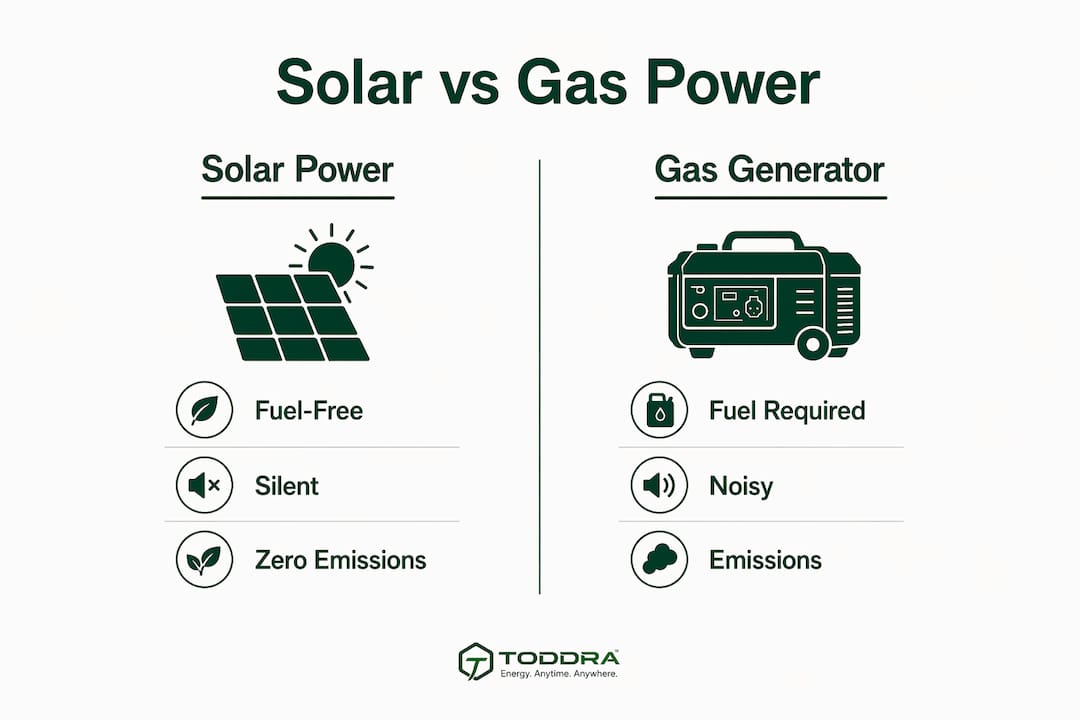
Solar generators produce zero carbon monoxide. That fact alone makes them categorically safer for any indoor or semi-enclosed use during an emergency. Gas generators emit carbon monoxide at levels that can be lethal within minutes in a closed space. Every year, emergency events produce a wave of carbon monoxide poisonings from gas generators used indoors or in garages. Solar eliminates that risk entirely.
Solar generators operate silently and require no combustion. That means no fumes, no fire risk from fuel storage, and no noise that disrupts sleep or communication during a crisis. For families with children, elderly members, or anyone with respiratory conditions, that difference is not a minor comfort. It is a genuine health protection.
The environmental benefits compound over time. Solar systems produce no direct emissions during operation. Gas generators burn fossil fuels continuously, releasing carbon dioxide and particulates with every hour of use. For consumers who care about their carbon footprint, solar is the only responsible choice for long-term emergency preparedness.
Safety advantages of solar over gas generators:
- Zero carbon monoxide production, safe for indoor use
- No fuel storage required, eliminating fire and spill risks
- Silent operation, no noise pollution during extended outages
- No exhaust fumes, protecting air quality inside and around the home
- Lower maintenance risk, no engine oil or spark plug failures
Pro Tip: Place your solar generator near a window or exterior wall to run a short cable to solar panels outside. This keeps the unit indoors for safety while still capturing sunlight efficiently.
When does a hybrid solar-gas setup make sense?
Solar power excels at sustained, quiet, and clean energy delivery. Gas generators excel at short, high-power bursts. Hybrid systems combining both cover each other's weaknesses and offer the best overall emergency preparedness for households with complex or unpredictable power needs.
The practical case for a hybrid setup comes down to load management. Solar generators have real output limits. Running a well pump, a central air conditioner, or a large electric range simultaneously can exceed what a portable solar station can deliver. A gas generator handles those peak loads while the solar system manages continuous, lower-draw devices like refrigerators, lights, and communication equipment.
Managing energy loads is the skill that makes any emergency power system work. Prioritizing essential loads means running refrigeration and communication devices first, since heating is generally less efficient to power from a portable system. A hybrid approach lets you use gas for short, heavy tasks and solar for everything else, reducing fuel consumption dramatically compared to running a gas generator around the clock.
| Scenario | Best Choice | Reason |
|---|---|---|
| Multi-day outage, moderate loads | Solar with battery storage | Zero fuel cost, continuous operation |
| Short-term, high-power demand | Gas generator | High output for heavy appliances |
| Extended crisis, mixed loads | Hybrid solar-gas system | Covers both sustained and peak needs |
| Indoor or apartment use | Solar only | No fumes, safe for enclosed spaces |
| Low-sun winter emergency | Hybrid system | Gas fills gap when solar input drops |
The portable vs. stationary emergency power question also matters here. Portable solar stations give you flexibility to move power where it is needed. A stationary gas generator is fixed in place and requires ventilation planning. For most households, a portable solar generator as the primary system with a gas generator as a backup for peak loads is the most practical and cost-effective configuration.
Key Takeaways
Solar power outperforms gas generators in emergencies because it delivers fuel-free, silent, and safe electricity with lower lifetime costs and greater long-term resilience.
| Point | Details |
|---|---|
| Fuel independence wins crises | Solar panels keep generating power when gas supply chains collapse or fuel runs out. |
| Zero fuel cost advantage | Solar operating costs are effectively zero; gas fuel makes up 60–70% of generator expenses. |
| Safety is non-negotiable | Solar produces no carbon monoxide, making it safe for indoor use unlike gas generators. |
| Battery storage extends reliability | LiFePO4 batteries provide multi-day storage with fast response and long cycle life. |
| Hybrid setups fill the gaps | Combining solar and gas covers both sustained loads and short high-power demands. |
Solar power and emergency readiness: my honest assessment
I have followed the emergency power space closely for years, and the shift toward solar is not hype. It is a rational response to real vulnerabilities that gas-dependent systems expose every time a major storm, conflict, or supply disruption hits.
What strikes me most is how the conversation has changed. Three years ago, most consumers asked whether solar was "good enough" for emergencies. Now the question is how to size the system correctly. That shift reflects genuine confidence in the technology, and it is well-earned. LiFePO4 battery technology has matured to the point where portable solar stations are genuinely reliable for multi-day outages, not just a novelty for camping trips.
The one thing I push back on is the idea that solar alone solves every emergency scenario. It does not. A week of heavy cloud cover in january during a winter storm is a real constraint. That is exactly why I think hybrid setups deserve more attention than they get. Solar handles 80–90% of your emergency load with zero fuel cost and zero fumes. Gas covers the rest. That combination is more resilient than either system alone, and it is more honest about the limits of current technology.
The data from 2026 confirms what the technology already suggested: solar is not the future of emergency power. It is the present. Consumers who invest in solar now are building resilience that compounds over decades, not just preparing for the next outage.
— Jackson
Toddra's solar generators for dependable emergency power
Reliable emergency power starts with the right equipment, and Toddra carries a carefully selected range of portable solar generators and power stations built for exactly this purpose.
Toddra's lineup includes systems equipped with LiFePO4 battery technology, fast charging, and solar compatibility, giving you the fuel-free, quiet, and safe backup power that gas generators simply cannot match. Whether you need a compact unit for essential devices or an expandable system for whole-home backup, Toddra's solar generator selection covers the full range. For consumers who want to extend runtime further, the Jackery Battery Pack 2000 Plus adds over 2,000Wh of expandable capacity to compatible systems. US-based customer support and secure checkout make the process straightforward from first question to final purchase.
FAQ
Why does solar power outperform gas generators in emergencies?
Solar power requires no fuel, produces no carbon monoxide, and operates silently, making it safer and more reliable when supply chains fail. Gas generators depend on fuel access that often collapses during the same crises that cause power outages.
How long can a solar generator power a home during an outage?
Runtime depends on battery capacity and load size, but systems with LiFePO4 batteries can power essential devices like refrigerators, lights, and phones for multiple days when paired with adequate solar panels.
Are solar generators safe to use indoors?
Solar generators produce zero emissions and no carbon monoxide, making them safe for indoor use. Gas generators must always be used outdoors or in well-ventilated spaces due to lethal fume risk.
What is the cost difference between solar and gas for emergency power?
Solar fuel costs are zero, while gas fuel accounts for 60–70% of a gas generator's operating expenses. Solar installation costs have dropped roughly 90% since 2010, widening the lifetime cost advantage further.
When should you use a hybrid solar-gas system?
A hybrid system makes sense when your emergency loads include high-power appliances that exceed solar output limits, or when extended low-sun periods reduce solar input. Solar handles continuous loads; gas covers short, heavy-demand tasks.