
TL;DR:
- A portable power station under 20 pounds provides essential, quiet energy for travelers on short or long trips. Choosing the right weight and capacity ensures reliable device support while complying with airline regulations and maximizing off-grid independence. Pairing lightweight stations with solar panels extends energy supply, making outdoor adventures safer and more sustainable.
A lightweight power station is a portable battery system under about 20 pounds that delivers dependable energy for travelers without adding bulk or fatigue. Understanding why lightweight power station matters travel comes down to one core truth: when your devices die far from an outlet, the weight of your power solution determines whether you carry it at all. Industry guidance defines lightweight travel power stations as under 20 lbs, with under 10 lbs ideal for small devices and 10–25 lbs for 1kWh-class capacity. That range covers everything from a weekend backpacking trip to a two-week road trip through national parks. Choosing the right weight class is the first decision every traveler should make before buying.
Why does a lightweight power station matter for travel?
Weight is the single most practical constraint in travel. A unit you leave in the car because it's too heavy to carry to the campsite is a unit that fails you. Battery failure on the road causes loss of access to boarding passes, hotel reservations, and navigation apps, creating real time loss and emergency charging costs. That consequence alone makes travel power station importance impossible to ignore.
The physical experience of carrying power matters just as much as the watt-hours on the spec sheet. Consider these weight thresholds and what they mean in practice:
- Under 10 lbs: Fits in a carry-on or daypack. Handles phones, tablets, earbuds, and small cameras. Best for short trips and light travelers.
- 10–20 lbs: One-handed carry from car to campsite. Powers laptops, camera gear, and small fans. The sweet spot for most weekend travelers.
- 20–25 lbs: Two-handed carry, often with a handle. Supports 1kWh-class capacity for multi-day trips with heavier devices.
- Over 30 lbs: A large power station at 39 lbs may require two people to carry over rugged terrain, increasing setup time and reducing real-world usability.
Airline regulations add another layer of complexity. Most carriers restrict lithium batteries by watt-hour rating, not weight alone, but heavier units almost always carry larger cells that push against carry-on limits. Checking those limits before you pack saves you from a gate-side decision you don't want to make.
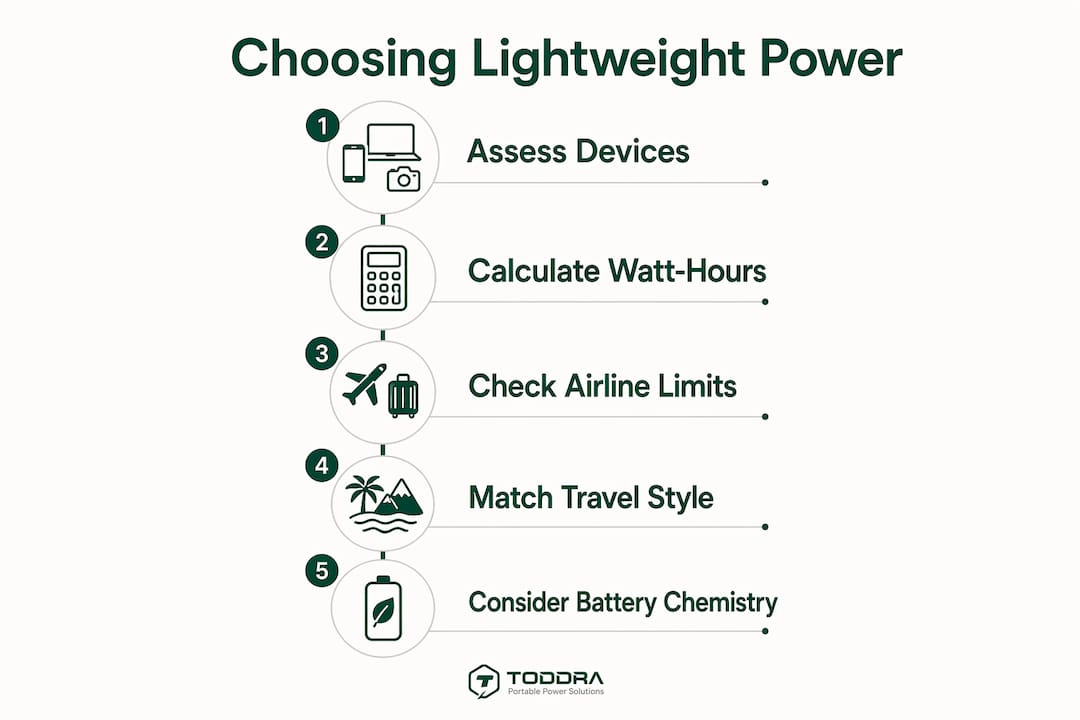
Pro Tip: Before buying, list every device you plan to charge and add up their watt-hour needs. Then choose the lightest unit that covers that total with 20% headroom for efficiency loss.

What power capacities are practical for different travel styles?
Matching capacity to travel style prevents two common mistakes: buying too little power and going dark on day three, or buying too much and straining your back for the entire trip. The right answer depends on how you travel, how long you stay out, and what devices you need to keep running.
For trips shorter than 5–7 days, a high-quality USB-C PD power bank weighing around 1–1.5 lbs often suffices. Trips longer than seven days benefit from a dedicated lightweight power station paired with portable solar panels for continuous off-grid power. That functional cutoff is worth writing down before you shop.
The table below maps typical capacity ranges to travel styles, approximate weights, and device compatibility:
| Capacity | Typical Weight | Best For | Device Support |
|---|---|---|---|
| Under 100Wh | Under 2 lbs | Day trips, flights | Phones, earbuds, small cameras |
| 100–500Wh | 2–10 lbs | Weekend trips | Phones, tablets, laptops |
| 500Wh–1kWh | 10–20 lbs | 3–5 day camping | Laptops, CPAP, mini fridge |
| 1kWh–2kWh | 20–25 lbs | Week-long off-grid | Full device suite, power tools |
Output port variety matters as much as raw capacity. Lightweight stations with AC outlets, USB-C PD, and 12V sockets let travelers create a reliable digital home in remote locations, reducing anxiety over finding power at airports, hotels, or cafes. A unit with only USB ports leaves your laptop and CPAP machine out of luck.
Battery chemistry also shapes the trade-off between weight and longevity. NCM batteries offer higher energy density and lighter weight than LiFePO4 batteries, which are heavier but deliver a longer cycle life. Frequent travelers who prioritize a lighter pack often choose NCM. Travelers who want a unit that lasts years of heavy use lean toward LiFePO4. Neither choice is wrong. The right one depends on how often you travel and how long you plan to own the unit. For guidance on sizing wattage to your needs, Toddra's camping wattage guide breaks down the math clearly.
How lightweight power stations have transformed off-grid travel
Silent, emission-free power is not a minor convenience. It changes the character of an outdoor experience entirely. Lightweight power stations provide silent, emission-free power capable of running sensitive electronics without the noise or fuel storage drawbacks of traditional generators. That shift has made van life, dispersed camping, and remote work travel genuinely comfortable rather than just survivable.
The practical benefits stack up quickly:
- No fuel storage: Gasoline generators require fuel cans, spill risks, and ventilation. A battery station needs none of that.
- Sensitive electronics support: CPAP machines, insulin coolers, and camera charging systems all run cleanly on battery power without voltage spikes.
- Solar compatibility: Pairing a station with portable solar panels creates a self-sustaining energy loop. Toddra's guide on portable solar panel benefits covers this in detail.
- Zero noise pollution: Running a generator at a campsite draws complaints and breaks the quiet that most outdoor travelers came to find.
"The emergence of silent, emission-free lightweight power stations has fundamentally increased off-grid travel comfort by allowing sensitive device use without noise or fume concerns. That shift is not incremental. It represents a complete rethinking of what portable power can feel like in the field."
For travelers who want to understand why portable power is safer than a generator, the safety case goes well beyond convenience. Carbon monoxide risk alone makes battery stations the only responsible choice inside a tent, van, or cabin.
How to maximize utility: pairing lightweight stations with solar panels
A lightweight power station paired with solar panels turns a finite battery into an indefinite energy source. That combination is the most practical upgrade any serious traveler can make. Pairing a lightweight station under 30 lbs with a 100W–200W solar panel saves over $600 upfront compared to heavier setups while providing sufficient energy for 3–5 day off-grid trips. The weight savings and cost savings arrive together.
Getting the most from a solar-paired setup requires a few deliberate choices:
- Match panel wattage to station input limits. A station that accepts 200W of solar input wastes nothing from a 200W panel. Oversizing the panel beyond the station's input rating adds weight without adding speed.
- Position panels for peak sun hours. Most regions in the continental United States receive 4–6 peak sun hours per day in summer. Plan your recharge window around that figure, not the full daylight hours.
- Charge the station during the day, draw from it at night. This simple rhythm keeps the battery topped up and eliminates the anxiety of watching percentage bars drop after sunset.
- Use foldable or rollable panels for carry efficiency. Rigid panels deliver slightly better efficiency, but foldable panels pack flat and weigh less, which matters when you're moving camp every day.
- Track your daily watt-hour consumption. Add up the watt-hours each device uses per day, then confirm your solar input covers that number. A 100W panel producing 400–500Wh on a good day handles most light-to-moderate travel setups.
Charging speed matters more than most travelers realize. A slow-charging station that takes 10 hours to refill from solar creates a logistical problem on a three-day trip with limited sun. Prioritizing a station with fast solar input keeps your schedule flexible. Toddra's guide on connecting solar panels safely walks through the setup process step by step.
Pro Tip: Before your trip, run a full charge-and-discharge cycle at home to confirm your actual usable capacity. Rated capacity and real-world capacity often differ by 10–15%, and knowing your true number prevents surprises in the field.
Key takeaways
A lightweight power station under 20 lbs, paired with a 100W–200W solar panel, gives travelers reliable, silent, and cost-effective energy for trips of any length without sacrificing mobility.
| Point | Details |
|---|---|
| Weight thresholds define usability | Under 10 lbs suits small devices; 10–25 lbs covers 1kWh-class needs for multi-day trips. |
| Trip length drives the right choice | Trips under 7 days often need only a power bank; longer trips require a station with solar support. |
| Port variety matters as much as capacity | AC outlets, USB-C PD, and 12V sockets together support the full range of travel devices. |
| Battery chemistry shapes the trade-off | NCM offers lighter weight; LiFePO4 offers longer cycle life. Match chemistry to how often you travel. |
| Solar pairing extends range indefinitely | A 100W–200W panel paired with a sub-30 lb station saves $600+ and powers 3–5 day off-grid trips. |
What I've learned carrying power stations across three continents
The spec sheet never tells the full story. I learned that the hard way carrying a 39-pound unit across a rocky campsite in Utah, watching my travel partner wait at the car while I made two trips. The weight on paper felt manageable. The weight on uneven ground at altitude felt like a different product entirely.
The most common mistake I see travelers make is buying for their worst-case scenario instead of their typical trip. They imagine a two-week off-grid expedition and buy a 2kWh station. Then they use it for three-day weekend trips and carry 15 extra pounds every time. Matching the unit to your actual travel pattern, not your fantasy one, saves your back and your budget.
I've also found that portable power for road trips and portable power for backcountry camping are genuinely different problems. A road trip unit lives in your trunk and gets carried maybe 50 feet. A backcountry unit goes on your back for miles. Treating them as the same purchase is where most people go wrong.
The other misconception worth addressing: lightweight does not mean underpowered. Portability is context-dependent and must match your travel mode and carry distance. A 15-pound station with 1kWh of capacity and USB-C PD, AC, and 12V outputs handles nearly every travel scenario short of running a full kitchen. That's not a compromise. That's a well-designed tool.
— Jackson
Reliable travel power from Toddra
Travelers who want high capacity without the weight penalty have a clear option worth considering.
The Jackery Battery Pack 5000 Plus delivers 5,040Wh of expandable capacity with fast recharge support and solar compatibility, making it a strong fit for travelers who need serious power without the bulk of traditional large-format stations. Toddra carries it alongside a full range of portable power solutions built for outdoor adventures, road trips, and off-grid living. Every product ships with US-based customer support and secure checkout, so you can buy with confidence and focus on planning the trip itself.
FAQ
What is a lightweight power station for travel?
A lightweight travel power station is a portable battery system, typically under 20 lbs, that stores electrical energy and delivers it through AC outlets, USB-C PD ports, and 12V sockets to charge devices anywhere.
Do I need a power station for travel or will a power bank work?
For trips under 5–7 days with light device needs, a USB-C PD power bank around 1–1.5 lbs often suffices. Trips longer than seven days, or those requiring laptop or CPAP power, benefit from a dedicated lightweight power station.
How does weight affect which power station I should buy?
Units under 10 lbs handle phones and small devices; 10–20 lbs covers most weekend camping needs; 20–25 lbs supports 1kWh-class capacity for longer trips. Choosing the lightest unit that meets your actual device list is the most practical approach.
Can I use a lightweight power station on a plane?
Most airlines restrict lithium batteries by watt-hour rating. Units under 100Wh typically fly without restriction; larger units require airline approval or must be checked. Always confirm with your carrier before travel.
What is the benefit of pairing a power station with solar panels?
Pairing a sub-30 lb station with a 100W–200W solar panel creates a self-sustaining energy source for 3–5 day off-grid trips while saving over $600 compared to heavier alternative setups.