TL;DR:
- Portable power stations can run most campfire-replacement appliances by matching wattage and capacity. Electric cooking is a fire-ban-friendly alternative, especially when powered by a suitable LiFePO4 station. Proper sizing, solar recharging, and careful safety measures ensure reliable, safe camp kitchen setups.
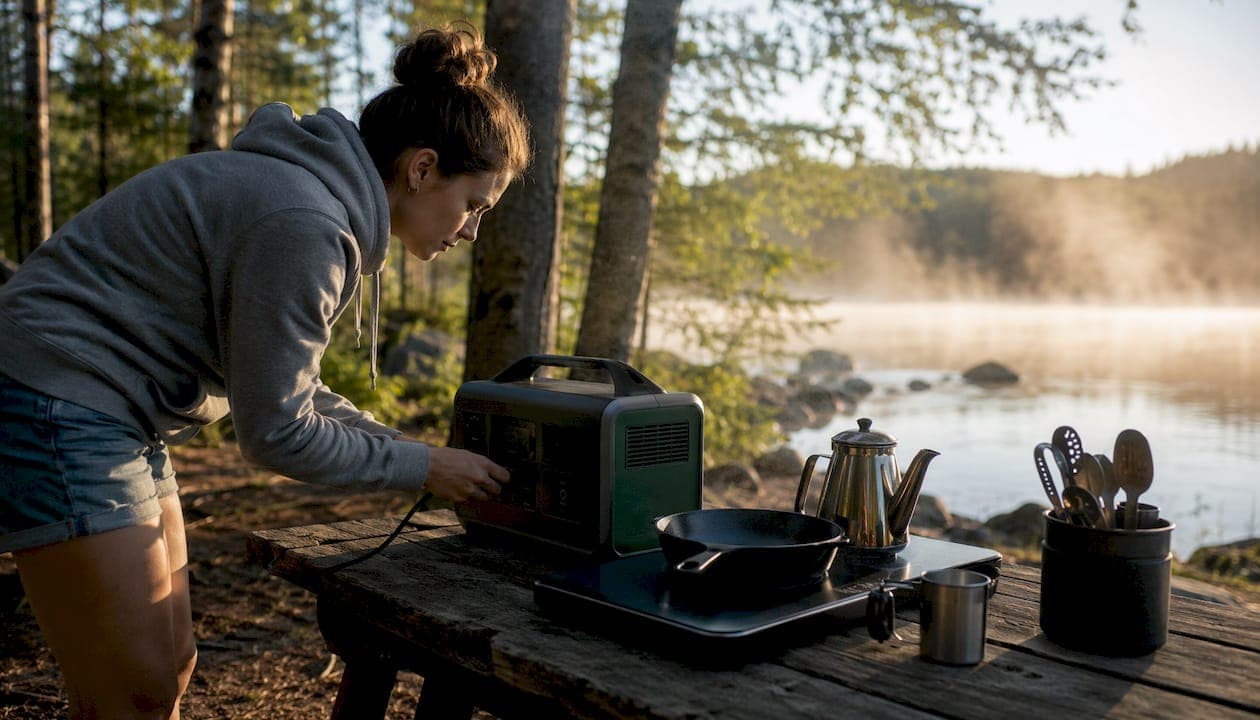
Portable power stations can reliably run most campfire-replacement cooking appliances, including induction cooktops, electric griddles, kettles, slow cookers, immersion heaters, and small electric grills, as long as you match the station's continuous wattage and capacity to your appliance's actual draw. Electric cooking is widely accepted as a fire-ban-friendly alternative in U.S. campgrounds where open flame is restricted. Most camp cooking appliances pull a wide range of continuous power, so a LiFePO4 station with ample watt-hour capacity covers a full day of realistic cooking. This guide walks you through appliance compatibility, sizing math, solar recharge planning, safety rules, and a practical packing checklist, with Toddra LiFePO4 stations as the recommended solution throughout.
Table of Contents
- Which power station campfire cooking appliances actually work?
- How do you size a power station for camp cooking?
- Can solar panels keep you cooking on a multi-day trip?
- Is electric camp cooking safe and fire-ban compliant?
- What should you pack and how do you hook everything up?
- What should you avoid when using a power station for cooking?
- Toddra portable power stations for your camp kitchen
- Key Takeaways
- Why electric camp cooking deserves a serious look
- Sources and further reading
Which power station campfire cooking appliances actually work?
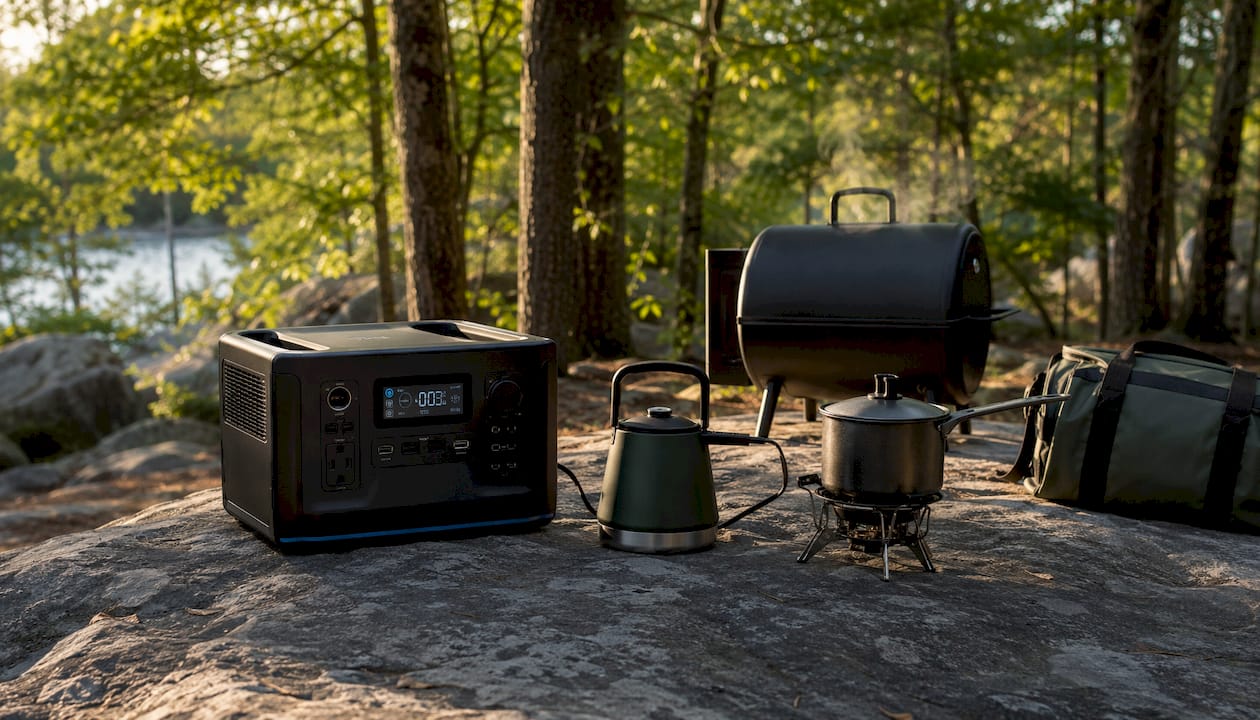
Most common camp cooking appliances run comfortably on a mid-size portable power station. The key is knowing each appliance's continuous watt draw and whether it has a surge requirement at startup, without specifying exact wattages.
| Appliance Type | Continuous Watts | Surge/Start Watts | Runtime: 500 Wh | Runtime: 1000 Wh | Runtime: 2000 Wh | Portability Note |
|---|---|---|---|---|---|---|
| Electric kettle (1 liter) | 1000–1500W | Minimal | 20–30 min | — | — | Compact; any cookware |
| Induction cooktop | 1000W | Low (100–200W) | — | — | — | Requires magnetic-bottom cookware |
| Electric griddle | 1000–1500W | Moderate | 20–30 min | — | — | Works with cast iron | | Portable electric grill | 600–1200W | Moderate | — | — | 100–200 min | Compact; no gas needed | | Slow cooker (low setting) | — | Minimal | 100–200 min | 3–6 hrs | 6–12 hrs | Ideal for overnight meals |
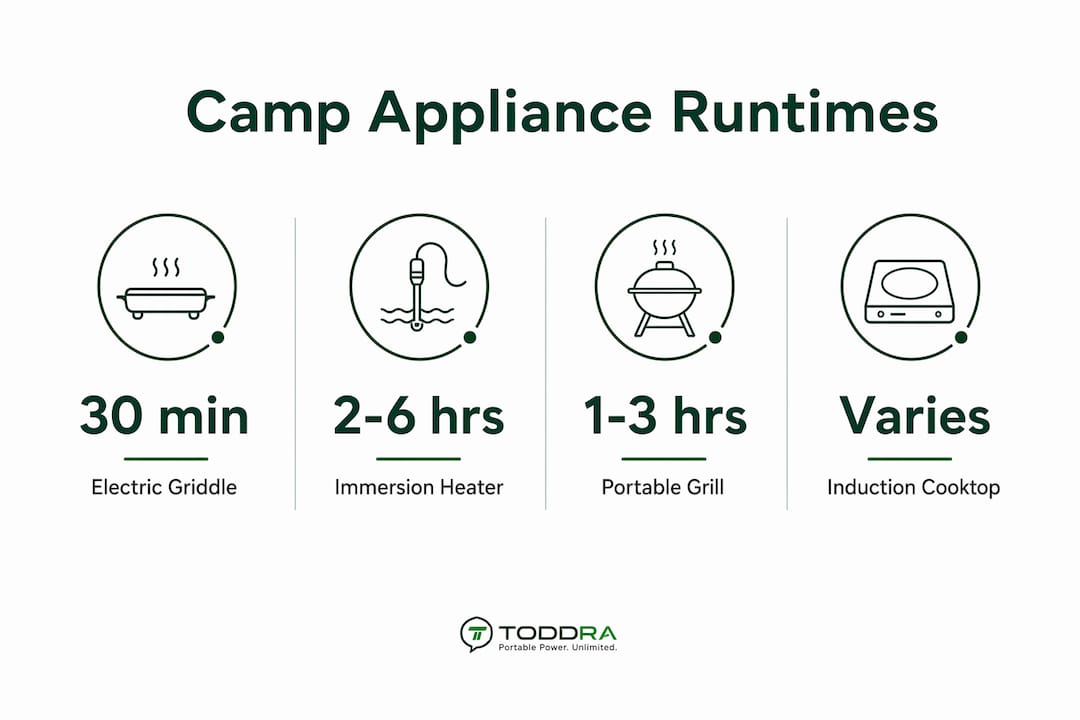
| Immersion heater | 300–500W | Minimal | 60–100 min | 2–3 hrs | 4–6 hrs | Ultra-compact; boils water only | | Compact electric cooker (e.g., 500W outdoor cooker) | 500W | Minimal | 60 min | 2 hrs | 4 hrs | Designed for fire-ban campsites |
Runtime estimates assume 85% inverter efficiency and do not account for accessory draws. Actual results will vary with temperature and cooking style.
A few practical notes on cookware: induction cooktops require magnetic-bottom pots, so pure aluminum pans won't work. Cast iron, however, performs well on both electric griddles and induction plates, making it a versatile choice for camp use. For cast-iron campfire cooking gear, the same skillets and Dutch ovens you'd use over a fire translate directly to electric griddles.
Compact multi-watt systems like the Nomad electric cooking system run from 200W to 1000W and are purpose-built for portable power station use, giving you flexibility to cook at lower wattage and extend runtime.
How do you size a power station for camp cooking?
Size for continuous watts first, then capacity. A station must handle your appliance's continuous draw without throttling and hold enough capacity to cover your planned cooking time.
The core formula:
Required Wh accounts for appliance watts times hours of use adjusted for inverter inefficiency.
The 0.85 factor accounts for inverter inefficiency. Here are three worked examples:
- Boiling water for coffee (1500W kettle, 10 minutes): (1500 × 0.17) ÷ 0.85 = ~300 Wh consumed. A 500 Wh station handles this with reserve.
- 30-minute griddle session (1200W griddle): (1200 × 0.5) ÷ 0.85 = ~706 Wh. You need at least a 1000 Wh station for comfortable headroom.
- Slow cooker overnight (250W, 8 hours): (250 × 8) ÷ 0.85 = ~2353 Wh. This requires a 2000+ Wh station or a solar top-up during the day.
For a full sizing walkthrough, the Toddra camping wattage guide covers these scenarios in detail.
Pro Tip: Add 20–30% extra capacity beyond your calculated Wh to account for cold-temperature derating, accessory draws like phone charging and lights, and the fact that LiFePO4 stations perform best when not fully depleted.
LiFePO4 chemistry gives you a deeper usable depth-of-discharge than older lithium-ion designs, meaning significantly more usable capacity. That means a 2000 Wh LiFePO4 station delivers meaningfully more usable energy than a same-rated lithium-ion unit. It also handles more charge cycles before capacity degrades, which matters for campers who use their station frequently. You can check which appliances are feasible for your specific station on the Toddra blog.
Can solar panels keep you cooking on a multi-day trip?
Yes, with realistic planning. Solar recharging works well for multi-day camp cooking when you match panel wattage to your daily energy budget and account for weather.
Key factors to plan around:
- Daily Wh budget: Add up all cooking and non-cooking draws for a full day.
- Peak sun-hours: Varies by location and season; 4–5 hours is a reasonable U.S. average for summer camping.
- Panel array size: 100W panels work for light use; 200–400W arrays are practical for regular cooking.
- End-to-end efficiency: Expect 75–85% efficiency from panel to battery after MPPT losses, wiring, and battery acceptance limits.
- Station input limit: Your station's max charge rate (in watts) caps how fast any panel array can recharge it.
Recharge example: A moderately sized panel array under typical peak sun-hours produces a substantial daily energy yield after efficiency losses. That covers a 1000 Wh daily cooking budget with 600 Wh to spare for other devices. For real-world solar camping setups with panel arrays and daily budgets, the Toddra blog has practical examples.
Pro Tip: Stagger cooking sessions to align with peak solar input. Pre-heat water or slow-cook during midday sun, then use stored capacity for evening meals. If you're driving between sites, DC charging from your vehicle adds meaningful Wh without any sun required.
Understanding the difference between AC and DC device efficiency also helps here. DC-coupled charging from solar panels to a LiFePO4 station skips an extra conversion step, which is why DC vs. AC device efficiency matters when planning your energy budget.
Is electric camp cooking safe and fire-ban compliant?
Electric cooking is often permitted when open-flame cooking is banned, but you still need to verify site-specific rules before you arrive. Many U.S. campgrounds explicitly list electric cooking as an approved alternative during fire restrictions, and purpose-built outdoor electric cookers are marketed specifically for fire-ban compliance.
Practical safety checklist:
- Use a GFCI-capable outlet or adapter when available.
- Place the power station and appliance on a stable, non-flammable surface.
- Keep a minimum 12-inch clearance around hot appliances.
- Use an outdoor-rated power strip with surge protection.
- Ventilate the cooking area, especially when cooking fatty or smoky foods.
- Never run a gas generator indoors or in an enclosed tent as a backup. Battery power is inherently safer than a gas generator in confined spaces.
- Confirm fire restriction levels at your specific campground before departure.
Pro Tip: Reserve 20–30% of your battery as an emergency buffer for device charging and lighting. If conditions change unexpectedly, that reserve keeps critical gear running.
What should you pack and how do you hook everything up?
A well-organized kit makes electric camp cooking fast to set up and reliable in the field.
Packing list:
- Fully charged portable power station
- Solar panels (sized to your daily Wh budget)
- MC4 cables and Anderson/XT60 adapters
- Outdoor-rated power strip with surge protection
- Heavy-gauge extension cord (12 AWG minimum for high-draw appliances)
- Induction-compatible cookware (cast iron or stainless with magnetic base)
- Compact multimeter for troubleshooting
- Inline fuse for solar connections
Hookup sequence:
- Place the power station on a level, non-flammable surface away from direct heat.
- Connect solar panels to the MPPT input and confirm the charging indicator is active.
- Plug the cooking appliance into the AC outlet, not a DC port.
- Start the appliance at its lowest watt setting, then increase gradually.
- Monitor the battery level display throughout cooking.
- After cooking, disconnect appliances before disconnecting solar panels.
For a complete pre-trip checklist, the Toddra camping power checklist covers everything from cables to cookware. Weight matters too: for car camping, a 2000 Wh station is manageable; for backpacking, a 500 Wh unit with a single 100W panel is the practical ceiling. Lightweight station selection is worth reviewing before you finalize your kit.
What should you avoid when using a power station for cooking?
Some appliances will drain or damage a portable power station. Knowing the limits protects both your gear and your trip.
Avoid any appliance with a sustained draw above 2000–3000W unless you own a dedicated heavy-duty station rated for that load. Full-size kitchen ovens, large induction ranges, convection ovens, and toaster ovens with heating elements above 1500W will overwhelm most portable stations and trigger thermal cutoff or permanent damage.
Common mistakes to avoid:
- Ignoring surge requirements: Some appliances draw 2–3× their rated watts at startup. Always check the surge spec, not just the continuous rating.
- Chaining too many appliances: Running a kettle, griddle, and phone charger simultaneously can exceed the station's continuous output limit.
- Cold-weather capacity loss: LiFePO4 handles cold better than lithium-ion, but capacity still drops below 32°F. Plan for 10–20% less usable Wh in cold conditions.
- Using non-induction cookware on induction plates: Aluminum pans produce no heat on induction. Always test cookware with a magnet before packing.
- Skipping the inverter efficiency factor: Ignoring the 85% efficiency rule leads to undersized stations and mid-meal power cuts.
Toddra portable power stations for your camp kitchen
Toddra LiFePO4 portable power stations give you the continuous output, usable capacity, and fast solar recharge that make electric camp cooking genuinely practical, whether you're at a fire-restricted campground or simply prefer a cleaner, safer setup.
For most car campers, a Toddra station in the 1000–2000W continuous output range paired with 1000–2000 Wh of LiFePO4 capacity covers a full day of cooking, including a morning kettle, a griddle breakfast, and a slow-cooked dinner. For multi-day solar setups, pairing a 200–400W solar panel array with a station that accepts high-wattage MPPT input keeps your cooking budget topped up daily.
Pro Tip: Match your panel array's total wattage to the station's maximum solar input rating. Exceeding that limit wastes panel capacity; falling short means slower recharge windows.
For buyers who need serious capacity for extended trips or group cooking, the Jackery Battery Pack 5000 Plus Expansion Battery (5040Wh) available on Toddra delivers enough storage for multi-day cooking without daily solar dependence. Visit Toddra.com to browse the full range of LiFePO4 stations, solar panels, and accessories with US-based support.
Key Takeaways
A LiFePO4 portable power station sized at 1000–2000 Wh with 1000–2000W continuous output covers most realistic camp cooking needs while keeping you fire-ban compliant.
| Point | Details |
|---|---|
| Size for continuous watts | Use the formula: required Wh = (watts × hours) ÷ 0.85, then add 20–30% buffer. |
| Match appliance to station output | Induction and griddles need 1000W continuous; slow cookers and immersion heaters work on smaller stations. |
| Solar recharge planning | A 400W panel array at 80% efficiency recovers ~1600 Wh per day under 5 peak sun-hours. |
| Avoid high-draw appliances | Skip full-size ovens and large induction ranges; anything above 2000–3000W sustained will overwhelm most portable stations. |
| Toddra LiFePO4 stations | Toddra's LiFePO4 stations offer deep usable capacity, fast MPPT solar input, and US-based support for camp cooking setups. |
Why electric camp cooking deserves a serious look
Electric camp cooking gets dismissed as a compromise, and that framing is wrong. The real story is that it expands your options rather than limiting them.
When fire restrictions hit, most campers either skip cooking or haul a propane setup that still triggers campground scrutiny. An electric setup powered by a LiFePO4 station sidesteps both problems. You cook a real meal, you stay compliant, and you don't spend the evening worrying about wind-shifted flames near dry brush.
What I find genuinely underappreciated is how well slow cookers and low-watt appliances fit the camp rhythm. You set a slow cooker at 250W before a morning hike, and dinner is ready when you return. That's not a compromise. That's a better outcome than most open-fire meals, which demand constant attention.
The honest caveat: electric cooking doesn't replace the campfire experience for everyone, and it shouldn't. If conditions allow a fire and you want one, build it. But having a reliable electric backup means fire restrictions no longer cancel your meal plans. That reliability, backed by a well-sized LiFePO4 station, is what makes the setup worth carrying.
Sources and further reading
- Power Station Wattage for Camping: Size It Right — Toddra blog sizing guide
- What Appliances Can a Portable Power Station Run? — Toddra appliance compatibility guide
- Solar-Powered Camping Setups: Real Examples for 2026 — Toddra solar setup examples
- Camping Power Checklist for Campers: 2026 Guide — Toddra pre-trip checklist
- Solar Generator Benefits for Campsites: 2026 Guide — Toddra solar camping guide
- Toddra.com — product pages, LiFePO4 stations, solar panels, and US-based support