TL;DR:
- The inverter in a portable power station converts DC to AC using high-frequency PWM switching and LC filtering, producing a stable 120 V, 60 Hz sine wave. Its design, protections, and waveform quality significantly impact appliance compatibility and system reliability. Choosing a pure sine wave inverter with robust protections ensures safe, efficient operation for sensitive devices.
The inverter is the single most important component inside any portable power station. It converts the DC electricity stored in the battery into the 120 V, 60 Hz AC that your appliances, tools, and electronics are built to run on, and it simultaneously manages voltage regulation, waveform quality, and safety protections for both the battery and whatever you plug in. Without it, a power station is just a battery with nowhere to go.
TL;DR:
- Conversion: The inverter switches DC from the battery on and off at high frequency, then filters the result into a smooth AC waveform your devices recognize.
- Waveform quality: Pure sine wave inverters work with everything; modified sine wave units can cause problems with motors, medical equipment, and sensitive electronics.
- Power ratings: Every inverter has a continuous watt rating and a higher surge rating. Size the continuous rating above your running load and the surge rating above your largest motor's startup draw (this is a standard sizing guideline).
- Built-in protections: Quality inverters include overload shutoff, over-temperature protection, short-circuit protection, and input voltage guards that protect both the inverter and the battery.
The U.S. Department of Energy confirms that inverters targeting the US market are designed to deliver 120 V at 60 Hz, matching the standard household grid. Understanding how that happens, and what limits apply, is what the rest of this guide covers.
Table of Contents
- Why do appliances need AC when batteries store DC?
- How does an inverter in a power station convert DC to AC?
- What hardware makes the switching stage work?
- How does PWM build a sine wave from square pulses?
- Pure sine, modified sine, or approximated waveform: which do you need?
- What do inverter ratings actually mean?
- Where does energy go that never reaches your appliance?
- What protections keep the inverter and your devices safe?
- Grid-following vs grid-forming: why it matters for off-grid use
- How do you size an inverter for real loads?
- Practical tips to keep your inverter running reliably
- Key Takeaways
- The inverter is where the real engineering lives
- Power stations with inverters you can trust, from Toddra
Why do appliances need AC when batteries store DC?
Batteries store energy as direct current: electrons flow in one direction, at a steady voltage. That works well for charging phones or running LED lights, but most household appliances, power tools, and kitchen equipment are designed around alternating current, where voltage cycles back and forth 60 times per second in the United States.
The reason AC became the standard is largely historical and practical. Transformers, which are central to motors, compressors, and most power supplies, only work with alternating current. AC also travels efficiently over long distances, which is why the US grid runs at 120 V and 60 Hz. A portable power station's battery produces DC, so without an inverter, none of that stored energy could reach an AC appliance.
Frequency matters more than most people realize. A motor designed for 60 Hz will run slower, run hotter, or fail to start properly if the frequency drifts. Sensitive electronics, including laptop chargers and medical devices, rely on the waveform shape to regulate their internal power supplies. A clean, stable 60 Hz sine wave is not just a preference; it is a functional requirement for many loads.
How does an inverter in a power station convert DC to AC?
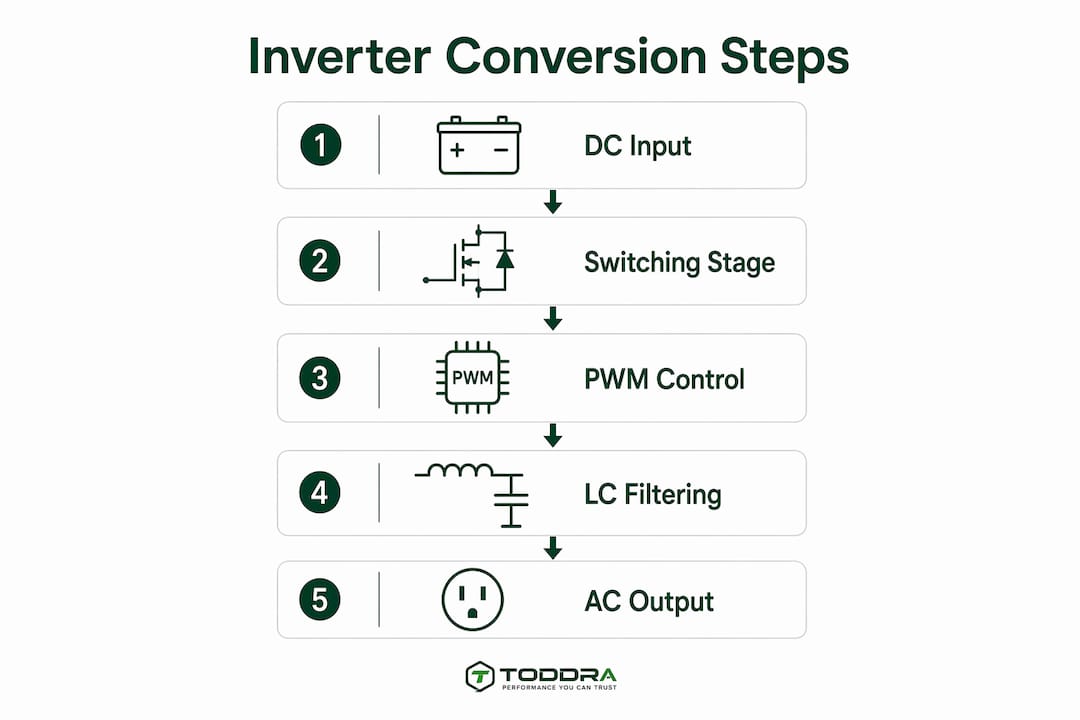
The conversion process follows a clear signal path from battery terminals to AC outlet. Here is the step-by-step flow:
- DC input and DC link: The battery delivers DC voltage to the inverter's input stage. A DC link capacitor buffers this supply, smoothing out voltage ripple from the battery and providing a stable energy reservoir for the switching stage.
- Voltage boost (if needed): Many portable power stations use a boost converter to raise the battery's DC voltage to a higher intermediate DC level before inversion. This allows the inverter to produce a full 120 V AC output even when the battery voltage is lower.
- Switching stage: High-speed semiconductor switches (MOSFETs or IGBTs) open and close in a carefully timed pattern, chopping the DC into a rapid pulse train. This is where PWM controls shape the output waveform.
- LC filtering: An inductor-capacitor filter smooths the pulse train, removing high-frequency switching harmonics and producing a waveform that closely approximates a sine wave.
- Output regulation: A control loop continuously measures the output voltage, current, and frequency, then adjusts the switching duty cycle in real time to hold the output at 120 V, 60 Hz within tight tolerances.
- Safety monitoring: Simultaneously, protection circuits watch for overload, short circuits, over-temperature conditions, and abnormal input voltage, ready to shut the inverter down in milliseconds if any threshold is crossed.
- AC output: The filtered, regulated AC reaches the outlet, ready for your appliances.
The control loop is what separates a quality inverter from a basic one. Real-time feedback keeps the output stable even as load changes suddenly, such as when a refrigerator compressor kicks on mid-cycle.
What hardware makes the switching stage work?
Switching devices: MOSFETs vs IGBTs
The choice of switching semiconductor depends on the power level and voltage range. MOSFETs switch faster and generate less heat at lower voltages, making them the standard choice in portable power stations rated below roughly 2,000 W. IGBTs handle higher voltages and currents more efficiently, which is why they appear in larger, higher-power inverter systems. For the portable power station you use at a campsite or during a power outage, MOSFETs are almost certainly doing the switching.
Topologies: H-bridge and its variants
The most common topology for single-phase AC output is the full H-bridge (also called a full-bridge). Four switches are arranged in an H pattern around the load. By turning on diagonal pairs alternately, the bridge drives current through the output in both directions, creating the alternating nature of AC. A half-bridge uses two switches and two capacitors instead, which reduces component count but requires more careful voltage management. The full-bridge is preferred in portable stations because it delivers cleaner output and handles asymmetric loads better.
Component reference table
| Component | Purpose | What to watch for |
|---|---|---|
| MOSFETs / IGBTs | High-speed switching to create pulse train | Voltage and current ratings; heat dissipation |
| DC link capacitor | Buffers battery supply; smooths input ripple | Capacitance value; voltage rating above battery max |
| Boost converter | Raises battery DC to inverter input level | Efficiency rating; inductor saturation current |
| LC output filter | Removes switching harmonics; shapes sine wave | Inductor current rating; capacitor ESR |
| Gate driver IC | Controls switch timing and dead-time | Isolation rating; propagation delay |
| Microcontroller / DSP | Runs control loop and protection logic | Firmware update support; protection response time |
| Heat sink / thermal interface | Dissipates switching and conduction losses | Thermal resistance; contact quality |
Higher switching frequencies reduce the size of the inductors and capacitors in the filter, which is why modern portable stations can be compact. The trade-off is that higher frequencies increase switching losses and can raise electromagnetic interference (EMI) levels, requiring better shielding and filtering to keep nearby electronics happy.
How does PWM build a sine wave from square pulses?
Pulse Width Modulation is the technique that makes modern inverters possible. Instead of trying to produce a smooth analog sine wave directly, the inverter switches its MOSFETs on and off thousands of times per second. By varying how long each pulse stays on relative to its off time (the duty cycle), the controller shapes the average voltage seen by the LC filter over each cycle.
Think of it this way: a pulse that is on 90% of the time delivers nearly full voltage on average; one that is on 10% of the time delivers almost nothing. By modulating the duty cycle to follow a sine-wave pattern, the inverter creates a pulse train whose averaged effect, after filtering, is a smooth sine wave. The LC filter does the averaging, blocking the high-frequency switching content while passing the 60 Hz fundamental.
The switching frequency in portable inverters typically runs in the tens of kilohertz range. That is far above the audible range, which is why a well-designed inverter is quiet. The LC filter is sized to attenuate everything above 60 Hz effectively, so the output looks clean to connected devices.
Pro Tip: When evaluating a portable power station for motors, audio equipment, or medical devices, check the spec sheet for Total Harmonic Distortion (THD). A pure sine wave inverter with THD below 3% is the target for sensitive loads. Also look for the switching frequency: higher switching frequencies generally allow smaller, lighter filters, but only if the EMI shielding is adequate.
Pure sine, modified sine, or approximated waveform: which do you need?
Waveform type is one of the most consequential specs on any power station, and it is often buried in the fine print.
Pure sine wave inverters produce output that is electrically identical to what comes from the utility grid. Every appliance designed for AC power will run correctly on a pure sine wave, with no efficiency penalty, no extra heat, and no noise.
Modified sine wave (sometimes called quasi-sine) inverters produce a stepped waveform that approximates a sine wave using three levels: positive, zero, and negative. It works for many loads but causes real problems with others.
Approximated or stepped waveforms are multi-level variants that add more steps to reduce harmonic distortion, sitting between modified sine and true pure sine in quality.
Compatibility at a glance:
- Works reliably on modified sine: incandescent and LED lights, resistive heaters, simple battery chargers, most USB chargers with their own internal regulators.
- May work but with reduced efficiency or extra heat: older laptop power bricks, some power tools with universal motors, basic fans.
- Requires pure sine wave: induction motors (refrigerators, air conditioners, sump pumps), variable-speed motors, CPAP machines, medical equipment, audio amplifiers, laser printers, and most modern laptop chargers with active power factor correction.
The practical takeaway: if you are running a refrigerator, a CPAP, or any motor-driven appliance from your power station, a pure sine wave inverter is not optional. For a camping trip where you only need to charge phones and run LED lights, a modified sine unit can work. Toddra's portable power station guide covers appliance compatibility in more detail if you want to cross-check specific devices.
What do inverter ratings actually mean?
Continuous watts vs surge watts
Every inverter carries two power ratings, and confusing them is the most common sizing mistake.
Continuous watts (also called rated watts) is the load the inverter can sustain indefinitely without overheating or tripping. This is the number to match against your appliance's running power draw.
Surge watts (peak watts) is the higher, short-duration output the inverter can deliver for a few seconds, typically during motor startup. Motors can draw 2–3 times their running current at startup, so the surge rating must cover that spike.
VA (volt-amperes) appears on some specs and accounts for reactive power in inductive loads. For resistive loads, VA equals watts. For motors and transformers, VA is higher than watts by a factor called the power factor (typically 0.8–0.9 for motors).
Specs reference table
| Spec | Typical range (portable stations) | What it means for you |
|---|---|---|
| Continuous watts | Must exceed total running load | |
| Surge watts | Must exceed largest motor's startup draw | |
| Output voltage | 120 V AC (±5%) | Matches US household standard |
| Output frequency | 60 Hz (±0.5 Hz) | Matches US grid; critical for motors |
| THD | <3% (pure sine) | Lower is better for sensitive electronics |
Quick sizing example
A mid-size refrigerator runs at 150 W but starts its compressor at 450 W. A laptop draws 65 W. Running both simultaneously:
- Running load: 150 + 65 = 215 W continuous
- Surge requirement: 450 W (refrigerator startup) + 65 W = 515 W peak
You need an inverter rated above your running load and with a surge rating above your largest motor's startup draw (this is a standard sizing guideline). Sizing to the minimum is not recommended; extra capacity gives you thermal headroom and longer component life. For a deeper look at what specific appliances draw, Toddra's guide on appliance power compatibility is a practical reference.
Where does energy go that never reaches your appliance?
No inverter converts 100% of battery energy into usable AC. Losses come from four main sources:
Switching losses occur every time a MOSFET or IGBT transitions between on and off states. During that brief transition, both voltage and current are simultaneously present in the switch, and the product of the two is heat. Higher switching frequencies mean more transitions per second, so switching losses scale with frequency.

Conduction losses happen when current flows through the resistance of the switches, inductors, and PCB traces while they are on. These losses follow the I²R relationship, meaning they grow with the square of the current, which is why heavily loaded inverters run hotter.
Filter and transformer losses come from the inductors and capacitors in the LC filter, particularly from core losses in the inductors at high frequency.
Auxiliary loads include the cooling fan, the microcontroller, the display, and the battery management system, all of which draw power continuously regardless of what is plugged in.
Efficiency note: Portable inverters typically operate at their highest efficiency (often in the 85%–93% range) when loaded to roughly 50%–75% of their continuous rating. At very light loads, the auxiliary draw becomes a larger fraction of total consumption, pulling efficiency down noticeably.
Runtime rule of thumb: Multiply the battery's watt-hour capacity by the inverter's efficiency at your expected load to get usable AC watt-hours.
Example: A 1,000 Wh battery with an inverter running at 90% efficiency delivers about 900 Wh of AC energy. Running a 150 W refrigerator, you can expect roughly 6 hours of runtime (900 ÷ 150). Real-world runtime will be shorter if the compressor cycles frequently or if ambient temperature is high. Toddra's camping wattage guide walks through similar calculations for outdoor use cases.
What protections keep the inverter and your devices safe?
Quality inverter design treats protection as a core function, not an afterthought. Here is what a well-built portable power station inverter includes:
- Overload protection: When the connected load exceeds the continuous rating for more than a few seconds, the inverter reduces output or shuts down to prevent overheating and component damage.
- Short-circuit protection: A dead short at the AC output triggers an immediate shutoff, typically within milliseconds. Research on utility-scale inverter failures shows that delayed fault responses can allow fault currents exceeding 1 kA and cause catastrophic internal damage, which is why fast protection timing matters even in portable units.
- Over-temperature shutoff: Thermal sensors on the switching devices and heat sink monitor temperature continuously. If the inverter exceeds its safe operating temperature, it shuts down and waits to cool before restarting.
- Input over-voltage and under-voltage protection: If the battery voltage rises above the inverter's maximum input (which can happen with certain charging conditions) or drops below the minimum (deep discharge), the inverter disconnects to protect both itself and the battery cells.
- Input reverse polarity protection: A safeguard against incorrect battery connection, common in DIY setups, that prevents immediate component destruction.
- Anti-islanding protection: Relevant for grid-tied configurations, this prevents the inverter from continuing to energize a line that utility workers believe is de-energized, a critical safety feature for any system that can connect to the grid.
Protection circuits are specifically designed to handle the high-current surges that occur during motor startups, absorbing the spike without tripping unnecessarily while still catching genuine fault events.
Red flags that suggest a problem:
- Repeated overload trips under loads well within the rated capacity
- Unusual burning smell or visible discoloration near vents
- Output voltage or frequency that drifts noticeably under load
- Inverter that restarts immediately after a fault without a cooling period
Grid-following vs grid-forming: why it matters for off-grid use
Most portable power station inverters operate in grid-following mode: they synchronize their output to an external voltage reference. In a home backup scenario where the station is powering a few appliances directly, this distinction is invisible. But as off-grid and microgrid applications grow, the difference becomes meaningful.
A grid-following inverter requires an existing voltage and frequency reference to lock onto. Without one, it cannot operate. This is fine for standalone portable use where the inverter itself sets the output, but it creates limitations in more complex multi-inverter setups.
A grid-forming inverter generates its own stable voltage and frequency reference internally, without needing an external grid signal. This capability enables black-start operation (powering up a system from zero), microgrid support, and stable operation in weak-grid conditions.
From the U.S. Department of Energy: Grid-forming inverters can create their own stable voltage and frequency reference and support black starts and microgrids, representing a key advancement in inverter technology for distributed energy systems. The DOE highlights this as a defining feature of advanced inverters that goes beyond simple DC-to-AC conversion.
NERC guidance reinforces this point, emphasizing that inverter software and controls determine how distributed systems respond to grid events and faults, and recommending that planning practices evolve to account for significant levels of inverter-based resources. For consumers, the practical implication is straightforward: the firmware and control software in your power station matter as much as the hardware. A unit with updatable firmware and well-documented protection settings is a more future-proof investment. For a broader comparison of portable versus stationary backup systems, Toddra's emergency power guide covers the trade-offs clearly.
How do you size an inverter for real loads?
Sizing an inverter correctly comes down to three numbers for each appliance: its running power, its startup (surge) power, and how long you need to run it.
Step-by-step sizing method:
- List every appliance you plan to run simultaneously.
- Find the running wattage on the nameplate or spec sheet.
- Identify the startup surge for any motor-driven device (use 2–3× running watts if the spec is not listed, per standard sizing guidance).
- Add all running watts for the total continuous load.
- Identify the single largest startup surge and add it to the total running load of everything else running at that moment.
- Choose an inverter whose continuous rating exceeds the total running load and whose surge rating exceeds the peak startup demand.
Worked examples
| Appliance | Running watts | Startup surge | Notes |
|---|---|---|---|
| Mid-size refrigerator | 150 W | 450 W | Compressor surge is the dominant sizing driver |
| Laptop charger | 65 W | 65 W | No surge; purely resistive/capacitive load |
| 7.25" circular saw | 1,200 W | 2,400 W | Universal motor; surge is brief but high |
| CPAP with humidifier | 30–60 W | 60 W | Requires pure sine wave; low continuous draw |
For example, a portable inverter with a continuous rating above typical household running loads and a surge rating above typical motor startup draws will cover general use cases. For high startup loads like power tools, a larger inverter rating is recommended, and simultaneous use of large loads should be avoided in practice. Always size for your realistic simultaneous load, not the theoretical maximum of every device you own.
Practical tips to keep your inverter running reliably
Good operating habits extend inverter life and prevent the kind of gradual degradation that shows up as reduced efficiency or unexpected shutoffs.
Routine checks to run every few months:
- Confirm ventilation openings are clear of dust, debris, and obstructions. Blocked airflow is the leading cause of thermal shutoffs.
- Listen for the cooling fan during moderate to heavy loads. A fan that runs constantly at light loads, or one that never runs under heavy load, signals a thermal management issue.
- Inspect visible wiring and connectors for corrosion, loose connections, or heat discoloration, especially at the battery terminals.
- Check for firmware updates from the manufacturer. As NERC guidance notes, inverter software controls are central to safe operation, and manufacturers periodically release updates that improve protection behavior and efficiency.
- Verify that the battery's state of charge and voltage are within the inverter's specified input range before extended operation.
Operating best practices:
- Avoid sustained loads above 80% of the continuous rating. Running near the ceiling for hours accelerates thermal wear on switching devices.
- Allow the inverter to cool for several minutes after a thermal shutoff before restarting under load.
- Keep the unit out of direct sunlight and away from heat sources during operation. Ambient temperature directly affects how much the inverter can output before thermal derating kicks in.
- Follow the manufacturer's temperature derating recommendations. Most portable inverters derate output above 40°C (104°F) ambient to protect internal components.
Protection features built into battery-inverter systems make them inherently safer than combustion generators for indoor-adjacent use, but they still require basic care to perform reliably over time.
Key Takeaways
The inverter in a portable power station converts battery DC to 120 V, 60 Hz AC through high-frequency PWM switching and LC filtering, with built-in protections that guard both the battery and connected loads.
| Point | Details |
|---|---|
| DC to AC conversion | The inverter uses PWM switching and LC filtering to produce 120 V, 60 Hz AC from battery DC. |
| Waveform type matters | Pure sine wave inverters work with all AC loads; modified sine can damage motors, CPAP machines, and sensitive electronics. |
| Size for surge, not just running watts | Motor startup draws 2–3× running watts; your inverter's surge rating must cover that peak. |
| Efficiency and runtime | Multiply battery Wh by inverter efficiency (typically 85%–93%) to estimate usable AC energy and realistic runtime. |
| Toddra resources | Toddra's guides on appliance compatibility and sizing help you match the right power station inverter to your specific load. |
The inverter is where the real engineering lives
Most buyers focus on battery capacity when shopping for a portable power station, and that is understandable. Watt-hours are easy to compare. But the inverter is where the real engineering lives, and a poorly designed one will waste your battery capacity, damage your appliances, or fail under load precisely when you need it most.
The waveform type is the spec I would check first. A modified sine wave unit might cost less, but if you ever need to run a refrigerator, a CPAP, or a variable-speed tool, you will pay for that savings in appliance damage or failed startups. Pure sine wave is the standard worth holding to.
The second thing most guides underemphasize is protection timing. The research on utility-scale inverter failures is clear: delayed protective responses to fault events cause disproportionate damage. That same principle applies to portable units. A fast, well-calibrated protection circuit is not a luxury feature; it is what stands between a minor overload and a damaged inverter or battery.
Finally, firmware matters more than it used to. As grid-forming capability and smart energy management become standard features even in consumer-grade stations, the software running your inverter will determine how well it handles edge cases, integrates with solar input, and responds to unusual load events. A manufacturer that supports firmware updates is giving you a product that can improve over time.
Power stations with inverters you can trust, from Toddra
Understanding how an inverter works is the first step. Finding a power station where that inverter is built to the standard you just read about is the next one.

Toddra carries carefully selected portable power stations and solar generators designed for home backup, camping, and off-grid use, all featuring pure sine wave inverters, LiFePO4 battery technology, and built-in protection circuits that meet the standards covered in this guide. Every unit is backed by US-based customer support and a secure checkout, so you can shop with confidence.
If you are ready to extend your runtime or pair a power station with a high-capacity battery, the Jackery Battery Pack 5000 Plus offers 5,040 Wh of expansion capacity for compatible systems. Visit Toddra to browse the full range and find the right match for your load, your budget, and your lifestyle.