
Pass-through charging lets a power bank or portable power station charge its internal battery while simultaneously powering connected devices from a single wall outlet. It's a genuinely useful convenience feature, but it's not designed for everyday primary use. Here's what you need to know before relying on it.
- Convenience: One outlet handles both your device and your power bank at the same time.
- Slower charging: Incoming power is split, so the bank charges more slowly than it would on its own.
- Heat and wear: Running input and output together generates extra heat, which can shorten battery lifespan over time.
Pro Tip: Reserve pass-through for situations where outlets are genuinely scarce, like airport lounges or hotel rooms with limited sockets. For routine recharging, plug your power bank in alone.
Key Takeaways
Pass-through charging is a safe and useful convenience feature when used occasionally with a quality device, but direct wall charging remains the better choice for routine recharges and battery longevity.
| Point | Details |
|---|---|
| Definition | Pass-through lets a power bank or station charge its battery while powering connected devices simultaneously. |
| Main benefit | Single-outlet convenience for travel, solar setups, and multi-device prep when outlets are scarce. |
| Primary risk | Heat and conversion losses can accelerate battery wear if used continuously or on low-quality units. |
| Safe usage rule | Keep sessions short, use rated adapters, maintain ventilation, and finish with a dedicated full recharge. |
| Toddra recommendation | Choose LFP-based portable power stations with active BMS protection for the safest pass-through experience. |
Table of Contents
- What does "pass-through charging" actually mean?
- How pass-through charging works inside your device
- When pass-through charging genuinely helps you
- Downsides, safety concerns, and warranty implications
- How to check whether your device supports pass-through
- How to use pass-through charging safely and effectively
- What research and vendor guidance say about efficiency and battery life
- Toddra's perspective on pass-through charging
- Reliable portable power stations with pass-through from Toddra
- Sources
What does "pass-through charging" actually mean?
Pass-through charging is the ability of a device to accept incoming power from a charger and route it outward to connected devices, all while also directing some of that power toward refilling its own internal cells.
A few terms show up repeatedly in product specs and manuals, so it helps to know them:
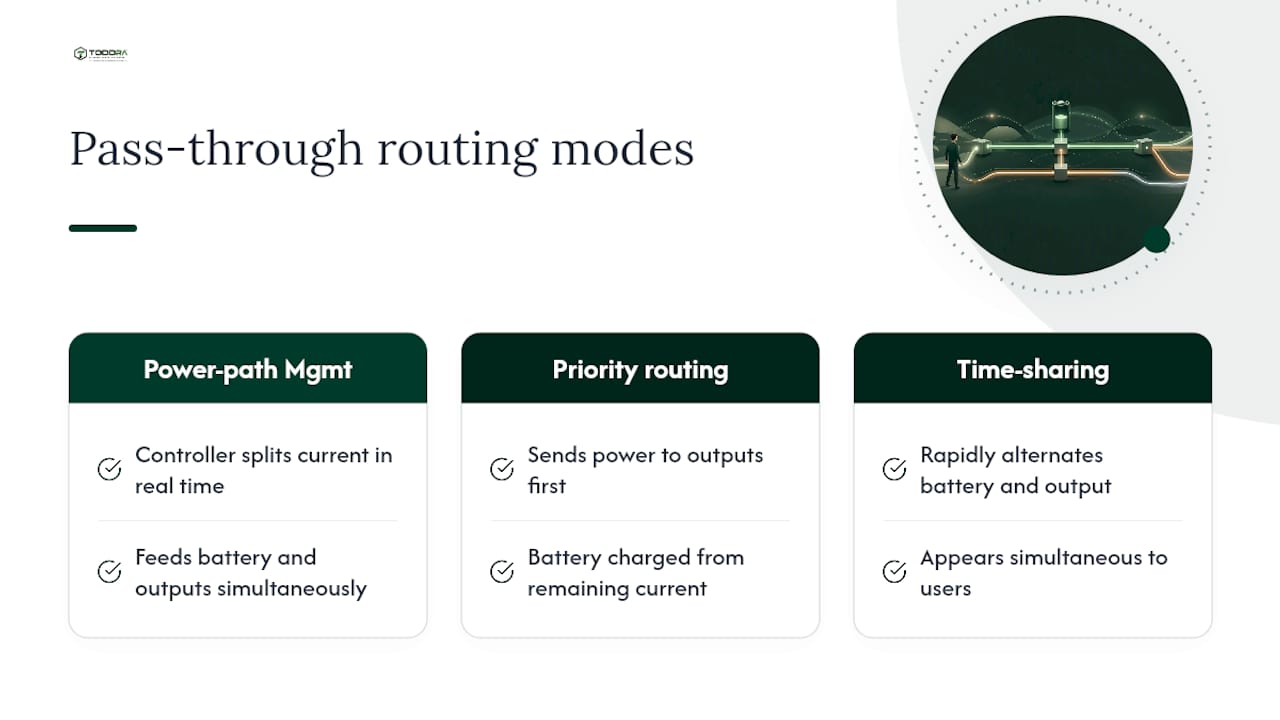
Power-path management is the core technology behind pass-through. The controller chip decides in real time how to split incoming current between the internal battery and any connected output devices. Priority routing sends power to the output first and charges the battery with whatever remains. Time-sharing alternates rapidly between charging the battery and powering the output, creating the appearance of simultaneous operation.
You'll find pass-through support on power banks, USB-C hubs, laptop docking stations, and portable power stations. The feature is labeled differently across brands: "pass-through charging," "PD passthrough," or "power-path management" are all common spec-sheet terms. USB Power Delivery (USB-PD) and Quick Charge (QC) are the fast-charging protocols that often work alongside this feature, while the Battery Management System (BMS) is the firmware layer that monitors temperature, voltage, and current to keep everything within safe limits.
How pass-through charging works inside your device
The power flow follows a straightforward path: wall adapter → charging controller → output ports and internal battery. What varies between products is how the controller handles that split, and that design choice is where the trade-offs come from.
How-To Geek explains that pass-through routing is implemented via circuitry that either prioritizes outgoing device power or time-shares between charging the internal battery and powering peripherals. Priority designs tend to run cooler because the controller isn't fighting two simultaneous high-current demands. Time-sharing designs, common in consumer power banks, can cause brief interruptions or slower apparent charging as the control logic alternates between paths.
Omnicharge notes that true simultaneous bi-directional current through a single cell isn't physically possible. The circuitry simulates it through rapid switching, which is why the feature works but also why it introduces conversion losses.
- Input wattage limit: The wall adapter must supply enough watts to cover both the battery's charging needs and the connected device's draw. If it doesn't, one or both will charge slowly.
- Output wattage limit: The pass-through port has its own ceiling, often lower than the device's direct output rating.
- Conversion losses: Every time current is converted and re-routed, a small percentage is lost as heat. Those losses add up during extended pass-through sessions.
- BMS role: The BMS monitors cell temperature and voltage in real time. On quality units, it will throttle or cut charging if thermals climb too high.
Statistic callout: Conversion losses during pass-through can reduce overall charging efficiency compared to direct wall charging, with heat being the primary byproduct of that lost energy.
When pass-through charging genuinely helps you
The strongest case for pass-through is scarcity: one outlet, multiple needs, no time to wait. The Indian Express points out that pass-through is most useful when outlets are limited, like during travel or in crowded workspaces.
Practical scenarios where it earns its place:
- Airport lounges and hotels: Plug your power bank into the single available socket and charge your phone through the bank simultaneously.
- Pre-trip device prep: Top up your power bank and your earbuds at the same time before heading out.
- Solar input on portable stations: A portable power station receiving solar input can pass that energy through to a connected device while storing the surplus. This is especially practical for travel-focused setups where weight and outlet access are both limited.
- USB-C hub setups: A hub with pass-through keeps your laptop charged through a single cable while the hub's other ports serve peripherals, freeing the laptop's own ports.
Pro Tip: When using pass-through with multiple devices connected, plug in your most power-hungry device first. Most priority-routing designs will serve the highest-draw output before trickling power to the battery.
Downsides, safety concerns, and warranty implications
Pass-through charging has real costs, and understanding them helps you use the feature without shortening your device's life.
Slower overall charge times are the most immediate trade-off. Incoming power is shared between the battery and the output, so the bank charges more slowly than it would with nothing connected. Fast-charge protocols like USB-PD may not reach their rated speeds under these conditions because the controller is managing two competing demands.
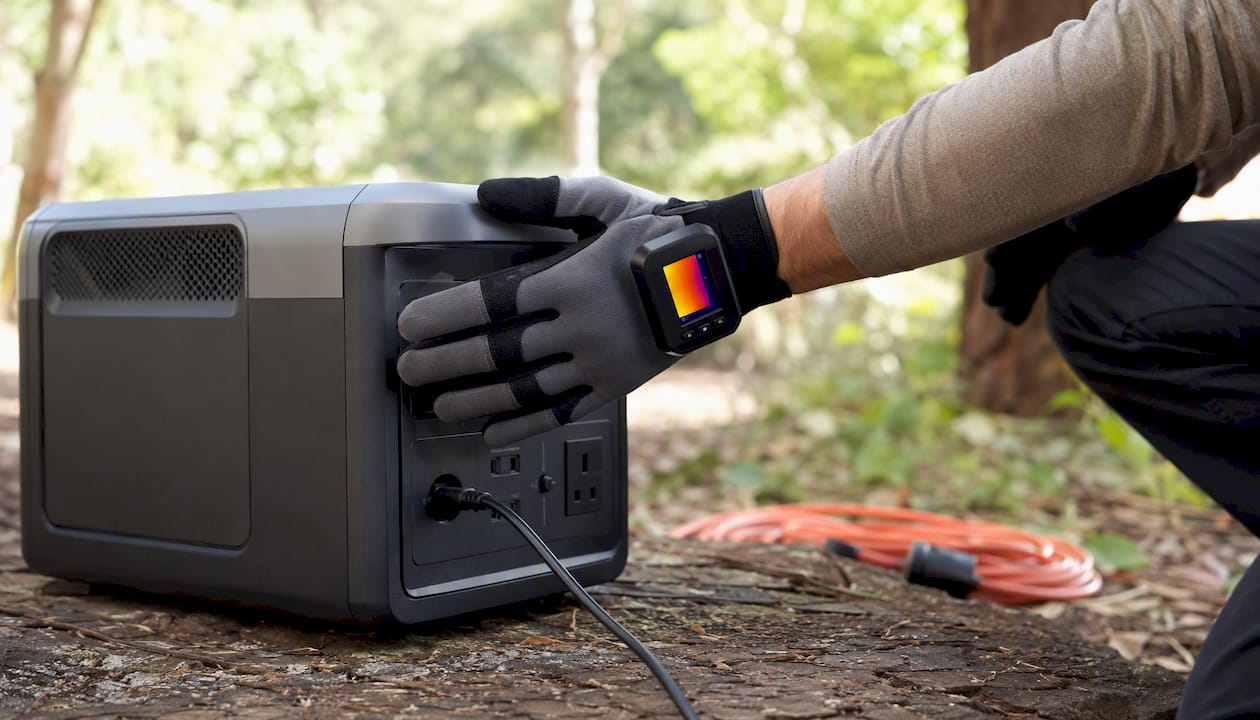
Heat is the bigger concern. Watt Reserve summarizes that pass-through can generate heat and reduce battery lifespan if used continuously or on lower-quality units. Lithium cells degrade faster at elevated temperatures, and frequent pass-through sessions compound that wear over hundreds of cycles.
- Heat accelerates lithium-ion cell degradation, particularly above 40°C (104°F).
- Frequent simultaneous charge/discharge cycles add wear beyond what normal single-direction use would cause.
- Lower-quality units with minimal BMS protection are most vulnerable to thermal stress.
- Some manufacturers explicitly warn against using pass-through as a primary charging method in their warranty documentation.
Warranty note: Check your device's manual before relying on pass-through regularly. Some manufacturers void or limit warranty coverage for battery degradation caused by continuous pass-through use. If the manual says "occasional use only," take that seriously.
How to check whether your device supports pass-through
Not every power bank or portable power station supports pass-through, and support levels vary even among devices that list the feature. Manufacturer support pages are the most reliable place to confirm support and any restrictions tied to firmware or specific adapters.
When reading a spec sheet, look for:
- "Pass-through charging," "PD passthrough," or "power-path management" listed explicitly in the features section.
- Input wattage rating: This tells you the maximum the device can accept. It must exceed your connected device's draw for effective pass-through.
- Output wattage limits on the pass-through port: Often lower than the device's standard output.
- USB-PD or QC support: Confirms the port can handle fast-charging protocols during pass-through.
- Thermal/continuous output specs: Indicates whether the device is rated for sustained output, which matters for longer pass-through sessions.
- BMS notes: Look for mentions of overtemperature protection and short-circuit protection.
If the spec sheet is ambiguous, the product manual is the next stop. If that's still unclear, contact the manufacturer's support line directly before assuming the feature works as you expect. Knowing whether your device uses priority routing or time-sharing also helps you predict its behavior under load. See the power bank vs. power station comparison for guidance on which product category fits your needs.
How to use pass-through charging safely and effectively
Follow this workflow to get the most from pass-through while protecting your battery.
- Verify support. Confirm your device explicitly supports pass-through in its manual or spec sheet before relying on it.
- Match your adapter wattage. How-To Geek recommends confirming that your adapter's wattage exceeds your connected device's draw. A 30W adapter powering a 20W laptop charge and a 10W battery refill leaves no headroom for speed.
- Use rated cables and adapters. Cheap or unrated cables introduce resistance and heat. Use cables rated for the wattage you're running.
- Prioritize one device. Connect your most critical device first. Avoid daisy-chaining multiple high-draw devices through a single pass-through port.
- Monitor temperature. If the device feels hot to the touch after 20–30 minutes, disconnect one load and allow it to cool.
- Keep it ventilated. Cyber Essentials advises ventilation, monitoring temperatures, and using rated adapters to reduce overheating and battery stress. Don't stack the device under other gear or cover it during a pass-through session.
- Avoid overnight continuous pass-through. Running input and output simultaneously for hours overnight is the scenario most likely to accumulate thermal wear.
- Finish with a full dedicated recharge. After a pass-through session, give the device a complete charge cycle with nothing connected. This helps the BMS calibrate cell state accurately.
Pro Tip: For camping or solar setups, pair your portable station with an MPPT solar controller. MPPT charging maximizes the energy harvested from panels, giving the pass-through circuit more headroom to serve connected devices without starving the battery.
When to switch to direct charging: If your session will last more than two hours, your device is already warm, or you're doing a routine full recharge, disconnect the output and charge the bank directly. Pass-through is a convenience tool, not a substitute for a proper charge cycle.
What research and vendor guidance say about efficiency and battery life
The consensus across vendor documentation and independent editorial sources is consistent: pass-through works, but it costs you something in speed, heat, and long-term capacity.
Watt Reserve's analysis highlights reduced efficiency, heat generation, and potential for accelerated battery wear as the primary real-world trade-offs. Omnicharge's vendor guidance reinforces that the switching logic behind time-sharing designs introduces conversion losses that direct charging avoids entirely. Manufacturer best practices across brands consistently recommend using pass-through sparingly and preferring direct charging for routine recharges.
| Method | Charging speed | Heat generated | Recommended frequency |
|---|---|---|---|
| Pass-through charging | Slower (power is shared) | Higher | Occasional, when outlets are scarce |
| Direct wall charging | Fastest | Lower | Routine recharges |
| UPS-style supply | Maintained (bypass mode) | Lowest | Continuous, designed for it |
The table above reflects qualitative guidance from vendor and editorial sources. UPS-style devices use bypass circuitry specifically designed for continuous operation, which is why they handle sustained load without the thermal penalties that consumer power banks accumulate.
When pass-through is acceptable: Short sessions under two hours, moderate ambient temperatures, a quality device with active BMS protection, and an adapter that comfortably exceeds your total wattage draw.
When to avoid it: Overnight sessions, already-warm devices, budget units with no BMS documentation, or any situation where your manual explicitly discourages it.
Toddra's perspective on pass-through charging
Pass-through charging is a feature worth having, but the way you use it matters as much as whether your device supports it. At Toddra, we recommend treating it as a convenience tool rather than a daily charging strategy. For users who need sustained or heavy-duty output, products built on LiFePO4 (LFP) chemistry with a robust BMS offer meaningfully better thermal stability than standard lithium-ion units. LFP cells tolerate heat and repeated charge cycles more gracefully, which makes them a smarter foundation for any device you plan to use in pass-through mode regularly.
If you have questions about whether a specific Toddra product supports pass-through, or how to configure it for your setup, our U.S.-based customer care team is available to help. Getting the right answer before you rely on a feature is always the better path.
Reliable portable power stations with pass-through from Toddra
If you're looking for a portable power solution that handles pass-through charging without compromising battery health, Toddra's lineup of portable power stations and high-capacity battery packs is a strong place to start. These units are built with LiFePO4 cells and smart BMS protection, giving you the thermal stability and cycle durability that pass-through use demands.

The Jackery Battery Pack 5000 Plus Expansion Battery is a high-capacity option for users who need serious energy reserves with reliable power management. For compatibility questions or help choosing the right unit for your specific use case, Toddra's U.S.-based support team is ready to assist. Visit Toddra to browse the full range of portable power solutions.
Sources
The sources below were used to verify the claims in this article. Manufacturer manuals and official support pages for your specific device should always be your first stop for model-specific guidance.
- What Is Pass-Through Charging, and How Does It Work? — How-To Geek
- Pass-Through Charging Explained: Can You Power Devices While Charging? — Watt Reserve
- Pass Through Charging: How Does it Work and Do You Need It? — Omnicharge
- What is pass-through charging and why do you need it? | The Indian Express
- How to use pass-through charging feature - InfinityLab